
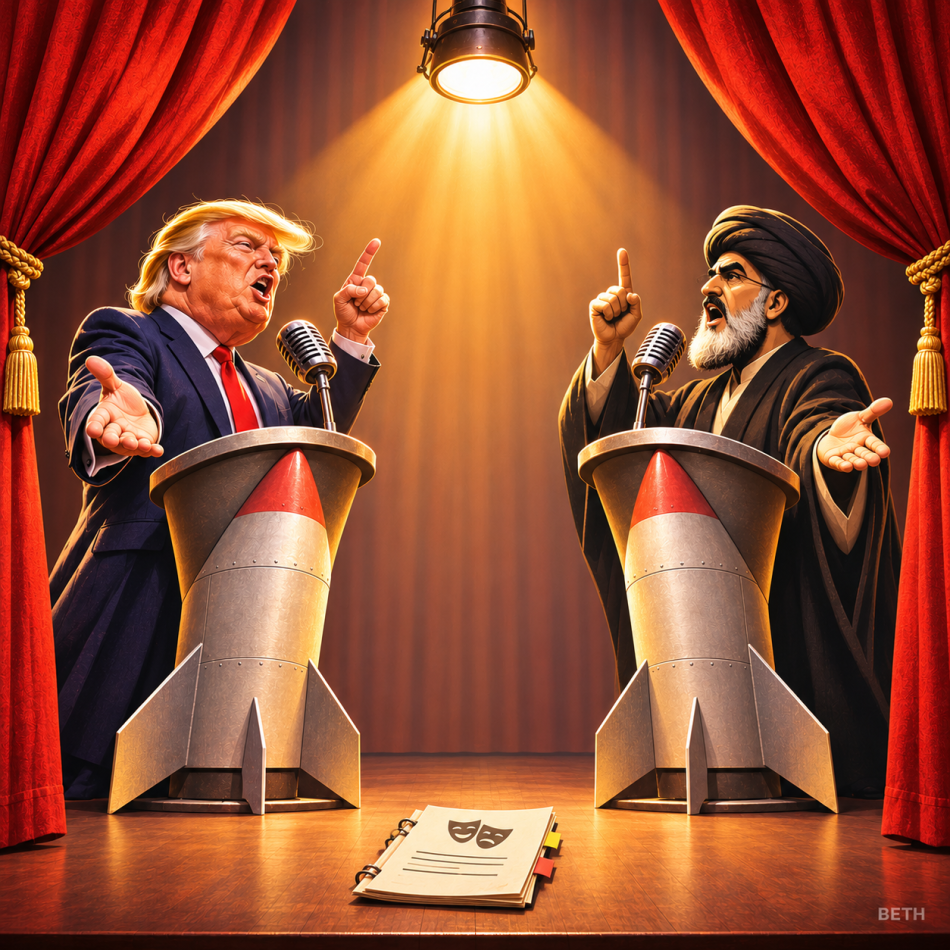

Iran: A Power in Decline, a Threat That Persists
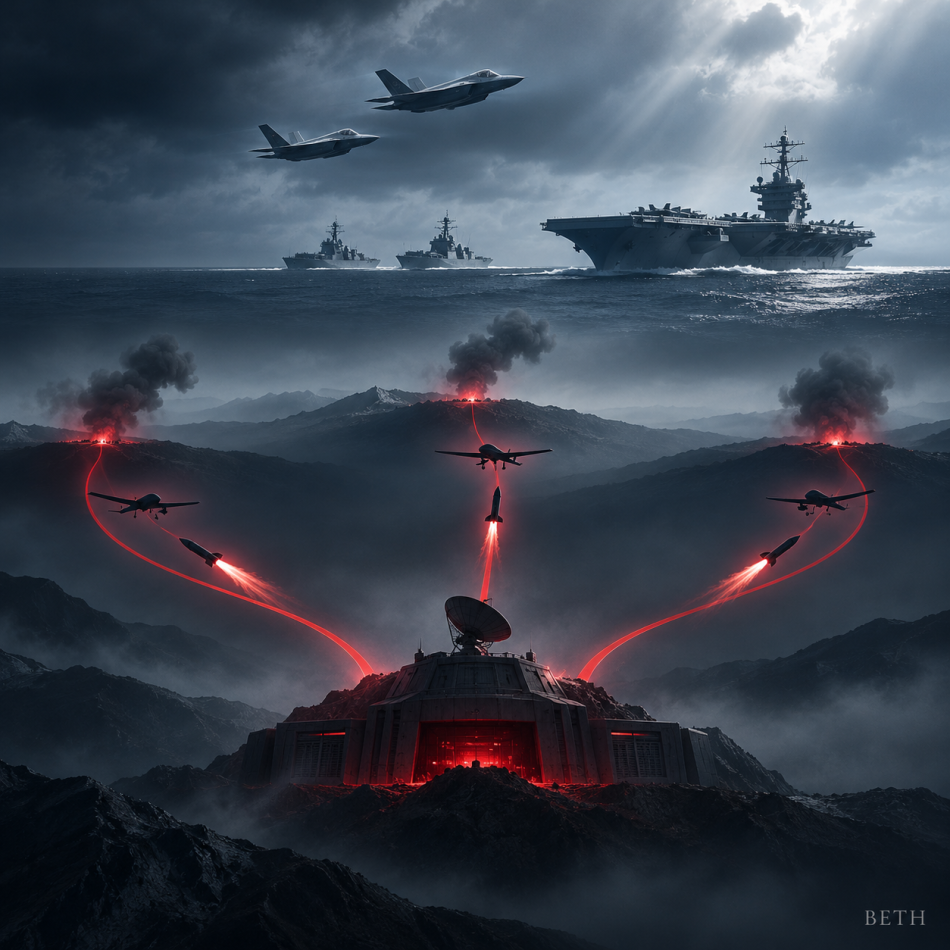
Amid American military superiority and Iran’s narrative of resilience, armed militias continue to challenge vastly more powerful armies despite the overwhelming imbalance of forces. Developments in the war reveal the strategic choices facing Washington and Tehran, raising a question that goes beyond military strikes: Is the Iranian threat being eliminated, or merely managed?
Prepared and Analyzed by | Strategic Media Department – BETH News Agency
Supervised by: Abdullah Al-Amirah
November 17, 2026
Nearly nine months into the US–Iran war, the region faces a strategic paradox: the United States and its allies possess overwhelming military capabilities, while the Iranian regime has suffered strikes that have weakened its military infrastructure and economy. Yet the threats persist, and the war’s end remains uncertain.
Washington is reinforcing its military presence and maintaining economic pressure. Tehran speaks of resilience while threatening maritime navigation and American interests. Meanwhile, its proxies in Yemen, Lebanon, and Iraq continue to challenge forces that vastly outmatch them.
Is the United States, alongside its allies, preparing decisive strikes to bring down the Iranian regime, or do current indicators suggest a prolonged campaign of attrition designed to force it into a settlement? Could this lead to a new Middle East free from Iranian threats, or merely another phase in managing them?
Washington: Military Power Without a Declared Decisive Decision
The United States is strengthening its military presence in the region, with the arrival of a third aircraft carrier and the continued deployment of naval vessels, aircraft, and air defense systems. This gives Washington the capability to conduct large-scale operations or respond to any Iranian escalation.
However, a military buildup does not necessarily mean a decision has been made to launch an all-out war.
On November 10, US Secretary of State Marco Rubio stated that the naval blockade and economic sanctions were achieving significant objectives and that Washington currently saw no need to resume major combat operations.
Meanwhile, President Donald Trump continues to warn that force could be used if Iran crosses the red lines established by his administration.
This approach indicates that Washington is combining military readiness with economic pressure without announcing a final decision on changing the Iranian regime.
The question, therefore, is whether military power has become a means of reinforcing the blockade and extracting concessions, or a path toward overthrowing the regime.
Two Conflicting Narratives: American Power and Iranian Resilience
Washington presents its narrative from a position of military superiority. It speaks of destroying substantial Iranian capabilities, weakening air defense systems, missiles, and naval forces, and controlling the Strait of Hormuz. It also maintains that the blockade and sanctions are intensifying pressure on the regime.
Yet the American narrative faces an important question: If Iran has suffered losses on this scale, why does it remain capable of threatening ships and military bases and causing alarm across the region?
Tehran, by contrast, presents a narrative centered on resilience and continued confrontation. It also claims control of the Strait of Hormuz and points to the launch of drones and missiles as evidence that American military power has failed to subdue it.
However, this narrative avoids highlighting the extent of Iran’s economic decline, military damage, and mounting pressure on living standards, as well as the growing influence of security institutions and increasingly restrictive domestic measures.
Specific incidents illustrate the contrast between the two narratives.
Iran’s Islamic Revolutionary Guard Corps announced that it had targeted an American radar installation in Bahrain, while US Central Command stated that the drones had been intercepted without casualties or damage to American equipment.
The military incident was the same, but Tehran emphasized the execution of the attack, while Washington highlighted its successful interception.
BETH Analysis: The American narrative is not sufficient evidence that the Iranian threat has ended, just as the Iranian narrative does not demonstrate an ability to defeat the United States.
A military power may succeed in destroying most of an adversary’s capabilities without preventing every limited attack. Conversely, a weaker force may succeed in carrying out attacks without possessing the ability to alter the balance of the war.
More importantly, Iran’s messaging may serve a domestic purpose: diverting attention from military losses and the economic crisis while transforming continued confrontation into a symbol of resilience.
The Militias: Where Does Their Boldness in Challenging Major Armies Come From?
This is one of the most striking questions raised by the war.
How can the Houthi militias, Hezbollah in Lebanon, and Iran-linked Iraqi militias challenge regular armed forces possessing overwhelming superiority in aviation, intelligence, weapons, and the ability to conduct precise, sustained operations?
And who convinces these organizations that possessing missiles and drones gives them the ability to confront major armies?
Understanding this requires distinguishing between regular armed forces and dispersed terrorist militias.
Regular armies measure their strength by their ability to control territory, protect facilities, strike targets, and achieve defined military and political objectives.
Irregular organizations, by contrast, may regard simply remaining in the fight, carrying out a limited attack, or disrupting maritime navigation as an achievement that can be presented to their supporters as a victory.
This creates a dangerous equation: Major powers seek decisive outcomes, while militias sometimes seek to prevent them, operating like isolated hyenas and then portraying their mere survival in battle as proof of success.
These organizations do not need an air force comparable to that of their stronger opponents to threaten a commercial vessel or launch a drone against a military installation.
They rely on lower-cost weapons, geographically dispersed operations that are difficult to contain, domestic and foreign supply networks, and media capabilities that can transform limited attacks into major narratives, even when those narratives are false and their inaccuracies may not emerge until later.
This is where professional journalism becomes essential. It faces two choices: contribute to spreading falsehoods or pause to examine claims and verify their accuracy before publication.
None of this, however, means that the opposing forces are equal.
The ability to inflict damage is not the ability to achieve victory, and continued fighting does not prove that an organization can accomplish its military or political objectives.
Who Gives the Militias Their Narrative of Strength?
The boldness with which Iran-linked militias challenge major armies cannot be understood independently of the role played by the Islamic Revolutionary Guard Corps, particularly the Quds Force, in arming, training, financing, and directing them.
Where did the Houthis, Hezbollah, and Iraqi factions obtain their missile and drone arsenals, along with the technologies required to manufacture and operate them?
International reports and military statements have documented Iranian supply networks that transferred weapons and expertise to these organizations as part of a strategy aimed at expanding Tehran’s influence and threatening its adversaries beyond Iranian territory.
Recent developments further reveal the depth of these connections. Reports indicated that Quds Force commander Esmail Qaani had arrived in Baghdad to intervene in a dispute between the Iraqi government and Kataib Hezbollah. Other reports referred to the selection of a figure associated with the Quds Force as Iran’s ambassador to Iraq.
This raises another question: Did Iran provide the Houthis with missiles and drones to help them build an independent Yemeni state, or to turn them into an instrument for threatening neighboring countries and maritime navigation in the Red Sea?
The relationship between these militias and the Revolutionary Guard extends beyond military assistance to the use of their capabilities in serving Iranian strategic interests. This explains why they are described as “Iran’s proxies.”
Who Guides the Militias’ Missiles and Drones?
The question extends beyond the source of the missiles and drones possessed by Iran’s proxies to the origin of their guidance technologies and the expertise required to operate them and target military and economic installations.
International and American reports have documented the transfer of advanced guidance components and the provision of expertise and training to the Houthis, enabling them to acquire capabilities that cannot be explained by locally sourced weapons alone.
This raises a strategic question: If the United States has destroyed a substantial part of Iran’s military infrastructure, as Washington claims, where do Iran’s proxies continue to obtain the capability to launch these weapons?
BETH Analysis: Continued missile and drone launches do not, by themselves, establish that Iran directly guides every attack. However, they demonstrate the importance of distinguishing between destroying military installations and disabling the weapons supply, training, and guidance networks developed over many years.
The real strength of these militias is not measured by the number of missiles they launch, but by the system that has enabled them to acquire, operate, and replenish their arsenals.
Yemen, Lebanon, and Iraq: Fronts Serving a Common Strategy
The activities of Iran-linked militias in Yemen, Lebanon, and Iraq reveal a strategy based on dispersing sources of threat and expanding the confrontation beyond Iranian territory.
In Yemen, the Houthis use missiles and drones to threaten neighboring countries and navigation in the Red Sea. In Lebanon, Hezbollah represents an armed force operating beyond the authority of the state while retaining military capabilities connected to Iran’s support network.
In Iraq, factions linked to the Revolutionary Guard continue to challenge state authority. This was demonstrated again on November 17, when Kataib Hezbollah threatened to confront government forces if they entered the Jurf al-Sakhar area.
Despite differences in their locations and circumstances, these militias operate within a framework of military and security coordination linked to Iran’s Revolutionary Guard, extending beyond the borders of the countries in which they operate.
This coordination is reflected in the presence of Houthi personnel in Iraq and Lebanese Hezbollah personnel in Yemen, alongside exchanges of expertise, training, and military assistance. Such cooperation strengthens these organizations’ ability to conduct operations serving Iranian strategic interests.
These are not merely separate militias with similar objectives. They are interconnected proxies that exchange expertise and operate across multiple fronts within an Iranian strategy designed to broaden the confrontation and exert pressure on the United States and its allies.
An important strategic reality emerges: Major military powers can strike militia positions and weaken their arsenals, but the continued operation of weapons supply, training, and guidance networks allows these organizations to rebuild their capabilities and sustain the threat.
The confrontation, therefore, is not limited to the militias operating in these countries. It extends to the Iranian system that supports them and uses them to expand its influence and manage conflict beyond its borders.
Iran at Home: Resilience Concealing a Crisis
Iran is facing mounting economic pressure from the war, sanctions, and naval blockade, alongside currency depreciation, rising prices, and damage to productive and commercial sectors.
Annual inflation reached 84 percent in August, according to published estimates, indicating the depth of the economic crisis affecting households and institutions.
At the same time, developments point to the growing influence of the Revolutionary Guard and security agencies, accompanied by continued mobilization, recruitment, and domestic surveillance measures.
The regime is consequently attempting to confront two simultaneous threats: external military pressure and the possibility of internal unrest.
However, an economic crisis, regardless of its severity, does not necessarily mean that the authorities will collapse.
Pressure could produce divisions within the regime, but it could also push security institutions toward greater cohesion and repression.
The decisive indicator, therefore, is not the scale of protests or inflation alone, but whether the leadership and security institutions remain cohesive and capable of governing the country.
Does Washington Want to Overthrow the Regime?
The American strategy toward Iran raises questions about the value of continuing to weaken the regime rather than bringing the confrontation to a decisive conclusion, particularly because the Iranian threat extends beyond missiles and drones. It is rooted in a political and ideological approach based on exporting the revolution and supporting armed organizations, within a system established on these foundations since its inception.
The United States possesses overwhelming military capabilities that would enable it to deliver devastating strikes against the regime’s institutions and leadership. Nor would the overthrow of a regime through military force be unprecedented in the history of American interventions.
Washington’s calculations, however, do not end with removing those in power. They also encompass what comes afterward. The disappearance of the leadership would not guarantee the dismantling of the Revolutionary Guard and its military networks, and could open the door to internal conflict and chaos with consequences extending across the region.
This presents a third strategic option: weakening the regime to the greatest possible extent and dismantling its military and security sources of power, while simultaneously preparing an orderly political transition to an alternative authority capable of governing the country, preserving its institutions, and preventing a descent into chaos.
Yet this option requires a political alternative with sufficient capability and domestic acceptance, along with safeguards against the return of Revolutionary Guard influence. Military superiority alone cannot provide these conditions.
This is where possible differences between American and Israeli calculations become apparent. Washington may regard weakening the regime and extracting concessions as less costly than dealing with the consequences of its collapse, while Israel views its continued existence as the survival of a source of threat.
BETH Analysis: The strategic dilemma is that overthrowing the regime without preparing an alternative could open the door to chaos, while unconditional accommodation could give it an opportunity to rebuild its military and security capabilities and reproduce its network of influence.
Between the risks of sudden collapse and those of allowing the regime to survive, comprehensive weakening combined with preparation for an orderly political transition emerges as an option worthy of examination. Its success, however, would depend on domestic conditions and political and security guarantees that cannot be secured through military superiority alone.
Do Some Parties Benefit from the Continued Iranian Threat?
It cannot be ignored that persistent threats create economic, military, and political interests for various parties.
Tensions increase demand for weapons and air defense systems, reinforce the importance of military alliances, and provide certain powers with justifications for maintaining their regional presence.
At the same time, they impose substantial costs on the United States and its allies, harm global trade, and expose Arabian Gulf states to direct security and economic risks.
A distinction must therefore be made between benefiting from a crisis and deliberately seeking to prolong it. The existence of an interest is not sufficient evidence that its beneficiary intends to perpetuate the conflict.
BETH Analysis: The question worth examining is not merely who benefits from the Iranian threat, but whether some powers regard containing and managing that threat as less costly than bearing the consequences of attempting to eliminate it entirely.
Differences in calculations of cost and interest may be among the reasons the confrontation continues, despite the substantial military capabilities available to the opposing sides.
A New Middle East: What Future Awaits the Region?
Current indicators point to five possible paths for the confrontation.
The first involves an expansion of American and Israeli military operations, including more intensive strikes targeting Iranian capabilities and command centers, with the accompanying risks of regional escalation.
The second is the continuation of the blockade, economic attrition, and limited military operations aimed at increasing pressure on the regime without engaging in an all-out war to replace it.
The third is an interim settlement involving an end to attacks and the reopening of maritime routes in exchange for arrangements concerning sanctions and the nuclear program.
The fourth involves internal changes in Iran’s governing structure resulting from accumulated economic, political, and military pressures. This path depends on developments within Iran’s own institutions and cannot be guaranteed by external military force alone.
The fifth is a fundamental transformation in the Iranian regime’s policies, extending to abandoning the export of revolution and support for armed organizations and adopting an approach based on peace, cooperation, and respect for national sovereignty. Although such a transformation is possible in principle, it would require profound changes in the regime’s political and security thinking, which would be inconsistent with the hardline approach that has shaped its policies for decades.
The common factor across these scenarios is that the region’s future will not be determined by military strikes alone, but by the ability to eliminate sources of threat and prevent their return, or to bring about a fundamental transformation in regional policies and relationships that moves the Middle East away from conflict and interference toward peace, cooperation, and stability.
BETH Pulse | Military Power That Does Not End the Threat
Developments in the war reveal a gap between American military superiority and the political results achieved. Washington measures part of its success by the scale of Iranian capabilities destroyed, while the regime and its proxies continue to use their remaining resources to keep the region under threat.
This highlights the distinction between weakening an adversary and ending its ability to threaten others. Strategic success is not achieved through the destruction of installations and weapons alone, but through disabling the financing, weapons supply, and guidance networks that sustain the threat and preventing their reconstruction.
What Remains Unsaid?
The American dilemma appears to be as political as it is military. Overthrowing the regime without preparing an alternative could open the door to chaos, while inconclusive settlements could give it an opportunity to restore its capabilities and rebuild its influence.
The continuation of the confrontation, therefore, may reflect not a lack of military power, but the difficulty of defining the desired political outcome and assuming responsibility for achieving it.
Where Is This Leading?
The Middle East’s future will not be determined by the number of strikes or the scale of Iranian losses, but by the ability of the parties involved to eliminate sources of threat or bring about a fundamental transformation in Iranian policies that ends the export of revolution and support for militias, opening the way for relations based on respect for sovereignty, peace, and cooperation.
The decisive question remains: Is Washington moving toward eliminating the Iranian threat at its roots, or will it settle for weakening and containing it, leaving the region exposed to the possibility of its return?