



Day 223: Negotiating Not to Negotiate
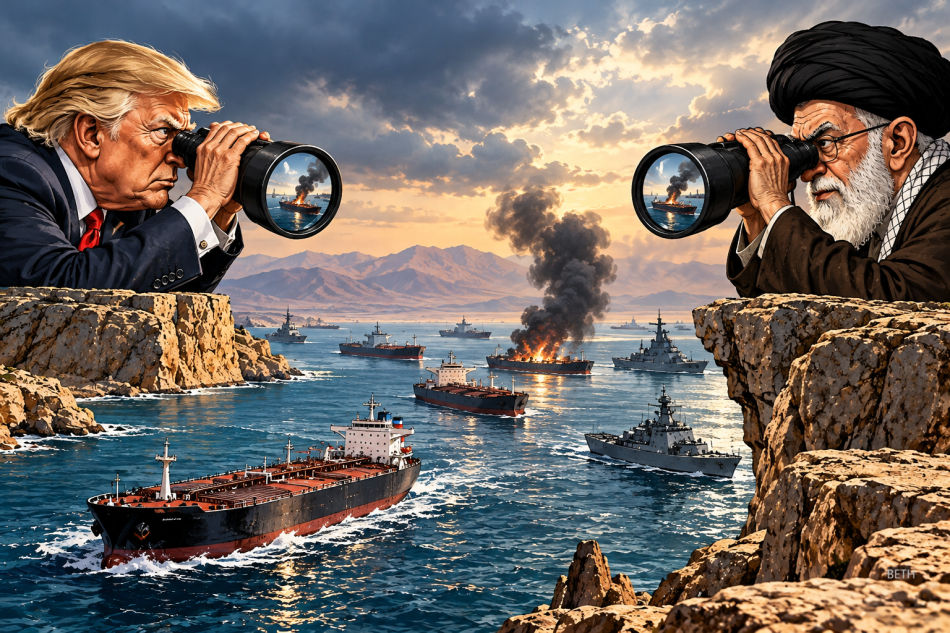
Two new attacks on vessels in the Strait of Hormuz amid escalating assaults on maritime navigation; oil exceeds $106, while U.S.–Iranian negotiations remain dependent on the conditions for reopening the strait and the nuclear issue
October 14, 2026
Prepared and Analyzed by | Strategic Media Department – BETH News Agency
The U.S.–Iran war entered its 223rd day amid escalating attacks on commercial vessels in the Strait of Hormuz, while disagreements between Washington and Tehran continue over the conditions for reopening the waterway and reaching a political settlement.
Commercial shipping has become one of the main arenas of confrontation, with growing risks to oil tankers and other vessels, rising transportation and insurance costs, and repercussions for global energy markets.
Hormuz: New Attacks
The United Kingdom Maritime Trade Operations (UKMTO) reported receiving two notifications that a tanker and a container ship had been struck by unidentified projectiles in the Strait of Hormuz, as part of a series of attacks in the area in recent days.
Published estimates indicated a significant increase in maritime incidents, with 24 vessels attacked over the two weeks ending October 11, the highest level since the early stages of the war.
These developments point to the widening impact of the maritime confrontation, as shipping companies have begun reassessing their voyages and routes because of increasing risks.
Tehran: Tightening Maritime Restrictions
Reports indicated that Iran had changed its methods of intercepting vessels in Hormuz, increasing surveillance and targeting operations.
This development reflects the continued use of the strait as an influential bargaining tool in the confrontation, alongside U.S. military and economic pressure on Iran.
Negotiations: Conditions Obstruct Progress
The political process remains stalled despite continuing indirect contacts.
No new agreement ending the dispute had been announced as of this morning.
Oil: Risks Drive Prices Higher
Brent crude exceeded $106 per barrel in Wednesday's trading, driven by concerns over supply disruptions and continuing maritime attacks.
The crisis now affects more than oil prices, extending to insurance and shipping costs and delivery times, as export traffic through Hormuz has declined compared with September levels.
Producing countries continue to use alternative routes and the flexibility of their transportation systems to mitigate the impact of disruptions on markets.
Yemen: A Parallel Front
The maritime escalation coincided with the continuing confrontation against the Houthis in Yemen and operations conducted by the Coalition to Support Legitimacy to target the group's supply sources and military capabilities.
Houthi attacks on Saudi Arabia, together with threats to navigation in the Red Sea and Bab Al-Mandab Strait, add a regional dimension to the energy crisis. BETH News Agency covers developments on this front in detail in its “Dawn of Yemen” report.
BETH Analysis
Today's developments reveal that the Strait of Hormuz has become a central instrument in managing the U.S.–Iranian confrontation, rather than merely one of its military arenas.
Continuing attacks increase the economic cost of the war and affect trade flows, while tighter maritime restrictions make the prospects for an agreement increasingly dependent on mutual concessions.
Washington faces the challenge of protecting international trade while maintaining pressure on Iran, while Tehran seeks to retain Hormuz as a bargaining tool in any forthcoming negotiations.
The most significant implication is that both sides continue to negotiate amid escalation, while global markets bear the cost of a prolonged war without a settlement.
BETH Analysis | Who Is Negotiating with Whom?
After 223 days of war, a more pressing question emerges: Who is negotiating with whom, and who holds the authority to end the confrontation?
Trump speaks of uncertainty surrounding Iran's leadership, even saying that no one wants to take over the leadership of Iran. Yet the continued exchange of proposals through intermediaries confirms the existence of communication channels, although the ability of the negotiating parties to conclude an agreement remains unclear.
Trump's statements can be interpreted as part of the political pressure on Tehran, rather than a complete description of the absence of a negotiating counterpart.
The real impasse, therefore, is not the absence of negotiators, but the continuation of negotiations without a clear willingness to settle the conditions for ending the war.
After 223 days, the war's paradox is becoming apparent: Washington is betting on exhausting Iran, while Tehran is betting on the cost of prolonging the confrontation. Meanwhile, the Strait of Hormuz has become a bargaining tool for which the global economy is paying the price.
The result is that neither side lacks channels for negotiation. What they lack is an agreement that offers each a way out without appearing to retreat, despite the imbalance in military, political, and economic power.
However, the impasse extends beyond Washington and Tehran. The interests of regional countries and their visions for their own security do not necessarily align with American and Israeli calculations. While Washington seeks to reshape regional balances of power and Israel approaches security from a position of military superiority, the question of the Iranian regime's future, the role of the Islamic Revolutionary Guard Corps, and their ability to threaten neighboring countries remains central to any settlement.
After 223 days, the available instruments of pressure have become clearer, yet the conditions for ending the war remain far apart. Lasting stability will not be determined merely by ending the war or rearranging the balance of power, but by the ability of any settlement to address the sources of threats and guarantee the security of regional countries in accordance with their interests and sovereignty, rather than solely according to the visions of external powers.