


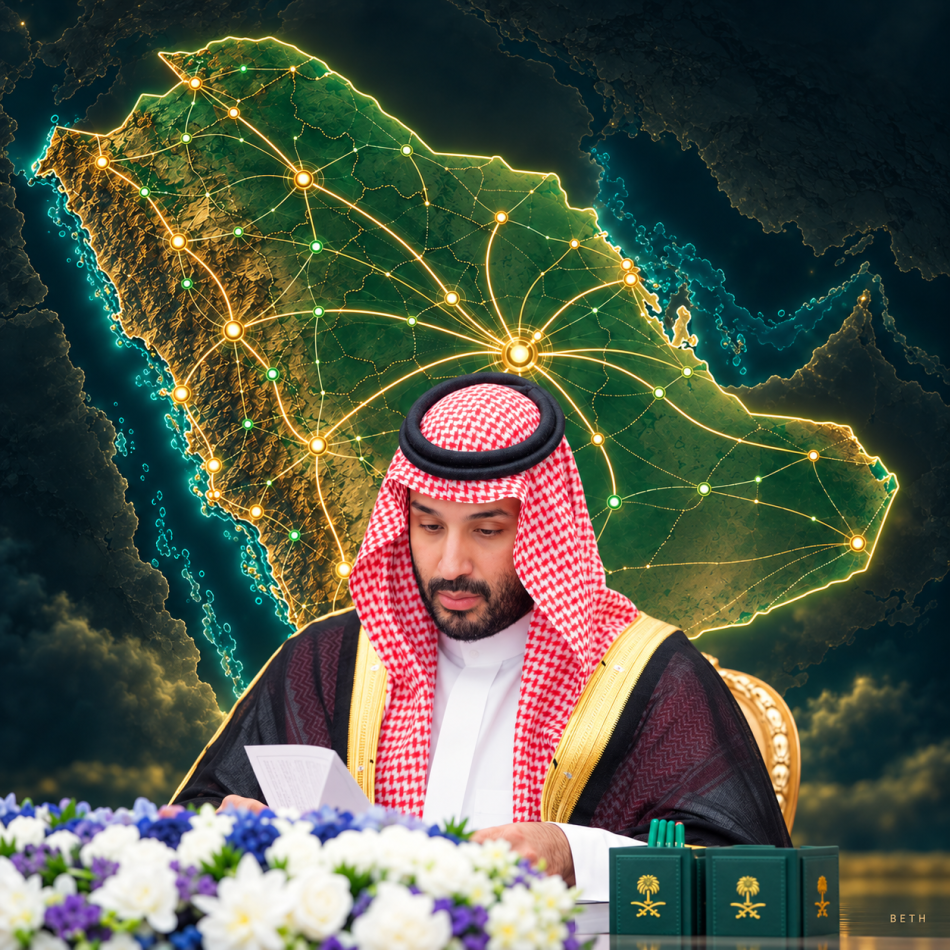
Mohammed bin Salman: Beyond Borders
From Vision 2030 to Palestine Diplomacy and Investments in Syria: How Is Mohammed bin Salman Leveraging Domestic Transformation to Expand Saudi Influence Beyond Its Borders?
October 12, 2026
Prepared and Analyzed by | Strategic Media Department – BETH News Agency
Supervised by: Abdullah Al-Omairah
It is not the distance between Riyadh and Damascus, Beirut, or Islamabad that explains the expanding Saudi role, but rather the nature of the decisions made in Riyadh and the instruments through which their effects extend beyond the Kingdom.
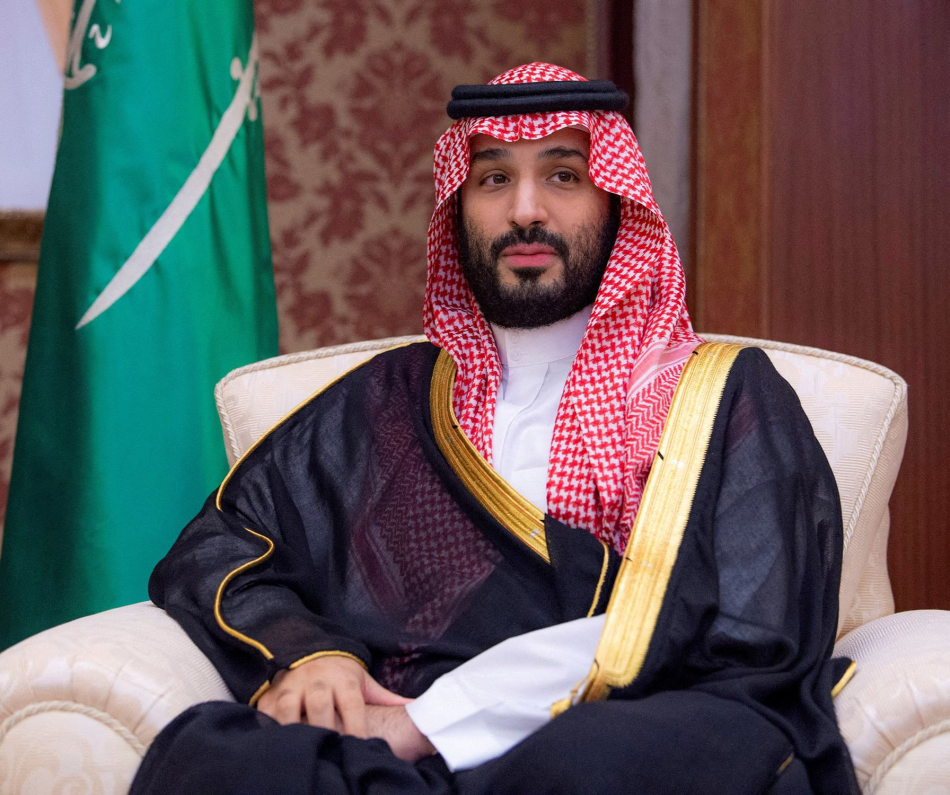
As Prince Mohammed bin Salman, Saudi Crown Prince and Prime Minister, combines leadership of a far-reaching economic transformation at home with the management of political, investment, and security relations beyond the country's borders, the question becomes broader than the scale of Saudi influence or the number of countries it reaches.
How does economic strength translate into political influence? How does diplomacy pave the way for investment? And how does the stability of other countries become part of Saudi Arabia's strategic interests?
An examination of the Crown Prince's decisions and the Kingdom's actions across several issues reveals an approach in which the instruments employed vary according to the nature of each challenge. Diplomacy takes precedence in one case, investment in another, and financial support or security cooperation in others.
More importantly, these instruments do not operate in isolation. They complement one another, expanding the options available to Saudi Arabia and its partners.
Strength Begins at Home
Since the launch of Saudi Vision 2030, Prince Mohammed bin Salman has led an economic transformation aimed at diversifying sources of income, developing new sectors, and expanding the role of investment.
Some of the results of this transformation are evident in the Public Investment Fund (PIF), whose assets under management rose from approximately $150 billion in 2015 to more than $900 billion by the end of 2025.
These figures reflect Saudi Arabia's expanding investment capacity, alongside the development of the economic and institutional foundations underpinning the Kingdom's international partnerships. However, not all assets under management represent resources available for overseas spending.
A strong economy does more than increase a country's wealth; it also gives its foreign policy additional options.
This is where the relationship between Vision 2030 and Saudi Arabia's international engagement becomes clear. A Kingdom seeking to diversify its economy needs stable markets, partnerships, and trade routes, while its growing capabilities provide it with a wider range of instruments to advance these interests.
Syria: When Diplomacy Opens the Way for Economic Cooperation
Syria offers one of the clearest examples of the relationship between political decisions and economic opportunities in the Crown Prince's approach.
On May 14, 2025, Prince Mohammed bin Salman hosted a meeting in Riyadh between U.S. President Donald Trump and Syrian President Ahmed al-Sharaa, with Turkish President Recep Tayyip Erdoğan participating by telephone.
The meeting followed Trump's announcement that U.S. sanctions on Syria would be lifted. Al-Sharaa expressed appreciation for the efforts of the Saudi Crown Prince and the Turkish President in supporting his country and seeking the removal of sanctions.
Saudi engagement did not stop at the political level.
In July of the same year, a Saudi investment delegation traveled to Damascus at the Crown Prince's direction, bringing together government officials and private-sector representatives.
The visit saw the signing of 47 investment agreements worth approximately SAR 24 billion, covering infrastructure, energy, telecommunications, industry, and services.
In August, Riyadh received a Syrian economic delegation to continue developing avenues of cooperation.
A connected sequence emerges: a diplomatic initiative that supports the removal of a political and economic obstacle, followed by the opening of investment opportunities and then institutional follow-up to develop the partnership.
This does not mean that all the agreements have become implemented projects. Rather, the sequence illustrates how diplomacy and investment can complement one another in addressing regional crises.
Political decisions open the way, investment translates opportunities into projects, and security and institutional stability provide the conditions necessary for their success and sustainability.
Palestine: Turning a Position into an International Process
The model of influence is different in the Palestinian issue.
Saudi Arabia, in partnership with France, helped lead the international conference on implementing the two-state solution, which produced the New York Declaration. The declaration was subsequently endorsed by 142 countries at the United Nations General Assembly in September 2025.
The significance of this initiative lies in moving beyond statements of political positions toward building a collective diplomatic framework that strengthens international recognition of the State of Palestine and broadens support for the two-state solution.
Saudi efforts, in cooperation with France and other countries, helped advance this political process, representing an important step toward the establishment of an independent Palestinian state. Achieving that objective on the ground still requires sustained political and international efforts.
This process demonstrates another instrument of Saudi influence: building diplomatic partnerships and broadening international consensus on major issues.
Lebanon: From Decision to Direct Impact
Lebanon provides a more specific example of the relationship between a decision by the Crown Prince and a measurable economic outcome.
In June 2026, Prince Mohammed bin Salman directed the resumption of Lebanese exports to the Kingdom, in response to a request from President Joseph Aoun and Prime Minister Nawaf Salam, and following steps taken by the Lebanese government to strengthen state institutions and cooperation with Saudi Arabia.
Ten days later, the first shipment departed from the Port of Beirut as part of the resumption of exports to Saudi markets.
The decision thus moved from the political level to a concrete commercial measure linked to institutional progress and cooperation between the two countries.
This example illustrates how economic relations can extend beyond trade to strengthen trust and political and institutional cooperation.
The broader impact, however, remains dependent on sustained trade and continued compliance with the measures that made its resumption possible.
Pakistan: Financial Support as an Instrument of Stability
Pakistan offers another model, centered on supporting financial stability.
In April 2026, Saudi Arabia announced, at the leadership's direction, the extension of an existing $5 billion deposit at the State Bank of Pakistan, alongside the announcement of an additional $3 billion deposit.
These arrangements help support foreign reserves and ease financial pressures within the broader strategic relationship between Riyadh and Islamabad.
While investment in Syria is directed toward productive and development opportunities, financial support for Pakistan serves a different purpose related to the requirements of economic stability.
The instrument here is financial, but its effects extend beyond foreign exchange reserves to strengthening the partner country's economic capacity.
Sudan, Yemen, and Somalia: Protecting the State
In Sudan, Yemen, and Somalia, other considerations take precedence: national unity, the ability of state institutions to function, and confronting security threats.
In Sudan, Saudi positions emphasize the country's unity, ending the war, and protecting civilians, while condemning attacks that threaten society and state institutions.
In Yemen, Saudi support for the internationally recognized government intersects with economic and security assistance amid Houthi threats to the Kingdom's security and maritime navigation.
In Somalia, Saudi Arabia affirms its support for the country's sovereignty and territorial integrity and rejects separatist moves that undermine its territorial unity.
The nature of these crises and the Saudi instruments employed in addressing them are not identical. They nevertheless converge on the importance of national institutions in confronting fragmentation and instability.
Protracted conflicts do not remain confined within the borders of the countries concerned. Their effects extend to neighboring countries' security, trade, investment, and maritime routes.
Power and Its Purposes
A comparison of these cases reveals the diversity of Saudi Arabia's instruments of power and the differing priorities governing their use according to the nature of each challenge.
In Syria, diplomacy and investment complement each other. In Palestine, multilateral diplomacy takes precedence. In Lebanon, trade openness is linked to institutional cooperation. Financial support serves as an instrument of stability in Pakistan, while sovereignty and security considerations take priority in Sudan, Yemen, and Somalia.
This diversity suggests an important strategic proposition: Saudi influence expands through the selection of different instruments suited to each situation, and through combining them when interests and objectives converge.
Providing financial assistance and opening markets to another country's economy represent two distinct instruments of influence. Both can complement diplomatic engagement to broaden opportunities for stability and political settlements.
There is also a difference between helping a country overcome a temporary crisis and contributing to the development of capacities that leave it better prepared to manage future challenges.
Influence that changes a decision may be temporary, but influence that broadens countries' options can have effects lasting for years.
The Interests Beyond the Headlines
Behind political meetings, investments, and diplomatic initiatives lies a broader strategic relationship between Saudi Arabia's domestic transformation and its regional environment.
Economic diversification requires stable trade flows. Infrastructure projects benefit from markets capable of growth, while security in the Red Sea and other maritime routes directly affects trade and supply chains.
From this perspective, part of the foreign policy led by the Crown Prince can be understood as an effort to protect Saudi interests by helping address sources of regional instability.
These interests are not limited to economics. Security, political, and humanitarian dimensions overlap, with their relative priorities varying from one crisis to another.
Yet the underlying relationship is clear:
The more capable the region becomes of achieving stability and growth, the greater the opportunities for Saudi Arabia and its partners alike.
Influence here extends beyond political presence to helping create more favorable conditions for economic and diplomatic cooperation, linking the success of domestic transformation with opportunities for regional stability.
An Image That Extends Beyond Saudi Arabia
The impact of the transformations led by Prince Mohammed bin Salman does not end with their political and economic results. It also extends to perceptions of his role outside Saudi Arabia.
Saudi initiatives are often discussed separately: investment in Syria, diplomacy concerning Palestine, support for stability in Yemen and Sudan, and economic assistance to Lebanon and Pakistan.
Viewed together, however, they offer a broader understanding of the range of instruments employed by the Crown Prince and the relationship between Saudi interests and the region's future.
A comprehensive assessment of Saudi Arabia's role requires examining decisions, the connections between the instruments employed, and the results they achieve, rather than relying solely on praise or criticism.
The full picture of an international role is shaped not merely by what is said about its leader, but by what his policies reveal and what is achieved on the ground.
Beyond Borders
Saudi Arabia's engagement in its regional environment did not begin with Vision 2030. The Kingdom has a long history of diplomacy, assistance, and economic and security partnerships.
However, the period under Prince Mohammed bin Salman's leadership merits a distinct assessment, given the expansion of economic capabilities, the diversification of their uses, and their connection to a far-reaching domestic transformation.
In some cases, his role is evident through direct initiatives and decisions, as seen in the diplomatic engagement concerning Syria and the resumption of Lebanese exports.
In others, it is reflected in his leadership of broader policy directions implemented by state institutions in cooperation with regional and international partners.
Tangible results remain the benchmark for assessing impact: projects implemented, institutional capacities strengthened, initiatives that generate sustainable opportunities, and challenges that still require further efforts.
What distinguishes power is not merely the extent of its presence in other countries' crises, but the kinds of options it opens and the outcomes it helps achieve.
This perspective helps explain one of the most important dimensions of the role led by Prince Mohammed bin Salman beyond the Kingdom: leveraging capabilities developed within Saudi Arabia to build broader partnerships, protect Saudi interests, and help create opportunities for stability and development.