



Saudi Arabia: Managing the State — and Managing a State
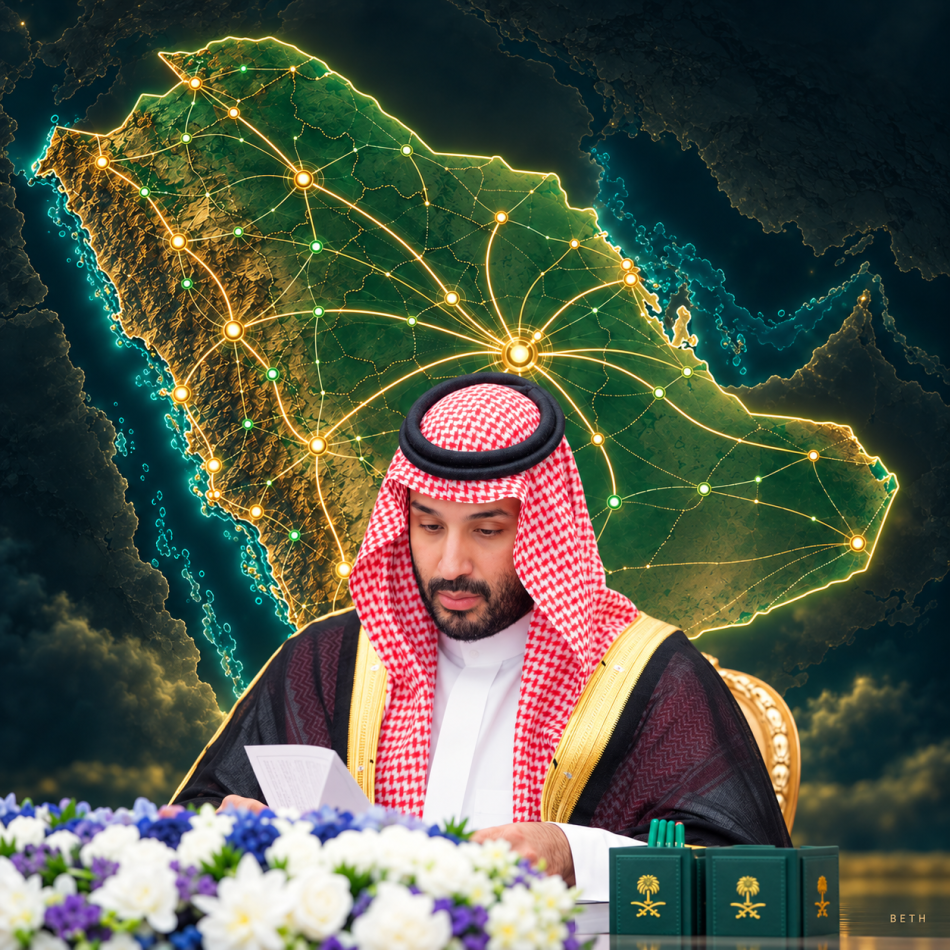
This week’s Council of Ministers session reveals a deeper dimension of the Saudi experience: managing sovereign decision-making abroad while managing the machinery of the state at home — from security and diplomacy to governance, services, and execution
By Abdullah Al-Omairah
A state’s strength is not measured only by the scale of what it possesses.
Money matters. The economy matters. International relations matter. Military power matters.
But there is a deeper question:
How is a state managed?
This is precisely where the differences between states begin to emerge.
One state possesses resources, but merely consumes them.
Another has institutions, but cannot make them work together.
A third makes decisions, but execution lags behind.
And another does not stop at knowing where it wants to go; it builds the machinery capable of getting there.
This is the dimension worth examining in Saudi Arabia today.
Managing the State
The first level is managing the state as a sovereign entity.
Political decisions.
National security.
International relations.
Regional crises.
Alliances.
Energy.
Maritime corridors.
Interests that sometimes converge and sometimes collide.
This level requires a clear vision, accurate information, the ability to set priorities, and the right timing for decisions.
And Managing a State
But there is another level, less visible and perhaps more difficult:
Making the state itself work.
Ensuring that ministries, institutions, and authorities move in coordinated directions.
Turning a decision into a system.
A system into a procedure.
A procedure into a service.
And a service into a measurable result.
Here, governance, data, capabilities, regulations, digitalization, follow-up, and performance measurement become elements of national strength, not merely administrative details.
Saudi Vision 2030 placed enhancing government effectiveness and improving the performance of the public sector among its core objectives, including building a more efficient and effective government and improving the performance of public entities and services.
The Ability to Work on Multiple Fronts
A large state does not deal with one issue at a time.
This week’s Council of Ministers session offers a clear example.
On the same table: the security of Hormuz and Bab al-Mandab, a joint defense agreement, Yemen, Palestine, multilateral action, counterterrorism, governance, privatization, the judiciary, customs, universities, and the protection of public facilities.
What matters here is not the number of files.
What matters is the ability to keep all of them under management at the same time.
Success in an external file does not compensate for an internal failure.
Economic success does not compensate for weak services.
And a strong political decision loses part of its value if it is not backed by institutions capable of turning it into action.
Leadership — or the decision-maker — is measured not only by the quality of the decision, but also by the ability to build the apparatus that implements it, follows it through, corrects its course, and connects its results to the objective for which the decision was made.
A state is not managed through one decision, however important it may be, but through a continuous chain of decision, execution, follow-up, and accountability.
Information Has Become a Capability
The modern state is not managed by experience and historical accumulation alone.
It is also managed through data.
Those who know what is happening, where it is happening, and when it is changing have a greater capacity to make decisions.
This is why Saudi digitalization should not be viewed merely as moving services from paper to screens.
The Government Digital Experience Maturity Index reached 87.06% in 2026 after evaluating 59 platforms, while Saudi Arabia ranked second globally in the World Bank’s 2025 GovTech Maturity Index, according to the Digital Government Authority.
The value is not in the ranking alone.
The real value lies in placing the citizen, the employee, and the decision-maker within a system that is faster at gathering information, delivering services, and measuring outcomes.
The State That Learns
One of the most important capabilities of modern administration is refusing to regard institutions as finished products.
A strong state is not one that claims its apparatus is perfect.
It is one that can reorganize it when needs change.
Merge.
Create.
Abolish.
Redistribute responsibilities.
Amend regulations.
Correct course.
This ability to reshape the state from within may be one of the least visible elements of national strength, yet it is among the most consequential over the long term.
People at the Core of Administration
In the end, institutions do not operate on their own.
There is an employee.
A manager.
A leader.
An engineer.
A teacher.
A doctor.
A soldier.
And someone making a small decision every day inside a vast system.
That is why building capability is no less important than building the project itself.
A state that builds the structure but does not build the people capable of running it merely postpones the problem.
The Difference
Managing the state means knowing where you want to go.
Managing a state means possessing the institutions, people, and systems capable of getting you there.
The difference between states does not appear only in times of prosperity.
It appears in times of crisis.
When fronts multiply.
When decisions crowd together.
And when the space between right and wrong becomes narrower.
That is when we discover that a state’s strength is not measured only by what it has.
But by its ability to make everything it has work together.
And this is one of the most important stories of Saudi Arabia that deserves to be told.