



Superstition and Politics
By Abdullah Al-Amirah
Superstition is not when a person believes there is a ghost behind the door.
That is a simple case; he can open the door, and the matter ends there.
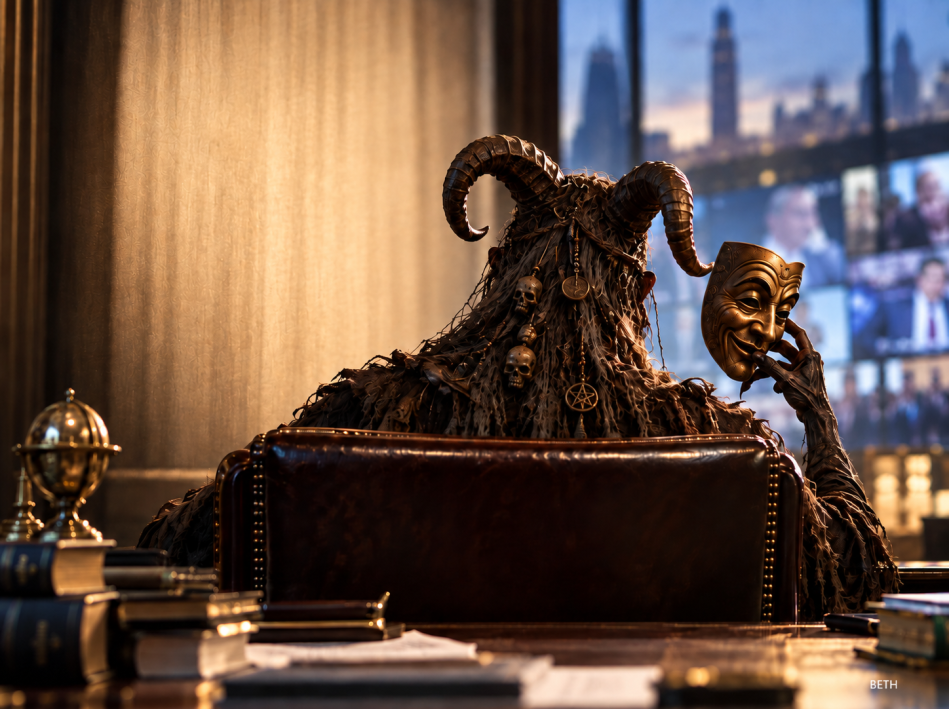
The more dangerous form of superstition is when people are told that behind the door there is a grand office, where a demonic, mythical leader sits, possessing enough power to shake the world.
Then the door is opened, and people find nothing.
No office.
No leader.
None of that alleged power.
All that remains is a voice offering an explanation:
He escaped.
This is where the problem begins.
Because we are no longer dealing with false information circulated by the media, but with an entire system that manufactures illusion, then protects it from the truth whenever it is exposed.
Politics, in its simplest definition, is the management of power, interests, and public decision-making.
Superstition, by contrast, is an explanation of the world that does not need evidence in order to survive; it only needs a mind willing to protect it.
And from here, the question arises:
What happens when politics is run by a mind that believes in superstition?
Science begins with doubt.
Superstition begins with certainty.
Science says: Show me the evidence.
Superstition says: The absence of evidence is part of the conspiracy.
Science changes its view when the facts change.
Superstition changes the facts so that it does not have to change its view.
This is why the relationship between science and politics is not easy, but it is necessary.
Science does not govern the state, nor does it decide on its own what is morally or politically right. But it gives decision-making something that superstition cannot provide:
A reality that can be tested.
When politics dispenses with that, it may still be able to make decisions, but it no longer knows what ground it is standing on.
Then we reach the harder question:
Can a politician who believes in superstition be trusted?
The problem is not that a politician may hold an unusual personal belief; all human beings carry their contradictions.
The problem begins when superstition moves from a personal matter to a tool for making public decisions.
But the more serious dilemma faces whoever employs people steeped in superstition to achieve his objectives; he may believe that he is securing short-term gains through them, without realizing that the very same instrument may eventually turn against him at a moment when containing the consequences becomes extremely difficult.
This is where strategic planning reveals its failure: when the tactic succeeds temporarily, only for the final outcome to run contrary to the objective for which it was originally adopted.
When the sign becomes more important than the information, suggestion more important than the report, intuition stronger than the numbers, and the comforting narrative stronger than the disturbing truth.
And the comforting narrative stronger than the disturbing truth.
Then the question is no longer:
What does this politician believe?
Rather:
On what basis does he make his decisions?
And then comes another question:
Can we believe a mind dominated by superstition?
Not because such a mind has completely lost its ability to think, but because it has developed a more serious problem:
It has created for itself a way of thinking that always wins.
If the prophecy comes true, it says: Didn’t I tell you?
If it does not, it says: Something happened that prevented it.
And if a fact emerges that contradicts it, it says: This fact was fabricated.
In this way, superstition becomes a closed system that facts cannot defeat, because it has already redefined the facts themselves.
That is what makes dealing with it so difficult.
Mockery alone is not enough.
Nor does overwhelming it with evidence always work; correcting misinformation can improve accuracy, but it becomes more difficult when beliefs are tied to political identity or to highly polarized issues.
Therefore, dismantling superstition does not begin by asking its believer:
How did you come to believe this?
It begins with a more unsettling question:
What would have to happen for you to say that your belief was wrong?
If the answer is: Nothing.
Then you are no longer debating an idea.
You are standing before a fortress.
And here, perhaps, lies the real difference between ignorance and willful ignorance.
The ignorant person does not know.
And can learn.
But someone who has locked the door around his belief, then swallowed the key, no longer suffers from a lack of information.
His problem is the refusal to accept the possibility that he may be wrong.
The most dangerous superstitions are not the ones people laugh at.
The most dangerous are those that wear a formal suit, sit behind a large desk, and ask the world to treat them as:
Politics.
“A mind saturated with superstition does not lack information as much as it lacks an opening through which contrary information can enter.”
But the danger does not stop at believing in superstition.
And there is a danger—perhaps greater than all that came before it—when superstition is exported through the media, and its power and influence are exaggerated, until it is transformed from an illusion inside one individual’s mind into an attempt to penetrate the minds of millions.
At that point, the matter is no longer merely misinformation.
It is an insult to the intelligence of public opinion.
But this attempt has another side that may turn against its author.
When the public senses that someone is treating it as easy to deceive, it may see the message itself as an insult to its intelligence. What the transmitter of superstition imagines to be a gain may then become a major loss of credibility, trust, and influence.
Spending money to manufacture an illusion does not make the illusion true.
Repeating it does not turn it into knowledge.
And amplifying it does not give it lasting power.
In the end, the outcome may come close to the profound Qur’anic meaning:
{Indeed, those who disbelieve spend their wealth to avert people from the way of Allah. So they will spend it; then it will become for them a source of regret; then they will be overcome. And those who disbelieve will be gathered into Hell.}
Superstition may possess money, platforms, and a loud voice.
But it will always face one problem it cannot buy:
The truth.
When Superstition Provokes the Sacred
Targeting Islamic religious symbols, foremost among them Makkah and Madinah, reveals how far superstition, when mixed with politics, can drive those who embrace it toward decisions that lose touch with any rational calculation of consequences.
Across different periods of history, and more clearly over recent decades, there have been attempts to use Islam and present it in a distorted form by mixing it with superstition and employing it in the service of political objectives that not only offend Islam, but also harm Muslims themselves and underestimate the intelligence of the world and its ability to distinguish between truth and distortion.
Targeting sacred places is not merely a hostile act.
It is a provocation of the peaceful giant.
It is in no rational actor’s interest to push the Kingdom into action in defense of its holy sites, or to stir Muslims around the world into mobilizing to defend Makkah and Madinah.
But when the mind becomes captive to the superstition of its age, it may lose the ability to comprehend the scale of the danger it is creating for itself.
And here the conclusion returns:
This is superstition when it is mixed with politics.