



Dawn of Yemen – Day 9: Advances in Marib
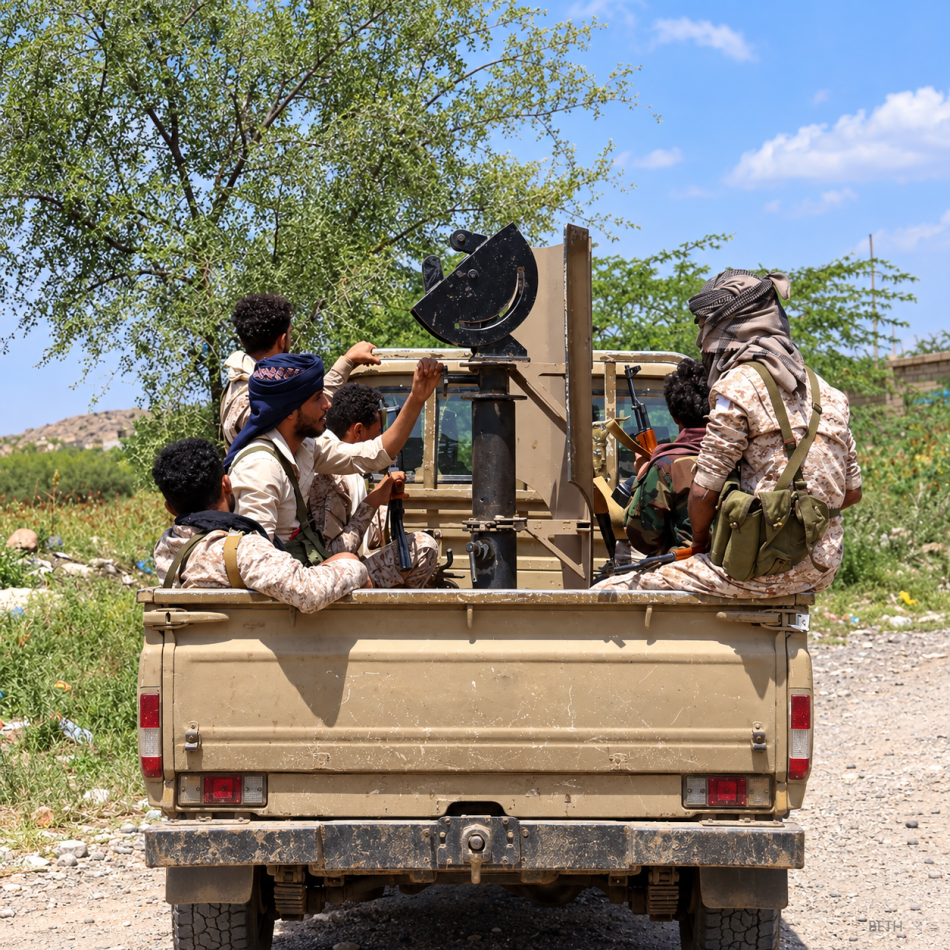
Government forces announce the capture of strategic positions in northern and southern Marib and continue fighting the Houthis in Taiz; Houthi shelling targets residential neighborhoods, while operations expand to target the militia’s fortifications and military capabilities
October 13, 2026
Monitoring and Analysis | Strategic Media Department – BETH News Agency
Operation “Dawn of Yemen” entered its ninth day as government forces announced new advances on the ground in Marib Governorate, coinciding with intensified fighting in Taiz and continued military operations against Houthi positions and fortifications.
The expansion of the battlefronts reflects government forces’ efforts to move beyond consolidating recaptured positions toward broadening the scope of their operations, in pursuit of the declared objective of restoring state institutions and liberating Sanaa.
Marib: Strategic Positions
Government forces announced the capture of strategic highlands and positions along the northwestern front of Marib, in the vicinity of Mas Military Camp in Medghal District, following clashes targeting Houthi fortifications.
On the southern front, forces from the Saba and Bayhan military commands announced the recapture of the Al-Muqaylat and Jabal Zajar positions north of Harib District.
These developments are significant for expanding the area under government control and strengthening military positions along the governorate’s northern and southern fronts.
Taiz: Fighting and Shelling of Civilian Areas
Taiz witnessed intense clashes along its eastern, western, and southern fronts, including Al-Dhabab, Hadharan, Jabal Han, Al-Shaqab, Al-Aqroud, and Al-Misrakh.
The fighting coincided with Houthi shelling of the residential Al-Ikhwa neighborhood, resulting in civilian deaths and injuries, with no final casualty toll announced.
Government military sources also announced the capture of 81 Houthi fighters on the Al-Dhabab front, while the Giants Brigades reported that a ballistic missile launched by the Houthis toward Jabal Kahbub landed without causing casualties or material damage.
Targeting Military Capabilities
Yemeni forces announced continued strikes against Houthi positions, military vehicles, and reinforcements, using drones, artillery, and combat aircraft.
The Yemeni military spokesperson announced that 1,879 precision strikes had been carried out, 950 Houthi fighters neutralized, and 380 military vehicles destroyed during the operations, according to figures released by the forces.
Attacks on Saudi Arabia
Government advances coincide with continued Houthi attacks on Saudi civilian airports and facilities.
This escalation can be viewed as an attempt to extend the impact of the confrontation beyond Yemen’s battlefronts and compensate for battlefield setbacks by inflicting human and economic damage.
However, targeting civilians and vital facilities broadens the scope of the confrontation without changing the declared objectives of the government operation.
BETH Analysis
The announced advances in Marib give Operation “Dawn of Yemen” a new battlefield dimension, while Taiz remains one of the principal fronts shaping the direction of forthcoming operations.
Expanding control over highlands and commanding positions allows government forces to strengthen their military positions, while continued strikes aim to weaken Houthi fortifications and their ability to move reinforcements.
However, the value of these gains depends on consolidating them, securing supply lines, and protecting civilians in areas experiencing fighting.
The most important test on the ninth day is not merely the expansion of the battlefronts, but the ability of government forces to turn their battlefield advances into stable territorial control that reduces the Houthi threat and brings them closer to the objective of restoring state authority.
Developments
Coalition Prepares for Special Operation in Sanaa
The coalition announces that it will shortly issue an evacuation warning to civilians at a location in Yemen's capital, Sanaa, ahead of a special military operation, without identifying the location or specifying when the operation will take place.
Major General Turki Al-Maliki, the official spokesperson for the Coalition to Support Legitimacy in Yemen, announced that the coalition's Joint Forces Command “will shortly issue a warning to civilians to evacuate a location in the Yemeni capital, Sanaa,” ahead of a special operation.
What stands out about this announcement is that it precedes the evacuation warning itself. Typically, such warnings identify the location to be evacuated and are issued sufficiently ahead of an operation to allow civilians to move away from the area.
The current announcement, however, signals preparations for a specific operation while postponing disclosure of its location until the forthcoming evacuation warning.
BETH Analysis
The advance announcement of an evacuation warning represents a different approach to military communication, drawing attention to the anticipated operation before its details are disclosed.
This approach can be interpreted as a preliminary message that separates the announcement of military intentions from the measures intended to protect civilians.
It also raises questions about the nature and significance of the operation, although the announcement does not yet provide sufficient information to identify the target, assess its scale, or determine when it might be struck.
The key test will be the content of the forthcoming warning, particularly how clearly it identifies the evacuation area and whether civilians are given sufficient time to reach safety.
BETH News Agency is closely following the coalition's forthcoming announcement and the details it may reveal about the targeted location, the nature of the operation, and subsequent developments.
The coalition has identified a well-known location in Sanaa: the Yemen Petroleum Company / Al-Sabaha Central Station. However, according to the warning issued, it has not disclosed the nature of the target that warrants a special military operation at the site.
What Can We Understand from the Location Identified?
There are three possible interpretations:
1. A military facility or activity within the site: This could involve the storage of equipment or the use of certain facilities for military purposes.
2. Military equipment or installations in the vicinity: In this case, identifying Al-Sabaha Station may serve as a way to inform civilians of the area to be evacuated, rather than precisely identifying the intended target.
3. Facilities associated with supply or logistical operations: This possibility would require an official statement clarifying the nature of their military use before it could be presented as a confirmed fact in news reporting.