



Aramco Expands Export Routes .. and Records Exceptional Sales in One Week
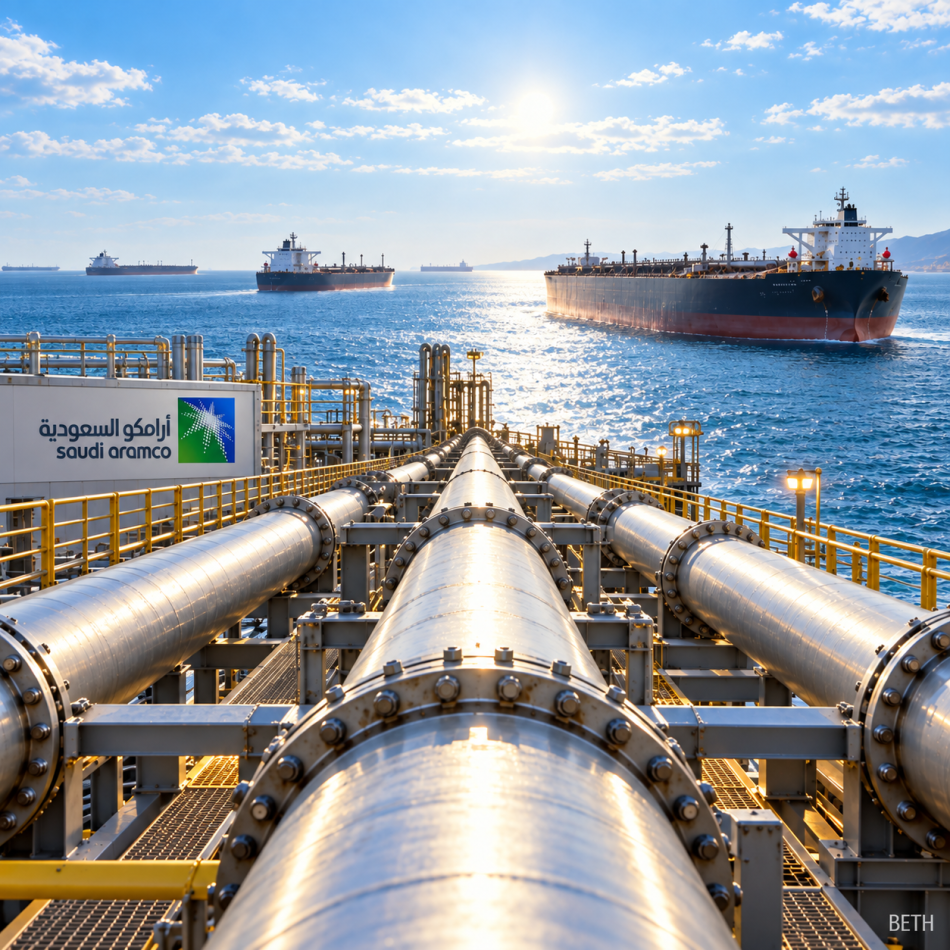
Al-Nasser: Saudi oil currently relies on three main export routes, while a fourth and fifth are under study to enhance supply flexibility and reduce dependence on sensitive maritime passages
Riyadh | BETH
Saudi Aramco is studying the addition of a fourth and fifth route for crude oil exports, as part of a plan to expand supply options and ensure that Saudi oil continues to reach global markets whenever any major route is disrupted.
Aramco President and CEO Amin Nasser said the belief that the East-West Pipeline is a single pipeline is inaccurate; in reality, it consists of several pipelines, giving the company greater flexibility in transporting crude oil and products.
Al-Nasser explained that Aramco currently relies on three main routes for crude exports: through the Strait of Hormuz, from the western coast through the East-West network and the Red Sea, and through the route linked to Egypt’s SUMED pipeline leading to the Mediterranean Sea. The company’s engineering teams are studying ways to expand these options and add new routes.
The East-West network has a design capacity of about 7 million barrels per day and extends for nearly 1,200 kilometers from production areas in the Kingdom’s east to Yanbu on the Red Sea, allowing Hormuz to be bypassed when necessary. Aramco also owns a 15% stake in Egypt’s SUMED pipeline, which provides an additional route to the Mediterranean.
The move toward new routes comes at a time when the current war has demonstrated the importance of having more than one export outlet. Shipping through Hormuz has been disrupted, while the East-West Pipeline itself experienced a temporary shutdown after the attack that targeted it in September before operations began to be restored.
Al-Nasser confirmed that Aramco can restore affected operations within days, citing the company’s ability to return to full capacity within 11 days after the 2019 attacks. The company is also studying an increase in its storage capacity outside the Kingdom, including in Asia, to ensure continued supplies to customers during short-term disruptions.
100 Million Barrels for Asia
From another angle that reveals the scale of actual market activity, Saudi Arabia, through Aramco, has sold around 100 million barrels of oil to Asian buyers since the middle of last week, in an exceptional wave of sales that helped ease concerns over supply shortages in the world’s largest oil markets.
The deals include state-owned and independent refineries in China, along with buyers in India, Japan and South Korea, with the shipments scheduled to arrive during October and November.
The volume sold is equivalent to roughly one full day of global oil consumption, and is also more than double Saudi Arabia’s recent flows to Asia through Hormuz.
The sales come at a time when Iranian supplies have declined because of the war and blockade, while some buyers have become more cautious toward Russian crude, prompting Asian refiners to seek alternatives from Africa, Latin America and the Gulf.
What stands out is that Aramco is not only selling crude oil; it is also offering to manage transportation and logistics operations until the shipments reach Asian customers, after some buyers became more reluctant to send their own tankers into routes exposed to risk.
Most of these shipments are expected to pass through the Strait of Hormuz, alongside the gradual return of the East-West Pipeline, in a picture that reflects Aramco’s simultaneous use of more than one channel to maintain the flow of supplies.
Saudi Arabia had already increased its exports from Ras Tanura during September and October; Reuters reported that it sold around 60 million barrels for loading from the Gulf, with some shipments carried out through ship-to-ship transfers near the port of Sohar in Oman.
BETH Eye
The figure is important, but what it reveals is more important.
When Asia began facing the possibility of a crude shortage, the Saudi response was not based only on increasing production; it was also based on selling the volumes, securing their routes, and expanding the ability to deliver them to buyers.
At the same time, the study of a fourth and fifth route shows that Aramco does not view supply security as a matter of production alone; it also sees it as diversity in the routes used to reach the market.
This is where the two pictures come together:
Large sales in the present, and additional routes for the future.
And this is one of Saudi Arabia’s most important strengths in the energy market:
The advantage is not in possessing oil alone, but in possessing the options that ensure it reaches the market when the market needs it.