


World Press Today – September 24 | BETH Eyes
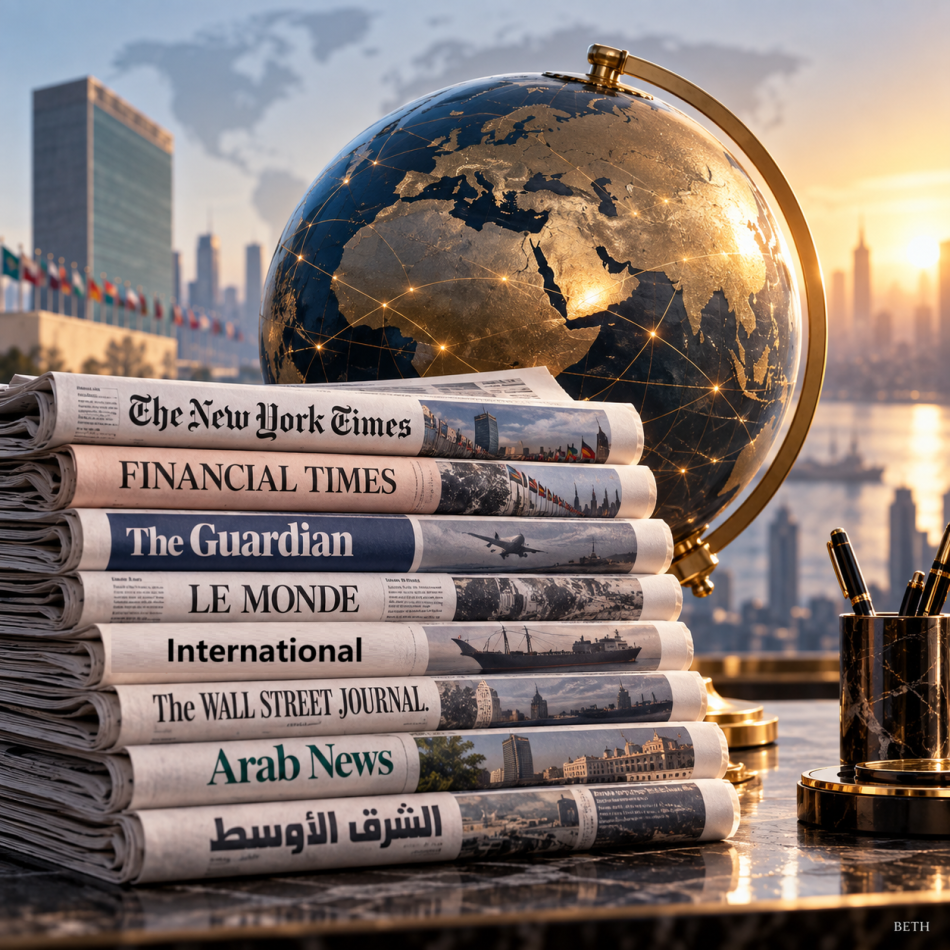
The Trump–Xi summit pulls the spotlight away from New York; Tehran opens the door to negotiations while keeping Hormuz closed under conditions, Ukraine calls for choking Moscow’s revenues, and markets read politics through oil and bonds
Monitoring and Analysis | Strategic Media Department – BETH Agency
Supervision: Abdullah Al-Omairah
The world today does not have one capital for the news.
In New York, wars and crises gather under the roof of the United Nations.
And in Washington, Donald Trump and Xi Jinping sit at a table that may affect trade, Taiwan, artificial intelligence, and Iran more than dozens of speeches at the General Assembly.
In the background, however, there is another language that is calmer and more precise:
Oil, bonds, straits, and drones.
This is the picture drawn by the global press on the morning of Thursday, September 24.
Washington and Beijing | The Other Summit
The American press placed the Trump–Xi meeting at the forefront of the scene; a state visit that is the first by the Chinese president to Washington in more than a decade, at a time when both sides are seeking to stabilize the relationship without addressing most of their fundamental disagreements all at once. Trade, Taiwan, artificial intelligence, and Iran are on the table, while preserving the trade truce appears to be a closer objective than achieving a major political breakthrough.
The striking picture is that world leaders are in New York, but two of the most influential among them have effectively left the UN stage for the White House.
“In Washington, the scene was described as a split diplomatic screen: the United Nations discusses the world order, while Washington and Beijing are practically negotiating a large part of its rules.
As for the French press, it approached a more sensitive angle: Taiwan; as concerns are growing there that American arms deals may become a card within the broader negotiations between Trump and Xi.
BETH Eye:
The summit does not need a historic agreement in order to be important. Sometimes the achievement between two major powers is preventing disagreement from turning into a crisis.
Iran | Negotiations and Hormuz
The international press today followed the parallel signals coming from Tehran and Washington regarding the possibility of returning to the diplomatic track, in parallel with the continuing dispute over the Strait of Hormuz.
The coverage highlighted Iranian President Masoud Pezeshkian’s statement that his country is ready for diplomacy, but that it will not allow the return of normal passage through the strait as long as the attack against it continues.
On the economic side, the financial press focused on the decline in oil prices on Thursday morning, with renewed talk about U.S.-Iranian contacts and the possibility of easing the supply crisis.
BETH Eye:
The Iranian message is dual: opening the door to negotiations, while keeping Hormuz as a pressure card until the terms of the settlement become clear.
Ukraine | The War Speaks in New York
“The Guardian” placed the new Russian attacks on Kyiv alongside Ukrainian President Volodymyr Zelenskyy’s speech before the United Nations.
Two people were killed and dozens injured in attacks on the capital, while Zelenskyy called on countries to continue pressure on Russia’s revenues and reduce trade that finances its ability to continue the war.
In return, Washington kept the door of communication with Moscow open; saying that Vladimir Putin is invited to the G20 summit in Miami in December, and that the United States remains ready to communicate regarding the war.
Thus, the same paradox appeared once again:
Sanctions and strikes continue, while channels of negotiation remain open.
It is almost the same equation appearing today in the Iranian file.
The Economy Reads the War
Away from political statements, the “Financial Times” picked up a different signal:
A sell-off wave in U.S. bond markets extended into Asia, while oil remained at elevated levels, and yields on Japanese bonds reached their highest levels in decades.
And the story here is bigger than the markets.
The world is not only paying the cost of wars on their battlefields; but also in:
Interest rates, inflation, energy, and debt.
That is why any move in Hormuz or any signal from Washington and Tehran now moves quickly from negotiation rooms to trading screens.
Developments Around the World Today
Away from the major files dominating the press, three notable developments stood out today:
Militarily: North Korea tested an upgraded 240 mm guided multiple rocket launcher system, with a range of about 115 kilometers, in a move that enhances its precision-strike capabilities near the South Korean border.
Scientifically: Researchers announced the creation of a detailed map of gene activity in the brain’s prefrontal cortex, the region associated with planning, decision-making, and complex memory; opening new paths for understanding neurological and psychiatric diseases and disorders.
Politically: The Trump–Xi meeting in Washington brought together trade, Taiwan, semiconductors, and Iran in a single discussion, while the trade truce between the two countries continues, as each side seeks to improve its position ahead of any broader understandings.
Saudi Arabia in the Global Press | More Than One Front
Saudi Arabia is strongly present in the international press this week, but not through one gateway.
From Riyadh to New York, from oil markets to Yemen, and from arms deals to climate and sports, the Kingdom’s image in global coverage is formed through parallel files.
Security | Riyadh Enters the Headlines
In the military field, “Reuters,” “Associated Press,” “Financial Times,” and “The Guardian” continue to focus on the Houthi escalation and attempts to target the Kingdom, particularly the interception of the ballistic missile heading toward Riyadh on September 19 without any damage being recorded.
It appears that the limited flow of new information, and the slow updating of some field details, have caused part of the Western coverage to continue relying on previous events instead of presenting new developments.
Internal Security | Life Continues
In contrast to the news of missiles and regional tension repeated by foreign media.. coverage of the National Day was noted in a different image.
Global newspapers reported the wide celebrations taking place in the Kingdom, including air, naval and military shows, fireworks and mass public events, while the Gulf Cup also began in Jeddah with the participation of eight national teams.
And it mentioned; what was journalistically striking was that these events are continuing continued, as are tourism and entertainment programs, in completely safe conditions, in which one does not feel that there are events taking place around the Kingdom..
The coverage also reported scenes of celebrations in the streets, family gatherings and cultural events across different regions, and FIFA President Gianni Infantino, who is in Jeddah, described the National Day atmosphere as wonderful, and praised the presence of people in the streets and their pride in the occasion.
BETH Eye:
The most important indication here is that security appears in the ability of cities to continue their lives and celebrations and host major events despite the surrounding threats.
Energy | Saudi Arabia Moves the Market
But the largest economic presence came from oil.
“The American press reported that the resumption of operations on the Saudi East–West pipeline and the increase in crude flows contributed to the decline in oil prices, after a period of concern over supplies through Hormuz.
The “Financial Times” focused on restarting the pipeline as a strategic route that allows Saudi oil to reach the Red Sea away from the Strait of Hormuz.
Here, the story goes beyond Aramco and Saudi Arabia.
Every barrel that the Kingdom can divert from the Gulf to the Red Sea has today become part of global energy security.
Even the American proposal to establish an investment fund with Arab countries to develop energy routes bypassing Hormuz brought Saudi Arabia back to the forefront of the discussion over the shape of energy infrastructure after the war. The “Financial Times” said that the proposed platform would begin with around $10 billion and could later expand, while examining routes and pipelines alternative to the strait.
New York | Saudi Arabia at Multiple Tables
Away from the war, Saudi Arabia appears in New York within a broad network of political meetings.
The American press documented the participation of Saudi officials in meetings on the sidelines of the General Assembly, including multilateral meetings, while Saudi Foreign Minister Faisal bin Farhan also held a trilateral meeting with his Turkish and Syrian counterparts.
At the same time, Saudi Arabia, Turkey, Pakistan, and Egypt appeared within a political move affirming support for the Kingdom’s security and its right to defend itself in the face of Houthi attacks.
This reflects an aspect that does not always appear in military headlines:
Riyadh is facing escalation from some of its surroundings, while in parallel it manages a broad diplomatic network around it, and a great ability to maintain internal security and stability.
Defense | The Relationship with Washington Expands
One of the Saudi stories that attracted the most attention in the British press was the Trump administration’s approval of a proposed deal to sell F-35 fighter jets to Saudi Arabia worth approximately $24 billion.
The British press addressed the deal as a major development in the U.S.-Saudi defense relationship.
Alliances | An Eye on the “Mecca Alliance”
Some of the press goes beyond the relationship with Washington.
“The Guardian” addressed the Saudi-Turkish-Pakistani rapprochement and the “Mecca Alliance” within a broader discussion about middle powers seeking to build regional arrangements and alliances with greater independence in a world that has become less dependent on a single American umbrella.
This is an important angle; because it shifts Saudi Arabia in the coverage from the image of a state seeking protection to a state working to diversify networks of power and partnerships.
Markets | The War Enters the Trading Screen
The American press also followed the effect of the war on the Saudi market itself.
The “TASI” index moved cautiously this week amid anticipation of U.S.-Iranian talks and the continuing Yemeni tension, while Aramco’s movements and oil export routes became part of investors’ daily reading.
This means that the financial press does not look at Saudi Arabia today only as an oil producer; but also as a market that receives the effects of the war and influences its pricing globally, and a source of security for energy in the world.
Climate | A Presence Under Scrutiny
International coverage of Saudi Arabia is not limited to security, economic, and diplomatic files; critical topics also appear relating to climate, sports, and some public policies.
“The Guardian” published an investigation into the participation of researchers linked to Aramco and Saudi institutions in preparing reports by the Intergovernmental Panel on Climate Change, in which some parties and experts raised questions about conflicts of interest.
The panel, in return, confirms that the mechanisms for preparing its reports are subject to broad reviews and that the diversity of researchers’ backgrounds does not mean that the results are subject to the interests of any particular state or company.
This coverage reveals that the increasing Saudi presence in international energy and climate institutions also brings with it a greater level of media scrutiny.
Sports | The Spotlight Brings Scrutiny
Even the Saudi league returned to the pages of “The Guardian,” but from an angle different from major deals.
As the Saudi sports project became more global, its local details also became more exposed to international scrutiny.
BETH Eye
If we bring together this coverage, Saudi Arabia today appears in the global press through an image broader than “oil and war.”
Among the most prominent aspects:
A state that possesses the ability to confront any security threat.
And a main corridor for the stability of global energy.
And a military partner of growing importance to Washington and London.
And a power building new regional networks.
And a safe market and investment environment despite what is happening around it.
Arab Press Brief | From the Atlantic to the Gulf
In the Arab press, Iran, the war, and Hormuz remained at the forefront.
“Asharq Al-Awsat” brought together on its front page the U.S.-Iranian openness to negotiations, field developments in Yemen, and the Trump–Xi summit, while highlighting the exceptional reception of the Chinese president in Washington.
It also followed the decline in oil prices with renewed talk of diplomacy, in a new confirmation that energy prices have become the fastest indicator for measuring the temperature of the war.
As for “Independent Arabia,” it focused on Tehran’s dual message: readiness to negotiate on one hand, and linking the reopening of Hormuz to the end of attacks on the other.
The general Arab picture this morning is clear:
The war is not ending, but it has begun searching for the terms of its end.
Inside the Capitals | Each Country Has Its Concern
Washington: wants to manage China, negotiate with Iran, and keep Moscow’s door open; three different files, but Trump’s tool in them is almost the same: pressure first, then negotiation.
Beijing: enters the White House wanting stability in the trade relationship, while protecting its interests in Iran, Taiwan, and technology.
Moscow: continues military pressure on Ukraine, while Washington does not close the channel of dialogue with it.
Kyiv: is trying to turn the United Nations platform from political sympathy into greater financial and economic pressure on Russia.
Tehran: negotiates from New York, but holds on to Hormuz as a power card.
Riyadh: manages the Houthi threat from the position of defending sovereignty, while expanding its diplomatic and humanitarian presence in New York.
Beyond the Pages
If we bring together the newspapers rather than the headlines, a larger direction appears:
The world is not moving toward peace yet; but it is moving toward negotiation under pressure.
America negotiates with Iran while threatening it.
It negotiates with China while competing with it.
It keeps the line of communication with Russia open while supporting Ukraine.
And Iran speaks of diplomacy while holding on to Hormuz.
What is new is not the end of conflicts.
What is new is that most parties have begun calculating the cost of their continuation.