


World Press Today – September 25 | BETH Eyes
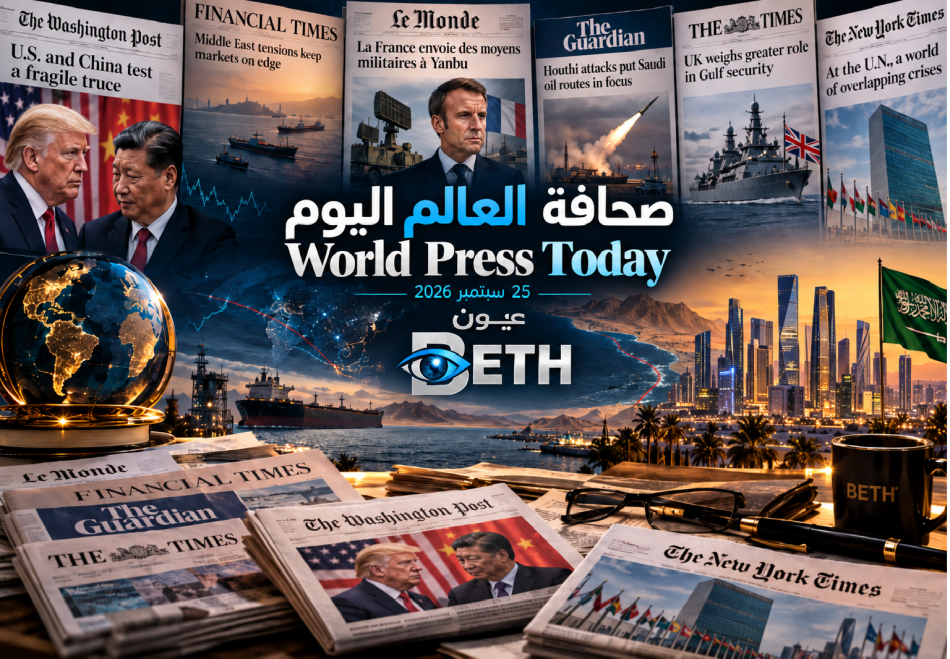
Washington and Beijing test an economic truce; Hormuz imposes itself on politics and markets, while Saudi Arabia advances in the international press at the intersection of security, energy, and the reshaping of alliances
Monitoring and Analysis | Strategic Media Department – BETH Agency
Supervision: Abdullah Al-Omairah
No single newspaper dominated the world today; rather, headlines were distributed among U.S.-China relations, the U.S.-Iran war, Gulf security, Ukraine, and the United Nations.
But one thread brings most of them together: the major powers are seeking to ease crises without giving up the tools of power.
Washington | Trump and Xi: De-escalation, Not a Settlement
The summit between Donald Trump and Xi Jinping in Washington occupied considerable space in Asian and international press coverage.
South China Morning Post focused on the two sides’ announcement of new economic arrangements whose details remain limited, and on discussions of a mechanism for reciprocal reductions in some tariffs on non-strategic goods. But the major files, from technology and artificial intelligence to trade and Taiwan, remained without final settlements.
BETH Eyes:
The picture that emerged from the summit is not a return of U.S.-China relations to normal, but rather the management of competition so that it does not turn into an open economic confrontation.
The Gulf | Hormuz Sets the Terms of Politics
The Wall Street Journal returned today to the Strait of Hormuz from an angle that goes beyond tanker traffic; it presented differences within the region over the shape of any settlement with Iran, with Gulf states seeking to ensure that the resumption of negotiations does not lead to a rapid retreat from economic and military tools before the security of navigation is guaranteed.
In the markets, oil continued to move with every political signal; prices fell in early trading today with renewed talk of U.S.-Iranian contacts, while security risks remained a factor in pricing.
The meaning here is clear:
Hormuz is no longer merely a maritime issue; it has become a point where war, negotiations, and energy meet.
Paris | France Heads to Yanbu
Le Monde focused on President Emmanuel Macron’s announcement that “military means” would be sent to Yanbu, including soldiers, radars, and defense systems, to protect the strategic Saudi oil site on the Red Sea. The newspaper explained that the mission is defensive and intended to protect the facility, not to participate in the fighting.
The French press reads the move within the growing importance of Yanbu and the East-West pipeline amid continued disruption to navigation in Hormuz; the port has become a more important outlet for Saudi oil exports and one of the elements of energy security outside the Gulf.
BETH Eyes:
France is not entering the war; but it is entering more clearly into the protection of Saudi Arabia’s alternative energy route, giving Yanbu strategic weight that extends beyond the Kingdom’s borders.
London | Saudi Arabia Enters British Calculations
The Guardian placed the Houthi escalation against Saudi Arabia in a context that goes beyond Saudi borders; the targeting of Yanbu and Taif comes while the Red Sea represents the most important alternative route for Saudi oil exports amid disruption in Hormuz, making any targeting of this route an issue affecting international energy and navigation security. The newspaper also linked the escalation of attacks to the Saudi-Turkish-Pakistani move under the Makkah Joint Defense Agreement.
The Times, meanwhile, took a more direct angle for Britain; it addressed the readiness of the Royal Air Force to provide support to Saudi Arabia in confronting Houthi attacks, in a move London justifies by the need to protect regional stability and prevent the effects of the attacks from spreading to energy and trade.
On the economic front, the British press is closely following the impact of the war on Saudi Arabia’s ability to export oil, and the position of the Red Sea and the East-West pipeline as an increasingly important part of the global energy network. Financial Times had focused in recent weeks on the decline in Saudi exports and the constraints imposed by disruption to traditional routes.
BETH Eyes:
The British reading today does not reduce Saudi Arabia to the question: Will Washington defend it?
The question has become broader:
How are Saudi Arabia, the Red Sea, and the energy routes on which the world depends to be protected?
Here, an important shift appears; Saudi Arabia is no longer merely a regional ally in the British press, but part of Britain’s own economic and strategic security equation.
Kyiv | The War Searches for a Farther Eye
In Ukraine, Finland’s request to expand Starlink coverage to include areas inside Russia stood out today, in a way that would help Ukraine reach ballistic missile launch platforms targeting its territory. Kyiv says the limitations of its air defenses are making the targeting of launch platforms before they are used an increasingly important part of its strategy.
This reflects a broader change in the Ukraine war: the battle is no longer over weapons alone; communications, space, and data have become part of the battlefield.
New York | The United Nations Faces a Broader World
The United Nations General Assembly this week has become a mirror of simultaneous crises: Iran, Gaza, Ukraine, Sudan, Congo, the economy, and climate.
Associated Press describes the scene as an international gathering facing a world in which wars are multiplying while the ability of international institutions to produce rapid settlements is declining.
Saudi Arabia in the International Press
Today, Saudi Arabia does not appear internationally through a single domestic story; rather, through three intersecting circles:
Security: Houthi attacks have brought the defense of Saudi cities and facilities back into the international press, alongside movement under the Makkah Agreement between Saudi Arabia, Turkey, and Pakistan.
Energy: Yanbu and the East-West pipeline have become part of a global discussion about how oil flows can continue if Hormuz remains vulnerable to disruption. The international press is examining the Kingdom’s ability to diversify export routes, while acknowledging that Hormuz remains an extremely important passage.
Alliances: France’s entry into the protection of Yanbu, alongside Saudi-Turkish-Pakistani coordination and the continuation of the U.S. defense partnership, presents a different image of Saudi Arabia in this war: a network of multiple security relationships instead of dependence on a single umbrella.
BETH Reading
The most important thing the world press says today about Saudi Arabia is not that the Kingdom has entered the circle of war; that has already been the case since the attacks expanded.
More important is that Saudi Arabia’s security has become directly linked to international energy and navigation security.
For this reason, Yanbu, the East-West pipeline, the Red Sea, the Makkah Agreement, and international defense cooperation are becoming parts of one file.
Saudi Arabia here does not appear as a marginal party in the U.S.-Iran war, but rather as a state located at the intersection of global energy, Red Sea security, Yemen, and the reshaping of defense partnerships in the region.
Top Newspaper Editorials | Friday, September 25
America | Taiwan and Power at Home
The Wall Street Journal editorials today focused on two files: Beijing’s attempt to push Washington to change the wording of its position on Taiwan’s independence after the Trump-Xi summit; the newspaper argued that an American concession on this point would alter a sensitive balance in the relationship with Beijing. Domestically, the newspaper criticized restrictions imposed by the White House on the access of some journalists, after the judiciary intervened to stop them.
Bottom line: The summit with China did not end the competition; rather, it moved it to the more difficult questions: Taiwan and the limits of presidential power inside the United States.
Europe | The Energy Crisis Is Not Far from Politics
Le Monde chose the energy crisis for its editorial today, placing major responsibility for its worsening on policies in Washington and Moscow, and warning that continued geopolitical tensions could return the world to the risks of shortages in oil and gas supplies.
Bottom line: Europe looks at wars today through a clear window: Who pays the price of energy if the conflict continues?
Japan | The War on Information
Mainichi Shimbun turned in its editorial to Japan’s domestic scene, warning against the spread of misinformation and defamatory attacks through social media during elections, and calling for the protection of the democratic process without turning the fight against disinformation into a tool for restricting freedom of expression.
Bottom line: The concern of the Japanese press today is not military; rather, how can elections be protected when information itself becomes a battlefield?
China | Partners, Not Rivals
The Global Times editorial was clear after the Washington summit: China and the United States should be “partners, not rivals.” The newspaper defended a relationship based on cooperation, disciplined competition, and the management of differences, while considering stability in the relationship between the two powers a necessity for the global economy and security.
Bottom line: Beijing wants to consolidate what it calls strategic stability; continuing competition, but without sliding into confrontation.
Turkey | The Makkah Agreement Becomes a Practical Question
No major institutional Turkish editorial stood out today on the issue with the same degree of clarity as its Chinese or French counterparts; however, political debate in the Turkish press turned strongly toward the Makkah Agreement. The most prominent commentary in Daily Sabah focused on the question: How far will Pakistan go in defending Saudi Arabia? while emphasizing the need to combine defense commitments with preventing the war from expanding. At the same time, the meeting of the chiefs of staff of Saudi Arabia, Turkey, and Pakistan led Turkish news attention.
Bottom line: The Turkish press has moved from discussing the agreement to how it would be implemented if the targeting of Saudi Arabia continues.
Russia | Preserving the “Cold Peace”
In the Russian press, Kommersant’s reading of the Trump-Xi summit stood out under a striking expression: preserving the “cold peace.” The analysis views the visit as important, but without expecting major breakthroughs; the main objective is to keep U.S.-China competition under control and prevent it from turning into open confrontation.
Bottom line: Moscow reads the summit as management of rivalry, not its end.
Arab Press | China and America Shape the Scene
The Emirati newspaper Al Khaleej chose the Trump-Xi summit for its editorial today, under a telling headline: “A Summit That Defines the Course of the 21st Century.” It argued that the real test is not the warmth of the reception, but the ability of the two countries to turn it into understandings that regulate commercial, technological, and political conflict, from tariffs and artificial intelligence to Taiwan and the Iranian war.
In the Saudi press, meanwhile, the issue of domestic cohesion in the face of attempts to target the Kingdom also stood out, with clear emphasis on the unity of the internal front amid Houthi escalation.
BETH Eyes | What Do the Editorials Say?
If we bring these editorials and readings together into one picture, a striking difference appears in the angle of view:
Washington looks toward China and Taiwan.
Paris looks toward energy.
Tokyo fears the information war.
Beijing wants to regulate competition.
Ankara is watching the test of the Makkah Agreement.
Moscow sees a “cold peace” between the two powers.
And the Arab press asks how all of this will reshape the international order.
The world today is not seeking an end to competition; rather, rules that prevent multiple rivalries from turning into new wars.
Arab Press Brief | From the Atlantic to the Gulf
The Gulf press is focusing on Houthi escalation and energy security; the Egyptian press is following the repercussions of Hormuz, oil prices, and navigation; in the Levant, the Israeli war and developments in Gaza and Lebanon continue to dominate attention, while New York remains the center of Arab diplomatic activity this week.
Inside the Capitals | Each Country Has Its Own Concern
Washington: How to ease the China front without backing down before Iran.
Beijing: Turning the Trump-Xi summit into economic stability that can be built upon.
Paris: A greater security presence in the Gulf and the Red Sea.
London: The limits of the U.S. role in protecting allies.
Moscow and Kyiv: Technology and long distances are entering a new phase of the war.
Riyadh: Protecting territory and energy, and widening the circle of partnerships without turning the Kingdom into an arena for others’ wars.
BETH Eyes Summary
The world’s headline today is not one war.
The major powers are trying to manage several crises at the same time; and Saudi Arabia has become positioned where three of the most important of them intersect: Iran, Yemen, and global energy security.