



Day 77: Escalating Threats… and the Approaching Decision
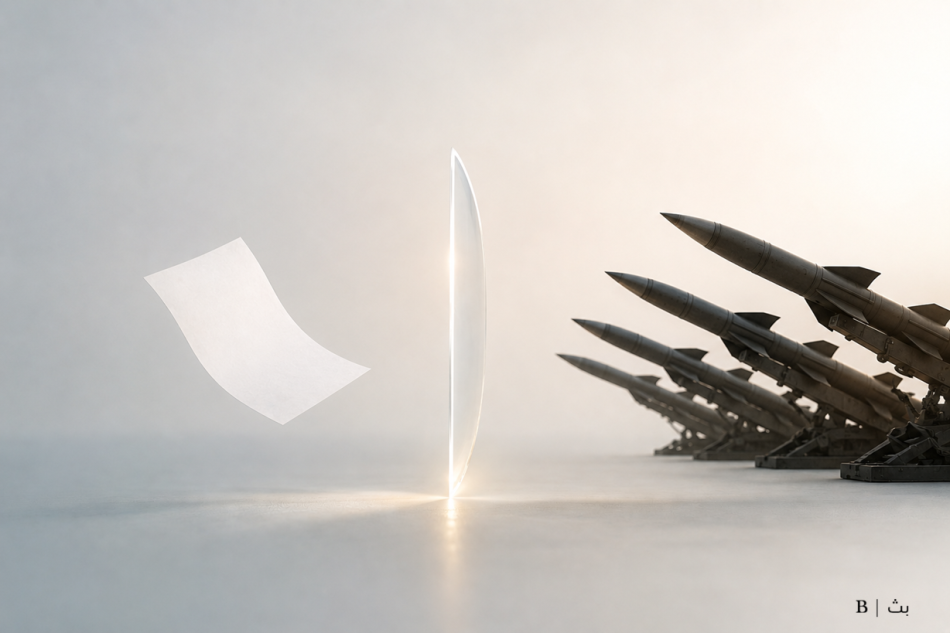
Follow-up & Analysis | B | بث
The language of escalation has forcefully returned to the forefront of the U.S.–Iran scene after U.S. President Donald Trump renewed his threats toward Iran, hinting that American strikes could come “from every direction.”
In a post on Truth Social, Trump shared an image showing Iran surrounded by attack paths from all directions, while also indicating that discussions on resuming strikes would take place tomorrow.
Over the past two days, speculation has intensified regarding renewed U.S. military operations against Iran, particularly amid stalled negotiations and the absence of any diplomatic breakthrough.
In the background, Israeli officials confirmed that an additional U.S. air bridge carrying weapons and ammunition to Israel has recently become active, while another official revealed that Tel Aviv is awaiting the “green light” from Trump to resume strikes.
This synchronization between:
political escalation,
military movement,
and logistical reinforcement,
suggests that the region has re-entered a phase best described as:
“pressure through fire… before the final decision.”
Yet backchannel diplomacy remains active.
While the Iranian Foreign Ministry confirmed that talks with Washington continue through Pakistani mediation, Pakistani sources revealed that Islamabad had already delivered a “modified Iranian proposal” to the American side.
However, a U.S. official described the revised proposal as:
“not sufficient,”
saying it contains only “minor improvements” compared to the previous version.
B Analysis
The current American message appears different from previous phases of escalation.
Washington is no longer relying solely on sanctions or political pressure, but is trying to project that:
the military option is ready,
multi-directional,
and capable of rapid execution.
At the same time, the United States understands that any large-scale strike against Iran could reshape:
global energy routes,
maritime corridors,
regional alliances,
and the overall level of international tension.
This is why Washington appears to be operating within a complex equation:
maximizing pressure,
without rapidly crossing into full-scale confrontation.
Iran, meanwhile, is attempting to:
manage time,
revise proposals,
and maintain diplomatic channels,
while preserving the image of:
“the side that has not closed the door to negotiations.”
And once again, the region faces the same question:
Are we witnessing a real escalation that precedes war?
Or the highest level of political and psychological pressure before a last-minute agreement?
Trump: Planned Strike on Iran Postponed Following Requests from Saudi Arabia, Qatar, and the UAE
U.S. President Donald Trump revealed that the strike planned against Iran for tomorrow had been postponed out of respect for requests made by the Saudi Crown Prince, the Emir of Qatar, and the President of the UAE.
The statement comes at a moment of sharp escalation in U.S.–Iran tensions, amid ongoing military and political pressure, alongside intensive regional diplomatic efforts aimed at preventing the region from sliding into a broader confrontation.
B Analysis
Trump’s statement clearly reveals that Gulf states were not distant from the moment of military decision-making,
but were actively involved in attempts to contain a potential escalation before it occurred.
It also reflects how Gulf political influence,
particularly that of Saudi Arabia,
has become an influential factor in regional de-escalation efforts rather than merely a recipient of the conflict’s consequences.
At a deeper level,
the postponement of the strike does not necessarily mean the risk of confrontation has disappeared.
Instead, it suggests that the region has entered a phase of:
“postponed war,”
where military pressure and strategic messaging continue,
while diplomacy is granted one final opportunity to test whether a larger explosion can still be avoided.
The development also reinforces the growing importance of Pakistani mediation, which continues to move between Washington and Tehran in an attempt to transform:
a temporary postponement,
into a genuine negotiating window,
before the region once again returns to the edge of open confrontation.