



Empty Propaganda
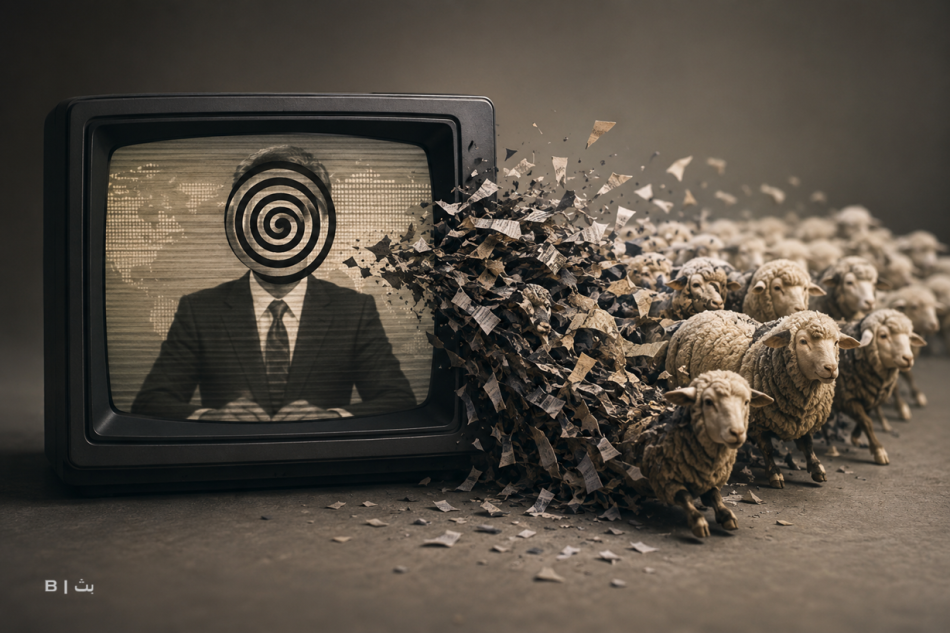
Or .. “Stupid Propaganda”
By Abdullah Al-Omairah
What is propaganda?
At its core, propaganda is the art of influencing the public, shaping opinion, and manufacturing conviction through: media, repetition, language, imagery, symbols, and emotional manipulation.
Historically, propaganda became deeply associated with wars, ideological regimes, and political conflicts. The name Joseph Goebbels remains one of the most infamous examples of what systematic propaganda can become.
Yet propaganda — despite its dangers — was not always stupid.
The most dangerous forms of propaganda throughout history were often intelligent, organized, and deeply aware of: human psychology, fear, and the mechanics of mass influence.
Today, however, we are witnessing something very different:
“Empty propaganda.”
Or perhaps more accurately: “Stupid propaganda.”
Why “stupid”?
Because it has reached a stage that can only be described as: “parrot propaganda.”
Endless repetition. Shallow messaging. A blatant underestimation of the audience.
Until the viewer no longer feels informed… but insulted.
You turn on the news in the morning, and you see:
the same headline, the same tone, the same urgency, and the same “Breaking News” banner.
Then you return in the evening, only to discover that the world has moved on — while the news ticker has not.
The event itself is over. New developments have already emerged. Yet the same old “Breaking News” headline remains alive.
This is no longer just a matter of weak professionalism. It reflects a media mentality that believes repetition alone creates influence — even when the content itself is empty.
In the past, propaganda tried to persuade you.
Today, some forms of media no longer even attempt to think with you. They simply ask you to: consume, applaud, and repeat.
Without the slightest respect for the intelligence or awareness of the audience.
As a result, much of today’s coverage has become little more than: continuous noise, without information, without analysis, without interpretation, and without meaningful depth.
Headlines Without Soul
Consider some of the endlessly recycled headlines repeated throughout a single news cycle:
“Trump: Calm Before the Storm” “Trump Warns Iran: Deal or Destruction” “Netanyahu: We Are Ready for War” “Breaking News” banners that survive longer than the events themselves.
Headlines repeated within what can only be described as a one-directional narrative — a form of “self-centered media discourse” that endlessly repeats its own version of reality without: real analysis, strategic interpretation, or respect for the audience’s right to understand what is actually happening.
The audience today is not as naïve as some media institutions still assume.
In fact, often the average viewer asks smarter questions than the headlines themselves.
Why is nothing explained properly? Why is every development reduced to emotional repetition? Why is the audience treated as if it only needs noise — not understanding?
And whenever someone asks for deeper explanation, the answer often becomes: “These are sensitive secrets that cannot be revealed.”
But the public quietly asks: Does the side that launched the strike not already know what happened?
Or is the real issue a deeper crisis of trust in how modern media handles truth itself?
The Exhaustion of Empty Language
One of the most overused phrases in parts of modern Arab media remains:
“We strongly condemn and denounce…”
Alongside:
“These attacks have crossed all red lines.”
Yet for months, those “red lines” continue to be crossed daily.
So the audience inevitably asks: What comes after condemnation?
The problem is not merely the phrase itself. The problem is that it has become: a recycled template, a ritualistic reaction, and a language emptied of real impact.
Sometimes, silence becomes more respectable than repeating language that has lost: its weight, its credibility, and its meaning.
Professional media does not survive through clichés. It survives through: fresh interpretation, intelligent framing, and the ability to continuously rethink events.
Noise Instead of Depth
As for promotional media content, the situation is often even worse.
An endless flood of: noise, forced tension, shouting panels, cheap spectacle, and formulaic talk shows drowning in repetition.
Faces screaming. Music threatening. Headlines flashing.
But the substance? Empty.
It is as if some institutions discovered a bizarre formula:
“If we lack depth… let us simply raise the volume.”
The crisis is no longer merely one of professionalism. In many cases, media platforms are no longer producing journalism. They are producing: visual addiction, emotional overstimulation, and endless consumption of superficiality.
This is propaganda that no longer trusts intelligence. Instead, it relies on: fatigue, repetition, and overwhelming the audience until critical thinking collapses.
When Media Stops Respecting the Mind
Perhaps the most dangerous part of all this is that some of those producing such discourse genuinely believe they are being “smart.”
In reality, they are exposing the deeper crisis of modern media:
The loss of: ideas, analysis, and genuine respect for human intelligence.
Real media influence is not measured by: louder voices, constant breaking alerts, or endless emotional escalation.
It is measured by: understanding, interpretation, and the ability to reveal what lies beneath the noise.
Empty propaganda may succeed in attracting attention for a while.
But over time, it becomes a repetitive performance that slowly consumes itself, until it loses its power entirely — and transforms from an instrument of influence into an object of ridicule.
Final Reflection
Media dominance is not built on noise. It is built on: clarity, analysis, and understanding the psychology of the audience.
Not every event deserves the same spotlight. Some stories are inflated beyond their value, while more important realities remain ignored.
The professional image extracted from an event can sometimes carry more impact than a thousand loud commentaries.
And perhaps the most important question remains:
Why does this decline continue, even though talented journalists and presenters clearly exist?
The answer may be simple:
Because many institutions still operate with the mentality of the “talk show,” not the mentality of knowledge, analysis, and intelligent journalism.
They fear originality. They fear deeper thinking. And they often prefer: fast noise, safe repetition, and emotional spectacle instead of journalism that respects the audience and understands the complexity of the modern world.
BETH (بث B) – All rights reserved