



Day 75: Hormuz Under Threat
Follow-up & Analysis | بث | B
The U.S.–Iran conflict has entered a more complex phase, with escalating messages surrounding the Strait of Hormuz, Iran’s nuclear program, and cyber capabilities, amid indications that Washington is considering additional steps following U.S. President Donald Trump’s visit to China.
U.S. Secretary of State Marco Rubio stressed that the Trump administration would not allow Tehran to exploit domestic American divisions to push for a “bad deal,” warning that a nuclear-armed Iran could gain permanent leverage over the Strait of Hormuz.
Overview
Iranian media announced that the Revolutionary Guard Navy has begun allowing more vessels to pass through the Strait of Hormuz under new “legal protocols” imposed by Tehran, in a move reflecting Iran’s continued practical control over the strategic waterway despite international pressure.
Meanwhile, U.S. Admiral Brad Cooper stated that American strikes had significantly reduced Iran’s military capabilities, claiming that Iran’s defense sector had declined by as much as 90%, alongside the disruption of supply routes to regional allies, including:
Hezbollah,
Hamas,
and the Houthis in Yemen.
American reports also revealed the possibility of reviving “Operation Freedom” to secure maritime navigation in the Strait of Hormuz using the U.S. fleet, while Washington studies options for additional strikes against Iranian infrastructure.
In a parallel development, U.S. authorities are investigating cyberattacks suspected to be linked to Iran that targeted fuel-monitoring systems at American gas stations, raising concerns related to energy security and public safety.
BETH Analysis
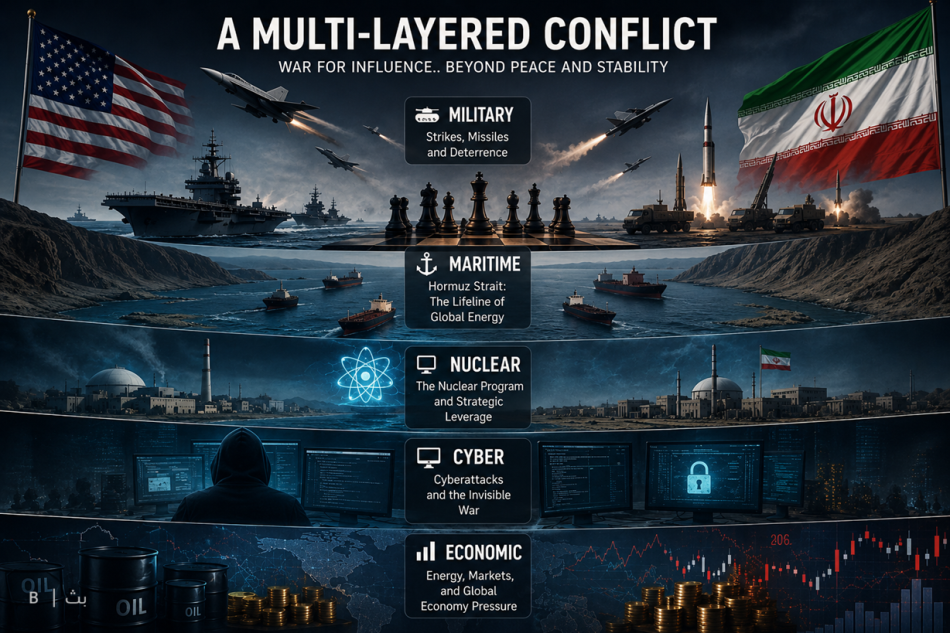
The scene is no longer merely a direct military confrontation,
but a multilayered conflict:
maritime,
nuclear,
cyber,
and economic.
Iran appears to be attempting to establish a new equation:
passage through Hormuz is now tied to its political and security rhythm.
On the other side,
Washington seems to be moving between two options:
containing the escalation,
or reimposing full control over maritime routes by force.
At a deeper level,
recent American statements reveal that the real danger — from Washington’s perspective — is not only the current war,
but what could happen if Iran acquires a nuclear capability that grants it permanent influence over one of the world’s most critical energy arteries.
As for the cyberattacks,
they confirm that the confrontation is no longer confined to missiles and aircraft,
but has entered the phase of “invisible warfare,”
where digital intrusions can become weapons capable of disrupting markets, energy systems, and everyday life without a single bullet being fired.
بث | B
BETH (بث B) – All rights reserved