


When Diesel Becomes the Subject of a Phone Call
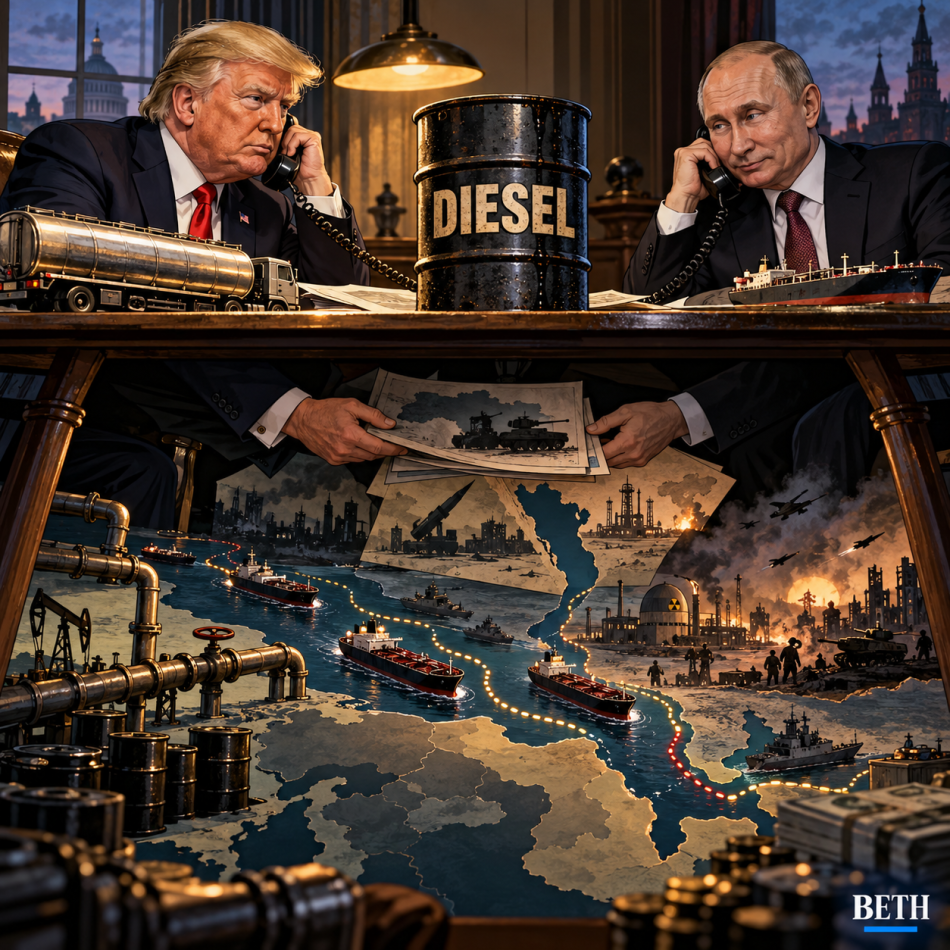
A 90-minute conversation between Trump and Putin ends with an agreement to supply global markets with Russian diesel and ease US sanctions.. Moscow offers to mediate with Iran as pressure on Ukraine intensifies
October 11, 2026
Prepared and Analyzed by | Strategic Media Department – BETH News Agency
Diesel was not the only issue that brought US President Donald Trump and his Russian counterpart Vladimir Putin together in a 90-minute phone call, which ended with the announcement of an agreement to supply Russian diesel to American and global markets and ease the sanctions imposed on it.
The conversation also covered the war in Ukraine, economic relations, and Russia's potential role in resolving the US-Iranian war, without disclosing any comprehensive understandings on these issues.
Why Diesel?
Trump announced an agreement to provide more than 300,000 tons of diesel immediately, followed by 500,000 tons during November and an additional one million tons later, with further quantities depending on the capacity of Russian refineries.
Washington issued a license allowing specific transactions involving Russian diesel until April 2027.
Diesel is not merely a fuel; it is the main driving force behind trucking, agriculture, heavy machinery, and extensive industrial sectors. Rising diesel prices translate into higher food, transportation, and living costs.
Its electoral importance is particularly evident as the November 3 US congressional elections approach, after its average price exceeded six dollars per gallon.
However, the announced agreement does not mean that shipments have actually arrived, nor does it alone guarantee a decline in global prices.
Why Global Markets?
Here lies the broader significance.
The United States is not purchasing diesel solely for its direct needs; rather, it is using its ability to ease sanctions to increase global supply, thereby influencing prices both inside and outside America.
Thus, sanctions are transformed from a tool for isolating Russia into an instrument Washington uses to manage the energy crisis caused by the war with Iran.
More importantly, this step gives Moscow an economic opening and a new position in its understandings with Washington.
Iran in the Diesel Equation
The Russian diesel agreement cannot be separated from the US-Iranian war. Disruptions to energy supplies and petroleum products have made market stability one of Washington's challenges.
Here lies the paradox: Trump is tightening the blockade on Iranian oil while easing restrictions on Russian diesel to compensate for supply shortages and limit price increases.
Russian fuel thus gives Washington economic room to continue its blockade of Iran, while Moscow benefits from the easing of sanctions and the strengthening of its negotiating position.
Did Trump turn to Russian energy to enable him to maintain the blockade on Iranian energy?
Russia Buys and Sells!
The paradox is that Russia itself imported more than 176,000 tons of petroleum products from South Korea during July and August, after its refineries were damaged by Ukrainian attacks.
So how can Russia promise to export diesel while importing it?!
Differences in production and consumption locations, as well as the types of petroleum products involved, explain part of the paradox. However, Moscow's ability to supply the announced quantities remains a test of the agreement.
Putin Offers Mediation
While the Russian-Ukrainian war continues, Putin has offered to help resolve the US-Iranian war, drawing on his relations with Tehran and his channels of communication with Washington.
No American acceptance of formal Russian mediation has been announced.
The phone call coincided with Trump's demand that Ukraine stop targeting Russian refineries and his criticism of President Volodymyr Zelenskyy, amid Ukrainian and European objections to easing sanctions.
The paradox is that Moscow is offering to help end another war while maintaining its own conditions in the war in Ukraine.
BETH Analysis | Beyond Diesel
Diesel appears to be the publicly announced element of a broader convergence of interests: Trump wants to contain energy prices ahead of the elections, Putin wants to ease economic restrictions and restore his negotiating influence, while Iran and Ukraine figure into the calculations governing relations between the two powers.
However, details of any additional political understandings have not been disclosed.
The question raised by the 90-minute phone call is not merely why America needs Russian diesel, but why Putin has become a partner in addressing the global energy crisis while the war in Ukraine and sanctions against his country continue.
The coming days will reveal the extent to which the agreement is implemented and whether the economic concessions will be followed by political steps.
Diesel is what was announced.. The political significance of the phone call will become apparent in the decisions that follow.