



Day 201: The War Enters New York
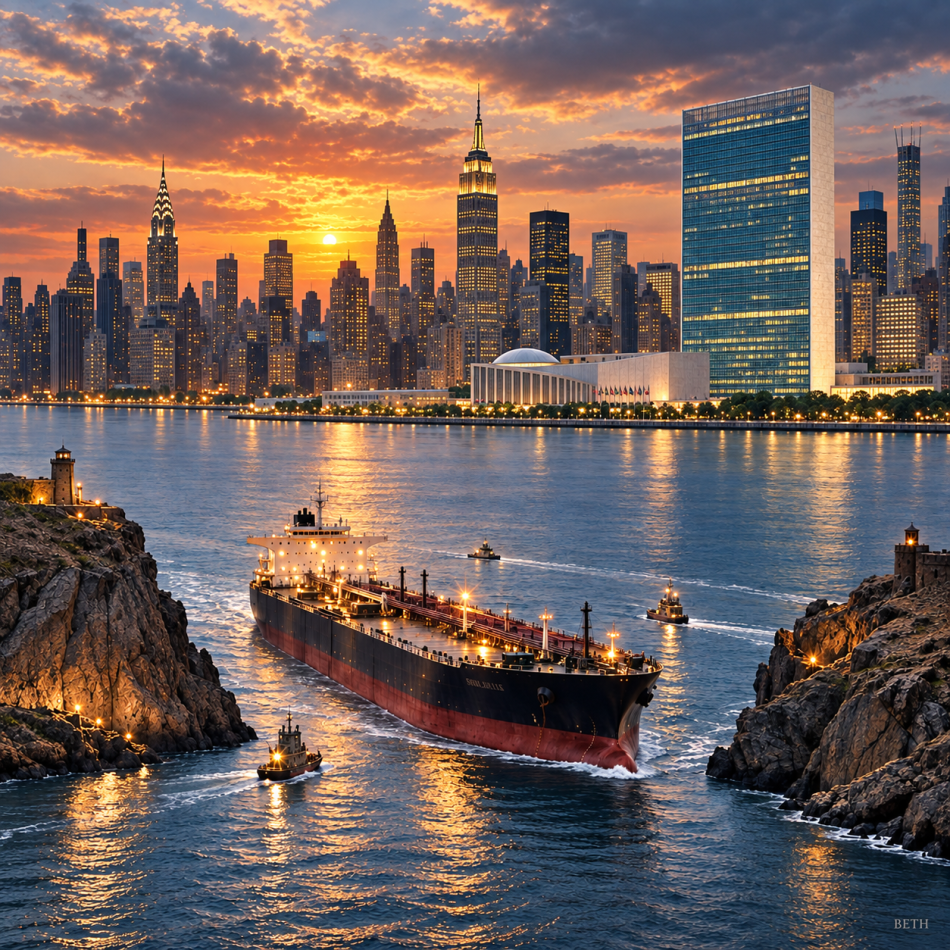
Hormuz is operating at half the logic of normal trade; oil is moving through costly floating bridges, Washington and Tehran are shifting part of the confrontation to the United Nations, and Saudi Arabia is coordinating with the Gulf while Yemen remains a front capable of escalation
September 21, 2026
Follow-up and Analysis | Strategic Media Department – BETH Agency
The U.S.-Iran war entered its 201st day without a new major strike changing its course, but the latest facts show that the war has not calmed down.
It has begun shifting from direct military strikes into a war over movement, time, cost, and negotiation.
The question is no longer only:
Who is striking whom?
But:
Who can continue, and who can make the continuation of the war more expensive for the other?
Hormuz: Ships Crossing With Difficulty
The latest shipping data reveal the scale of the change.
Over the weekend, only 17 commodity ships crossed the Strait of Hormuz, compared with 37 the previous week, while before the war the strait handled around 125 large commercial vessels per day. At the same time, other tankers are still crossing with their tracking systems switched off, which means the visible figures do not represent the full level of traffic.
This does not mean exports have stopped.
It means that the method of exporting itself has changed.
A Floating Oil Bridge
A new network of ship-to-ship transfer operations has emerged south of Hormuz.
Tankers enter the Gulf, load oil, then move out into safer waters near the Gulf of Oman, where they transfer the crude to other tankers that continue the journey to Asia.
Through this method, oil exports through Hormuz rose in September to around 6.5 million barrels per day, while about 2.5 million barrels per day are expected to move through ship-to-ship transfers.
But the cost is enormous.
The cost of transporting a barrel of Gulf oil to China on VLCC tankers has risen to more than $30 per barrel, compared with only a very small share of the crude price before the war; meaning transport alone now accounts for more than a quarter of the value of a barrel on some routes.
This is one of the most important facts of Day 201:
The war has not stopped oil, but it has made moving it more expensive and more complicated.
Saudi Arabia Redistributes Routes
This picture is particularly important for Saudi Arabia.
Kpler data show that 22 tankers carried around 42 million barrels through Hormuz during the week ending September 13, with Saudi Arabia and Iraq together accounting for the largest share of those volumes. In contrast, no visible oil-loading operations have appeared from Yanbu since September 16, according to shipping data cited by Reuters.
The result:
Saudi Arabia is not stopping exports.
But it is now using more than one route and more than one logistical tool in an environment where both the Red Sea and Gulf outlets are under pressure.
This is not merely an oil detail.
It is one of the keys to the war.
Bab al-Mandab Is Also Slower
Traffic through Bab al-Mandab has also declined.
Fifty-one ships crossed over the weekend, compared with 57 the previous week, according to Kpler data.
This means the world is facing, at the same time, pressure at two major gateways for energy and trade:
Hormuz in the east.
Bab al-Mandab in the west.
And here Saudi Arabia becomes part of the center of the equation, not its margins.
New York: The Political Front
Meanwhile, the war has begun moving this week to New York.
Washington allowed Iranian President Masoud Pezeshkian, Foreign Minister Abbas Araghchi, and key members of the Iranian delegation to attend the United Nations General Assembly, while imposing restrictions on the delegation’s movement within New York. The participation comes while intermittent contacts between Washington and Tehran continue despite the ongoing war.
This is a point worth pausing over.
The two sides are fighting, but the political door has not been closed.
This does not mean a settlement is near.
But it does mean that New York has become a place to test conditions and limits before any new decision.
Saudi Arabia Moves in Gulf Coordination
Also in New York, Saudi Foreign Minister Prince Faisal bin Farhan participated in a coordination meeting of Gulf Cooperation Council foreign ministers ahead of the high-level week of the General Assembly.
The meeting discussed common Gulf positions, international issues, and regional developments and their implications for security and stability.
The importance of the meeting today is not ceremonial.
The Gulf states are entering United Nations week while:
- The U.S.-Iran war continues.
- Hormuz is under pressure.
- Bab al-Mandab is unstable.
- The Houthis are escalating against Saudi Arabia.
- And the cost of energy and shipping is rising.
For this reason, Gulf coordination is now part of managing the war, not merely seasonal diplomacy.
Yemen: The Noise Continues
The Houthis, meanwhile, have continued over the past hours trying to raise their political and media profile.
Houthi official Mohammed al-Bukhaiti said his group had warned countries against joining Saudi Arabia, confirmed indirect contacts with Washington through Oman, and said the group does not want to target American ships. These are Houthi statements and do not, by themselves, represent a change in the balance of power.
Their real importance is not in the threat.
It is in the message:
The Houthis want to keep confrontation with America as distant as possible.
What Changed Today?
So far, there has been no new major strike.
But four things have changed or become clearer:
First: Hormuz is no longer operating normally; it is functioning through temporary and costly arrangements.
Second: The Red Sea and Bab al-Mandab have become part of the same oil equation.
Third: The political center of gravity has temporarily shifted to New York.
Fourth: Saudi Arabia and the Gulf are entering this phase with one combined security and economic file; the security of maritime routes is no longer separate from the security of the state.
China Enters Through the Economic Door
There is another dimension that should not be overlooked.
Trump is preparing to meet Chinese President Xi Jinping in Washington on September 24, following U.S.-China economic meetings in New York over the weekend. China is one of the largest importers of the region’s oil and has a direct interest in the stability of Hormuz and energy prices, while Washington also wants Beijing to play a larger role in pressuring Iran.
Here, the Iran war intersects with a larger file:
Washington needs Beijing economically and politically, while Beijing needs stable Gulf energy supplies.
This does not automatically make China a mediator, but it does make the war part of the agenda between the world’s two largest powers.
BETH Analysis
Day 201 does not yet appear to be the day of military resolution.
But it is a day in which the cost of continuing the war is becoming clearer.
Iran has not stopped the oil.
America has not ended the war.
The Houthis are limited to statements and attempts to harm Saudi Arabia, while receiving further strikes from the army.
But the global economy has begun paying the price of every additional day:
More tankers.
Shorter and repeated voyages.
Ship-to-ship transfers.
More expensive insurance.
More expensive shipping.
And greater risks.
This adds new pressure on all sides.
The equation is no longer only:
How many missiles remain?
But:
How many weeks can Iran continue to withstand the blockade and the strikes?
What We Are Watching in the Coming Hours
Three signals will matter more than the noise:
Will a new U.S. military move emerge?
Will New York produce a more serious direct or indirect political contact between Washington and Tehran?
And will Saudi Arabia move toward a broader operational step?
Until one of these three happens, the closest picture is:
The war continues, but everyone is repositioning before the next decision.
And Day 201 confirms something we have seen more than once:
Calm in this war does not mean that nothing is happening; sometimes it means that what is happening has not yet been announced.