



Smart Wars.. Old Endings
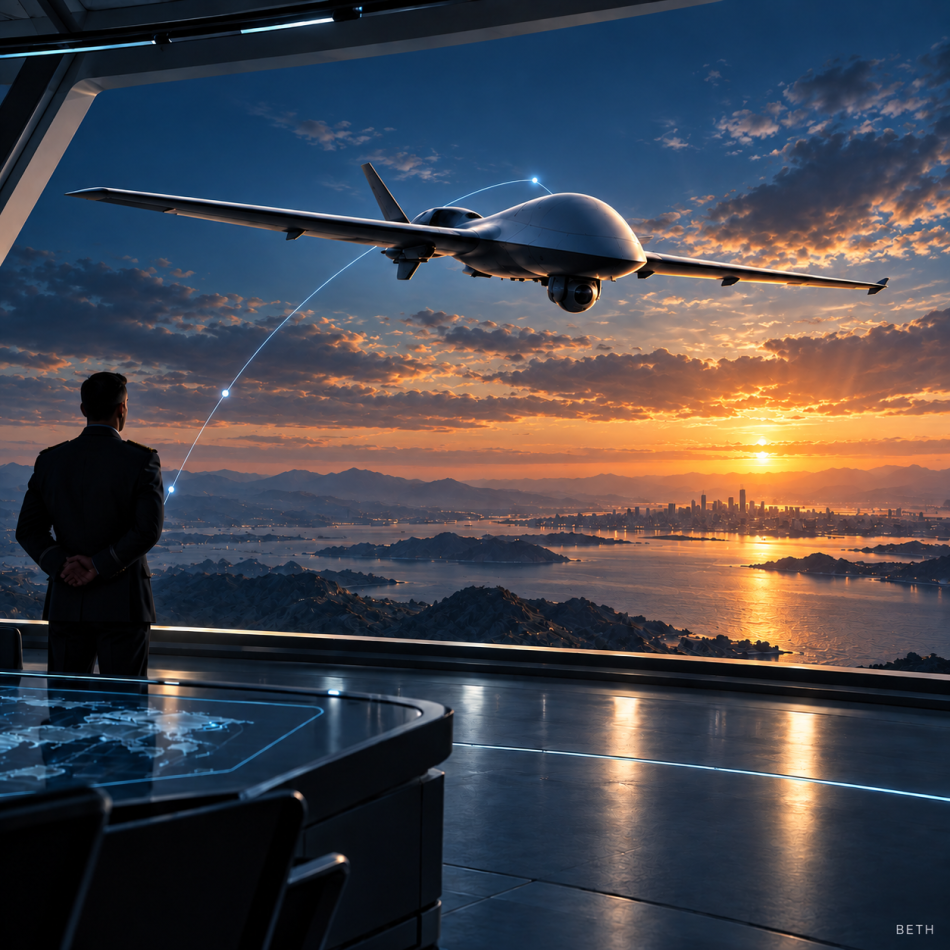
The U.S. Department of War is creating an “Autonomous Warfare Command” to integrate autonomous systems, robotics, and artificial intelligence into operations; a project that promises to accelerate combat, but revives an older question: will the way wars are fought change while the problem of how they end remains the same?
Prepared and Analyzed by | Strategic Media Department – BETH Agency
Supervised by: Abdullah Al-Amirah
The U.S. Department of War has announced the creation of the Autonomous Warfare Command (AutoWarCom), a new command aimed at accelerating the integration of autonomous systems, robotics, drones, and artificial intelligence across the various branches of the U.S. military, while directly linking development and procurement to operational use.
The project comes as part of a broader reorganization of unmanned systems, after the Department created a unified body this year to integrate drone and autonomous-system programs, and allocated tens of billions of dollars in the 2027 budget for these capabilities.
The transitional phase is being led through Project Agincourt, with the aim of building a model that brings operators, engineers, and companies closer to frontline units, while shortening the cycle of testing, modification, and procurement. The Department is also working to create new career tracks for military personnel specializing in the operation of autonomous systems.
What Will War Look Like?
The shift does not mean the disappearance of humans from the battlefield, but rather a reduced human presence at some points of direct contact, alongside an expanded role for unmanned platforms in reconnaissance, sensing, surveillance, targeting, protection, and maneuver.
The stated objective is to shorten the time between detecting a target, making a decision, and executing the mission, while linking sensors, platforms, and command in a faster and more integrated network. Recent U.S. counter-drone exercises are already using autonomous command-and-control software to connect sensors with interception systems.
But this does not mean that human decision-making disappears.
The faster the system becomes, the more sensitive the question becomes:
Who decides? Who reviews? And how much time remains for the human before the machine moves from observation to action?
Who Runs the War?
The expected scene is not a robot fighting alone.
Rather, it is a system that includes a military commander, an algorithm, sensors, operators, engineers, and technology companies, all working within a single cycle that is faster than the traditional military procurement model.
This is the core of the project: moving from a system in which the fighter waits years for technology to reach the field, to one in which the weapon itself changes according to what is happening on the battlefield.
What Will It Target?
In this type of warfare, the priority will not be limited to destroying tanks and aircraft.
The nerve centers of war become increasingly important: command and control, communications, radars, satellites, data centers, energy infrastructure, ports, and supply chains.
The objective becomes to paralyze the opponent’s ability to see, communicate, understand, and respond, rather than merely destroy its equipment.
But What About the Ending?
This is where the real test begins.
The United States did not enter its previous wars with primitive tools or a rigid military doctrine. In Iraq, Afghanistan, Syria, and elsewhere, it used air superiority, intelligence capabilities, advanced targeting technologies, and sophisticated command systems, achieving clear tactical successes at many stages.
But American studies themselves have drawn a distinction between success in battle and success in war.
In Iraq, U.S. forces achieved rapid military superiority, but a later analysis by the Center for Strategic and International Studies described the war as a series of tactical successes that failed to produce a stable strategic outcome, while also pointing to weak preparation for the period after the regime was overthrown.
In Afghanistan, the same problem reappeared in a different form: a high capacity for combat, but difficulty in building a political and security framework capable of enduring after withdrawal. Later American studies concluded that the problem was not only the ability to fight battles, but also defining the strategic objective, assessing the cost of continuation, and producing a viable end state.
The same idea appeared in reviews of Iraq, Syria, Libya, and Yemen: military victory is not enough if it is not followed by political stability, capable governance, and a viable economy.
The Old Problem
For this reason, the Autonomous Warfare Command may address an important part of the problem of modern warfare:
How do you see faster? How do you decide faster? And how do you strike faster?
But by itself, it does not answer the questions that exhausted previous American wars:
Why does the war begin?
What is its political objective?
When does it stop?
And who manages the day after?
Autonomous systems may make the United States more efficient in managing the battle.
But its success in managing the war will still depend on something that an algorithm cannot decide on its own:
the political ending.
And here lies the paradox:
The tools of war may change completely, becoming faster, more autonomous, and more intelligent.
But the old question remains the same:
Can a power that knows how to start a war also know how to end it?