

World Press Today, September 15 | BETH Eyes
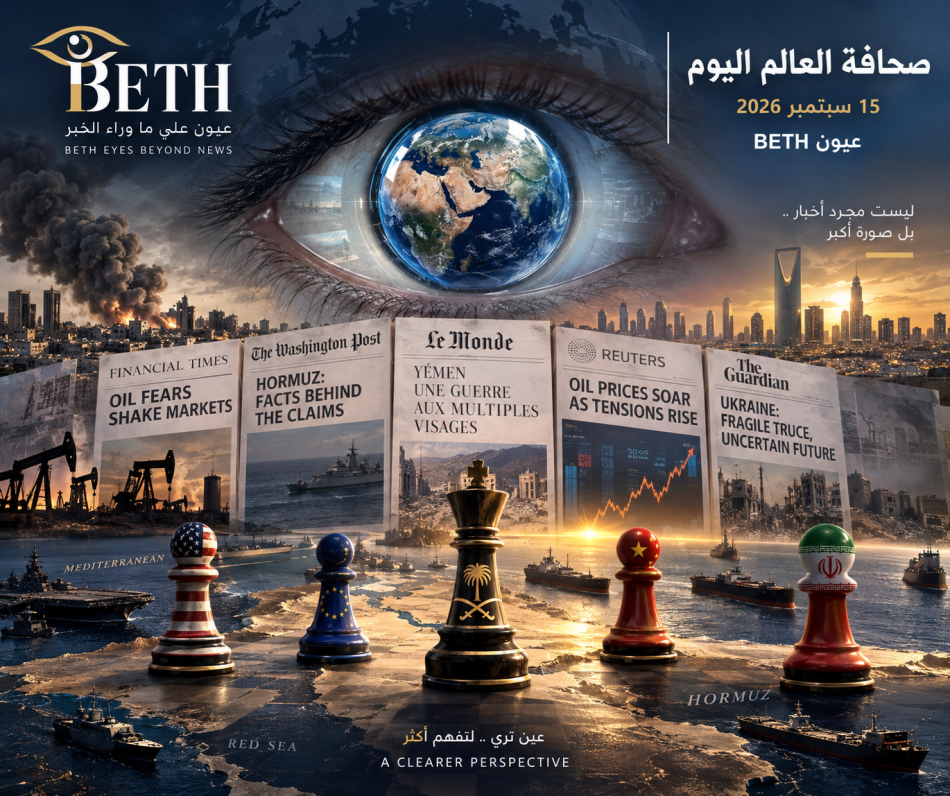
Oil and war are reshaping the priorities of the international press; London reads Saudi Arabia through the lens of pressure, Paris continues to build on the narrative of Houthi expansion despite the battlefield moving in the opposite direction, Washington scrutinizes the Hormuz narrative, and Europe returns to Ukraine and energy, while Mohammed bin Salman’s visit to Cairo moves to the forefront of the regional agenda
Prepared and analyzed by | Strategic Media Department – BETH Agency
Supervised by: Abdullah Alomairah
The Iran war is no longer a regional file in the global press.
Since this morning, energy, interest rates, inflation, navigation, Yemen, and Saudi Arabia have become parts of a single story.
Brent has returned above $108 per barrel, U.S. 10-year Treasury yields have exceeded 5% for the first time since 2007, and global markets have declined under the pressure of fears that higher energy prices could turn into a new wave of inflation that forces central banks into further tightening.
But reading the press itself reveals something else:
Not everyone writing about the war is seeing the battlefield at the same moment.
London | Saudi Arabia Under the Lens
The Financial Times devoted extensive space today to Saudi Arabia, but built much of its reading around the idea that “Iran’s allies are pressuring the Kingdom from all fronts,” linking Yemen, the East–West pipeline, attacks from Iraq, and Bab al-Mandab. In another article, it argued that the widening war has become a test for both Trump and Mohammed bin Salman.
The information is important, but the angle needs updating.
The newspaper focuses on what the Houthis achieved during their initial push, while the latest battlefield development is that Yemeni forces have begun retaking positions west of Taiz, and airstrikes are targeting reinforcements and movement routes, in parallel with a rise in the level of Saudi-U.S. coordination following the Crown Prince’s meeting with the CENTCOM commander.
This does not eliminate the pressure on Saudi Arabia, but it changes the question:
Not only how far did the Houthis advance?
But:
Can they hold what they took after the other side began organizing its response?
This gap between the “image of the advance” and the “phase of consolidating the advance” is still relatively absent from some British coverage.
Paris | The Narrative Moves Ahead of the Battlefield
Le Monde continues today to present the Houthis as the force that has strengthened its influence over Bab al-Mandab, the coast, and the islands, and argues that the group wants to use the strait to consolidate legitimacy and influence beyond the Yemeni war.
This reading is understandable from the perspective of the past few days, but it becomes less complete when read on its own.
The battlefield did not stop at the picture formed on September 12 or 13.
Government forces later announced the retaking of positions in Taiz, air operations are escalating, and there is a clear attempt to prevent the Houthis from turning their push into stable control.
Therefore, descriptions of “control” over Bab al-Mandab or some islands should be read with greater caution; because there is a difference between reaching, deploying, and being able to remain under opposing air and naval superiority.
More importantly, Bab al-Mandab itself has not yet turned into another Hormuz; navigation has declined, but it has not been paralyzed.
Washington | The Numbers War in Hormuz
The Washington Post chose a different and more precise angle: not who politically controls Hormuz, but how many ships are actually passing through?
The newspaper compared Trump’s statements about the volume of traffic with what maritime-tracking companies are recording, and showed a wide gap between political rhetoric and commercially available figures, while acknowledging at the same time that some vessels cross without operating their identification systems.
This is one of the smartest angles in U.S. coverage today.
Hormuz has become a war of narratives as much as a navigation crisis.
Washington wants to show that the passage is operating.
Tehran wants to show that passage occurs only under its pressure and conditions.
The market, meanwhile, does not care who wins the media sentence; it cares about how many barrels arrive on time.
The latest available figure indicates that only four commercial commodity vessels passed through on Monday, compared with ten the previous day, an extremely low level compared with before the war.
Trump | Oil Enters the Elections
The war has begun to enter U.S. politics through a door that needs little explanation:
Fuel prices.
U.S. 10-year Treasury yields have exceeded 5%, and markets have increasingly priced in a Federal Reserve rate hike, while Trump is demanding the exact opposite: lower interest rates.
Here, a new paradox appears.
Trump wants to pressure Iran until it retreats, but he does not want that pressure itself to turn into more expensive oil, higher inflation, and higher interest rates before the midterm elections.
That is why he has also begun pressuring Ukraine to stop striking Russian refineries, linking those strikes to higher U.S. diesel prices, while the broader economic reading indicates that the Middle East crisis itself is a major factor in rising energy prices.
The Iran war has therefore begun to enter the U.S. ballot box through the fuel station.
Europe | The Energy Truce Does Not Last for Hours
Europe returned this morning to Ukraine.
Trump said Russia and Ukraine had agreed not to strike energy facilities, and Zelensky expressed readiness for reciprocal measures to reduce escalation if Moscow complies.
But this same morning saw a Russian drone strike on a fuel station in Kyiv, in addition to storage facilities.
Here, a problem that has become familiar in this war repeats itself:
The political announcement comes before the implementation agreement.
There is still no clear monitoring mechanism, no agreed definition of the facilities covered by the halt in attacks, and no guarantee that Moscow and Kyiv interpret the commitment in the same way.
In the background, Europe itself is suffering divisions over sanctions; the European Union was unable to agree on a full extension of some measures against Russia and had to extend them by only one week while internal disputes continue.
Beijing | Iran Before the Trump Meeting
China is present today in more than one file.
Iranian Foreign Minister Abbas Araghchi’s visit to Beijing on Wednesday comes before the anticipated meeting between Xi Jinping and Trump on September 24, at a time when Tehran needs China as an oil market, political cover, and a channel that cannot be ignored in its relationship with Washington.
But Beijing faces a delicate equation:
It wants Iran as a partner, but it does not want Hormuz congested.
On another front, China emerged from the BRICS summit in New Delhi with a stronger position within the group, while its differences with India continue over payment instruments and possible Chinese dominance over the new financial architecture.
Ahead of the Xi–Trump meeting, three intertwined files stand out:
Trade.
Iran.
And artificial intelligence.
Technological tension has also escalated following renewed accusations over AI development and U.S. restrictions on chips, while Trump rejects calls for tighter regulation of the sector out of concern that this could give China an advantage.
Saudi Arabia in the Global Press
Saudi Arabia is today the most prominent Gulf country in the international press.
But the way it is presented is divided into two images.
The first portrays the Kingdom as being under simultaneous pressure from Hormuz, Yemen, the East–West pipeline, and higher oil prices.
The second is the image of a state that has begun rearranging the tools of response and its alliances.
Mohammed bin Salman’s meeting with the CENTCOM commander yesterday remains present in coverage, and today the Crown Prince heads to Egypt on a working visit to meet President Abdel Fattah El-Sisi to discuss bilateral relations and regional developments.
Here, the sequence deserves attention:
A meeting with the U.S. military commander.
Then Cairo.
At the same time, Yemeni counter-operations and a Security Council meeting on Bab al-Mandab.
We do not have enough to combine these developments into an announced “plan,” but treating them as completely separate events would also be superficial.
There is simultaneous political and military activity around Saudi Arabia, Yemen, and the Red Sea, and the coming days will reveal to what extent some of it is connected.
The expected visit of Australia’s energy minister to Saudi Arabia to discuss supply security also reflects Riyadh’s renewed transformation into a global hub for consultations on energy security, not merely a party affected by the crisis.
Arab Press Brief | From the Atlantic to the Gulf
The Arab press is clearly divided today.
Gulf newspapers focus on attacks against Saudi cities, the injury of 13 civilians, the need to respond, and the protection of infrastructure.
Other outlets focus on the Houthi push and Bab al-Mandab, with some repeating descriptions of “control” faster than the battlefield itself is changing.
Media close to Iran, meanwhile, are advancing the narrative that Tehran now holds the conditions and that the chokepoints have given it a stronger negotiating position.
But one development unsettles that narrative:
The Muscat meeting did not take place.
If Tehran had truly succeeded in turning Hormuz into regional recognition of its new role, the meeting would have been one of the most important tools for consolidating that.
Its postponement showed that the ability to disrupt the passage is one thing, and obtaining legitimacy to manage it is another.
Inside the Capitals | Each Country Has Its Own Concern
In Washington: oil, interest rates, and elections are beginning to overlap.
In London and Paris: the greatest fear is that the oil shock will spill into inflation and growth before winter.
In Beijing: the task is to protect supplies without losing Iran, while preparing at the same time for the meeting with Trump.
In Moscow and Kyiv: energy itself has become a tool of negotiation and war.
In Riyadh: the battle is no longer only about preventing damage, but about preventing the Houthi attack from turning into a lasting military reality on the coast.
And in Tehran: the hardest question is how to turn the ability to disrupt into a political gain before the cost of disruption turns into a domestic burden.
BETH Eye
What stands out today is not only the difference in the positions of newspapers.
What stands out is the difference between their speed and the speed of the battlefield.
Some Western coverage is still building its analysis on the Yemen map that was formed during the Houthi push a few days ago, while the ground has already begun to move.
Some of it treats the disruption of Hormuz as proof of Iranian strength without yet asking the opposing question:
What has Iran obtained in return for all this disruption?
And some U.S. media are chasing Trump’s figures on ship traffic, while the larger issue is that the world’s greatest naval power has not yet restored normal passage through one of the most important international chokepoints.
Here, the problem becomes clear:
The news may be correct, but the picture on which the analysis is built may already be outdated.
That is what must be watched most carefully in a war whose maps change faster than a newspaper’s publishing cycle.
BETH View
If we wanted to summarize the world press this morning in one sentence:
The war is no longer measured by the number of missiles, but by what it does to energy, trade, politics, and elections.
Iran is still capable of creating a crisis.
The United States still possesses the greatest military superiority.
But neither of these facts alone is enough to determine the outcome.
The test is now beginning to shift from:
Who can disrupt?
To:
Who can turn what they have done into a reality that lasts?
And this is where, in the coming days, the gap will emerge between the power of the event and the power of the outcome