


Day 193: Iran Tightens Its Grip on the Chokepoints
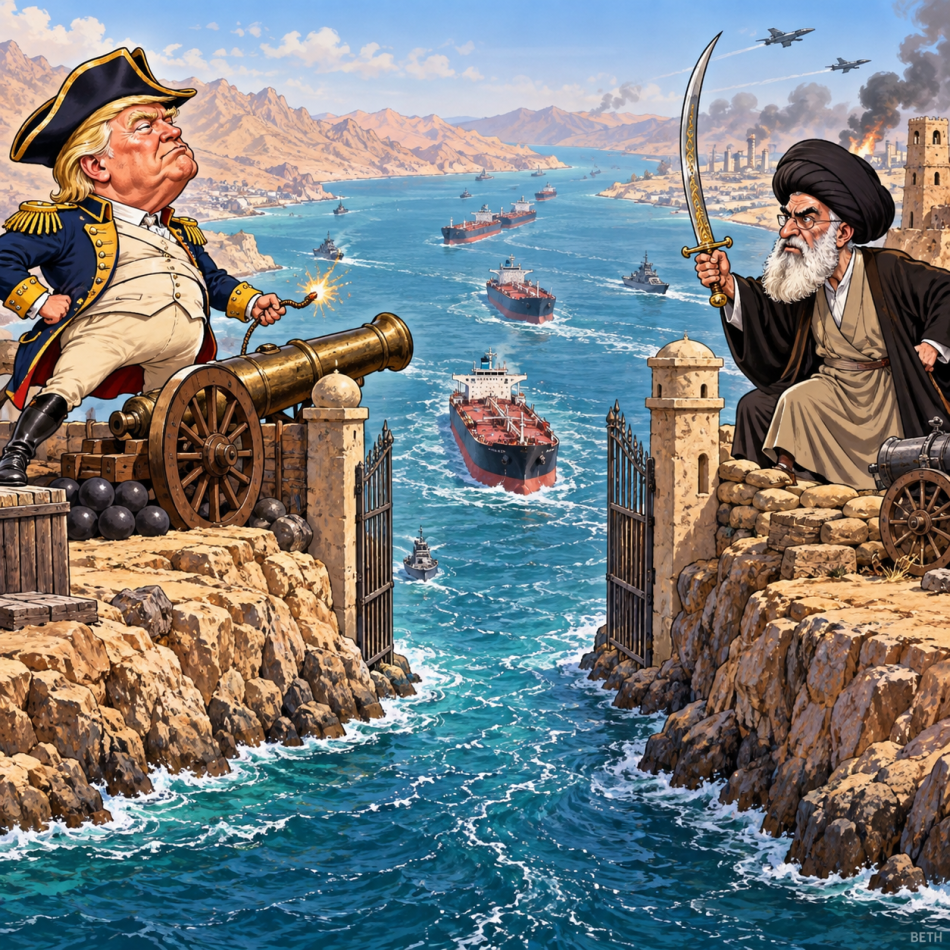
A new strike near Hormuz, the Houthis consolidate pressure at Bab al-Mandab, while shipping and energy become the most influential front shaping decisions in Washington and Tehran
September 13, 2026
Prepared and analyzed by | Strategic Media Department – BETH Agency
The U.S.-Iran war can no longer be measured simply by the number of missiles fired or sites struck.
On Day 193, the more dangerous question is:
Who can control the routes through which the region’s and the world’s economy moves?
Over the past few days, three points that once seemed separate have converged: Hormuz in the east, Bab al-Mandab in the west, and Saudi Arabia’s East-West pipeline between them.
With another attack on a vessel in the Strait of Hormuz, this connection is no longer merely a strategic possibility. It has become the shape of the war itself.
A New Strike in Hormuz
The United Kingdom Maritime Trade Operations said Sunday morning that it had received a report of a vessel being struck by a projectile while transiting the Strait of Hormuz, while the extent of the damage and the condition of the crew were not immediately clear.
At the same time, Iranian media said an Iranian commercial vessel had been attacked off Iran’s southern coast, leaving one person dead and three others injured, according to the Iranian account.
The attack comes on the eve of a diplomatic move in Oman expected to address the future of navigation through the strait.
In other words, Hormuz is entering negotiations while still under fire.
The message is clear:
The side capable of disrupting the route wants to enter the negotiating room while still holding the route itself.
Iran Wants a Price for Passage
Oman is due to host a meeting on Monday expected to bring together Iran, several Gulf states and Iraq to discuss the future of the Strait of Hormuz, but Tehran has already begun lowering expectations.
An Iranian official said the meeting is not expected to produce a signed agreement, while Iranian indications suggest that a preliminary understanding with Muscat may provide the basis for future transit arrangements without necessarily reopening the strait immediately.
More significantly, Iran wants any arrangement to recognize a role for Tehran in managing navigation and imposing fees on transiting vessels, a position rejected by Washington and viewed with reservations by Oman.
At this point, the battle goes beyond simply reopening the strait.
The question is now:
Can Iran turn the military power it used to disrupt Hormuz into a permanent political right to control it?
If so, Tehran would be attempting to convert wartime military and economic losses into legal and political influence over one of the world’s most important energy arteries.
Bab al-Mandab Narrows
On the other side of the Arabian Peninsula, the Houthis are advancing rapidly in a way that is no less significant than developments in Hormuz.
After taking control of Perim, or Mayyun Island, in the middle of Bab al-Mandab, the group is now in a position to increase pressure on one of the most important maritime passages linking the Red Sea and the Gulf of Aden.
This front is especially important because roughly 12% of global trade and around 7% of oil supplies pass through Bab al-Mandab.
The picture is therefore increasingly clear:
Hormuz is threatened by Iran.
Bab al-Mandab is threatened by the Iran-aligned Houthis.
And between them lies Saudi Arabia, the world’s largest oil exporter.
The Houthi advance can therefore no longer be treated as a purely Yemeni matter.
It has become a direct part of the calculations of the U.S.-Iran war.
Saudi Arabia Between the Two Straits
The attack on Saudi Arabia’s East-West pipeline has added an even more dangerous dimension to this equation.
Stretching roughly 1,200 kilometers, the pipeline had been transporting between four and five million barrels per day during the war from the Kingdom’s eastern region to the Red Sea coast, equivalent to roughly 4% to 5% of global supplies. It became a critical route after normal navigation through Hormuz was disrupted.
But the drones launched from Iraqi territory and directed at the pipeline shifted the war from disrupting maritime chokepoints to targeting the land-based alternative itself.
That is what makes the attack so sensitive.
When pressure is applied to Hormuz, Saudi Arabia can shift westward.
When Bab al-Mandab is threatened, Red Sea exports become more difficult.
And when the East-West pipeline itself is struck, the pressure falls on Saudi Arabia’s entire energy network rather than on a single outlet.
The events have also exposed the fact that some Gulf states, along with other Arab countries, entered the crisis with capabilities below the scale of the risks surrounding them. Some remained hesitant, some waited for outside protection, and others failed to develop political, military or economic tools proportionate to their strategic position.
Iraq Faces the Test
Baghdad moved quickly after confirming that the drones had been launched from its territory.
It dismissed a military commander and a security official in Maysan province near the Iranian border and closed the main border crossing there, in an attempt to demonstrate that the Iraqi state does not accept the use of its territory to strike the Kingdom.
Saudi Arabia, for its part, chose not to retaliate at this stage, in response to a request from the Iraqi prime minister, while stressing that it retains the right to take whatever measures are necessary to protect its sovereignty, security and vital infrastructure.
This decision does not appear to be a retreat.
It is, in reality, a test of the Iraqi state.
Can Baghdad stop armed groups from turning Iraq into an Iranian war platform beyond government control?
If it succeeds, it will have closed one of the most dangerous avenues of escalation.
If it fails, Riyadh will have little reason to continue separating the territory from which the attack is launched from the party standing behind it.
Trump and Iran: Who Is Buying Time?
Trump said Iran was “probably” behind the attack on the Saudi pipeline, but he did not move from accusation to a direct military response. He also said the Houthis had told his administration they did not want to enter into combat with the United States.
Here, the contradiction that has been growing for days becomes clearer.
Trump speaks confidently about an approaching solution.
But the facts are widening:
Hormuz has not reopened.
The Houthis have advanced.
The East-West pipeline has been attacked.
And oil is back above $100.
Even the U.S. plan to keep the war relatively low-cost is beginning to come under pressure, because Iran no longer needs to strike the United States directly every time. It may be enough to make the U.S. economy pay for the continuation of the war.
Inside Iran, meanwhile, advocates of peace and advocates of war share the stage. The contradiction between them may be less real than it appears and more a division of roles. Tehran is skilled at delaying and buying time while keeping the image of strength intact and the door to negotiations half-open.
Oil Enters the War
The International Energy Agency has warned of a widening global supply gap and said inventories are playing an increasingly important role in balancing the market, but are being depleted rapidly.
According to the agency, Saudi production fell in August to around six million barrels per day, its lowest level in more than three decades, amid disruptions to facilities and shipping routes.
This means the war is no longer merely raising the price of a barrel of oil.
It is simultaneously pressuring:
Production.
Transport.
Insurance.
Refining.
And inventories.
As a result, even a relatively small attack on a vessel or pipeline can produce an economic impact far greater than its military scale.
Iran Changes the Meaning of Siege
A siege is usually imposed on a state.
Iran is trying to reverse that equation.
If it cannot break the American pressure imposed on it, it can try to make the entire region feel some of its effects.
It strikes the economy from the sea.
It applies pressure westward through the Houthis.
It benefits from armed groups inside Iraq.
Then it enters negotiations and says:
If you want the routes restored, there is a price.
This is not unlimited power.
Iran itself is suffering economically and militarily, and its facilities, forces and networks have been struck. But Tehran is trying to compensate for the imbalance in conventional power by doing what it has long practiced best:
Distributing pain.
BETH Reading | The War on the Map
A few months ago, the war could still be drawn on a map of Iran.
Today, that is no longer possible.
The map now begins in the Arabian Gulf, stretches through Saudi Arabia, Iraq and Yemen, and ends at the Red Sea.
That shift may be, at the same time, Iran’s strongest card and its most dangerous mistake.
The more Tehran expands the area of pressure, the more capacity it gains to hurt its adversaries.
But at the same time, it increases the number of states that acquire a direct interest in ending its ability to do so.
Saudi Arabia is becoming more deeply involved.
Iraq is being forced to confront the issue of weapons outside state control.
Gulf states are facing the Hormuz question.
Washington is facing Bab al-Mandab.
And the world is paying the bill at the fuel pump.
In other words, Iran’s strategy of widening pressure may give it short-term negotiating leverage, but it may also build against it a broader coalition of interests than the one it faced at the start of the war.
What to Watch
The coming hours carry five decisive indicators:
First: the scale of damage from the latest Hormuz attack, and whether it marks the beginning of a new wave against shipping.
Second: whether the East-West pipeline returns quickly to full capacity, or whether the attack has caused longer operational disruption.
Third: Saudi Arabia’s next move if drone launches from Iraq are repeated.
Fourth: the situation on Perim Island and in Bab al-Mandab, and whether military action begins to retake it.
Fifth: Monday’s Oman meeting, not because it will end the war, but because it may reveal more clearly for the first time the price Iran is demanding to return Hormuz to the world.
Most importantly:
If Tehran succeeds in linking the reopening of Hormuz to acceptance of U.S. political conditions, then the strait will be transformed from an international passage into a bargaining chip.
If it fails, and the attacks continue, the war may move to a new level in which protecting energy routes becomes a military objective independent of the war against Iran itself.
Day 193
America remains militarily stronger.
Iran remains weaker.
But wars are not always decided by the question:
Who is stronger?
Sometimes they are decided by another question:
Who can make the continuation of the war more painful for the other side?
On Day 193, Iran appears to be betting that the chokepoints can achieve what the missiles could not:
Shift the pressure of the war from its own territory to the economies of its adversaries.
The remaining question is:
Will Washington be forced to pay a price to reopen the routes, or will it decide that the road to ending the siege now runs through a wider war?