


World Press Today, September 12 | BETH Eyes
Saudi Arabia moves to the center of the picture after the East-West Pipeline is targeted from Iraq and the Houthis advance toward Bab el-Mandeb; the global press increasingly reads the war as a struggle over energy routes, BRICS tests its ability to produce a unified position, while artificial intelligence moves deeper into weapons development and warfare
September 12, 2026
Monitoring and Analysis | Strategic Media Department – BETH Agency
Supervision: Abdullah Al-Omairah
The global press this morning is no longer asking only who is advancing militarily in the U.S.-Iran war.
The question being repeated in different forms has become:
Who controls the route?
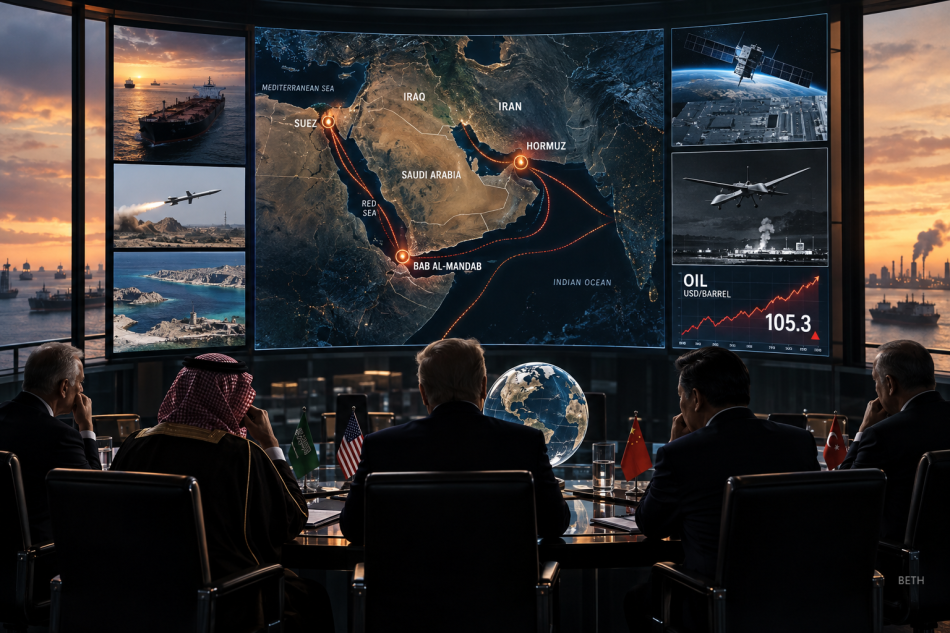
Within hours, three names appeared together before the world’s media with an intensity not seen before: Hormuz, Bab el-Mandeb, and Saudi Arabia’s East-West Pipeline.
From Washington to London, Paris, Beijing and New Delhi, a new reading is taking shape: the war has gradually moved from targeting military power to testing the world’s ability to keep energy and trade moving.
BETH Selection | Opinion
Washington | Bab el-Mandeb as an Iranian Card
The Washington Post argues that the Houthi advance along Yemen’s western coast and their arrival at Perim and Bab el-Mandeb cannot be separated from the U.S.-Iran war. With Hormuz under pressure, control of the southern entrance to the Red Sea gives Tehran an additional source of leverage over Washington and the global economy. The American reading does not view the Houthis as a separate Yemeni front, but as part of the widening range of Iranian influence in the war.
London | The World Is Losing Its Brakes on Escalation
In The Times, the analysis takes a broader and more pessimistic view: the crises involving Iran, Ukraine, energy, and the global economy are no longer moving separately, but are increasingly feeding into one another, while international leaders appear less able to halt escalation. The British reading concludes that the danger no longer lies in any single crisis, but in the fact that escalation itself is becoming the default behavior of the international system.
And the combination of the two is particularly revealing: the Washington Post explains where Iran is gaining a new card, while The Times asks what happens to the world when the cards and crises keep accumulating without brakes.
The World Discovers a Network of Chokepoints
Developments in Saudi Arabia and Yemen are leading the coverage of major international news agencies and newspapers.
Coverage has placed the temporary shutdown of the East-West Pipeline alongside the Houthi seizure of Perim, treating the two developments as simultaneous pressure on both sides of the Arabian Peninsula, while other reporting has focused on the Houthi advance at Bab el-Mandeb as giving Iran an additional card in its confrontation with the Trump administration.
The angle of coverage has therefore changed.
The issue is no longer simply the closure of Hormuz.
It has become:
What happens if the alternatives themselves come under pressure?
This is perhaps the most important idea in the world press today.
Washington | Iran Expands Its Cards
The American press views the Houthi advance as part of the broader balance of power with Iran, not merely another round in the Yemen war.
The Washington Post argued that the Houthis’ arrival at Bab el-Mandeb could increase Tehran’s leverage against the Trump administration, especially now that the passage has become more important amid disruption in Hormuz.
But another form of pressure is also emerging inside the United States.
Diesel prices have reached record levels, U.S. Treasury yields are approaching 5%, and the cost of energy has pushed the war back into the domestic debate over inflation and interest rates.
The foreign war is beginning to enter America’s domestic calculations through fuel stations and bond markets, not through the Pentagon alone.
London | Fear Moves into Prices
The British press is focusing on what the convergence of the Hormuz, Bab el-Mandeb and East-West Pipeline crises means for markets.
The Times placed the pressure on Saudi Arabia and the pipeline shutdown within a broader tightening of oil routes, while Brent remained above $100 and European gas and bond markets came under renewed inflation pressure.
London therefore starts from a different question than Washington:
The issue is not who wins the war, but how much the consumer will pay if it continues.
Paris | Saudi Arabia in a Strategic Test
Le Monde offered one of the sharper readings, portraying Saudi Arabia as facing simultaneous pressure from Iran in Hormuz and the Houthis at Bab el-Mandeb, while Washington shows less appetite for direct military involvement.
We may differ with the degree of pessimism in that assessment, but it reveals an important French angle:
Europe is beginning to see Saudi Arabia as a central point in the test of global energy security, not merely as an oil-producing state.
What strikes a Saudi route today may appear tomorrow in the cost of transport, insurance and energy inside Europe.
New Delhi | BRICS Faces the Test of War
In India, the BRICS summit is overshadowing many other files.
The summit brings together 11 countries at a moment when the wars in the Middle East and Ukraine, as well as U.S.-China tensions, are testing the bloc’s ability to reach agreement despite conflicting interests among its members.
The striking development is that, according to Indian media, member states have reached agreement on wording related to the Iranian war after earlier disagreements among some members, particularly Iran and the UAE.
If that consensus appears clearly in the New Delhi declaration, BRICS will take on a meaning that goes beyond economics:
Can the “Global South” produce a political position when war occurs between its members or along the edges of their interests?
That is the real test of the bloc.
Beijing | War and Money Converge
Asian media, including the South China Morning Post, have given significant space to the closure of the East-West Pipeline, viewing it as a route that has become more important as tanker traffic through Hormuz has been disrupted.
At the same time, Chinese attention is turning to turbulence in the U.S. bond market and to Xi Jinping’s expected visit to Washington, with expectations that he will be accompanied by senior executives from the technology, aviation and automotive sectors.
The picture in Beijing is clear:
The world is fighting over corridors, while China is trying to enter Washington with trade and investment.
Artificial Intelligence Enters the Weapons Field
Another story deserves attention away from oil.
Anthropic said it had detected the use of AI tools by developers linked to Russia in developing software for autonomous attack drones, while it also identified accounts in northern Yemen using its models to work on guidance technologies and long-range missiles.
This does not mean that artificial intelligence built the weapon by itself.
But the dividing line is becoming thinner:
The program that writes civilian code in the morning may help someone else write part of a weapons system in the evening.
This is a file whose importance will grow significantly after this war.
Saudi Arabia in the Global Press
Saudi Arabia is not a side story today.
Reuters, the Associated Press, Le Monde, The Times and Asian newspapers have placed the Kingdom near the top of their coverage because three developments are converging: the targeting of the East-West Pipeline by drones launched from Iraq, the Houthi advance toward Bab el-Mandeb, and the continued disruption in Hormuz.
But one detail deserves attention.
Riyadh’s decision not to respond to Iraq at this stage gave Baghdad an opportunity to rein in the armed groups involved, while Saudi Arabia retained its right to protect its security and sovereignty.
This will become a major point of international scrutiny:
Can Iraq shut down the launch platform, or will the problem of controlling militias shift from a domestic Iraqi issue into a regional security question?
Arab Press Brief | From the Atlantic to the Gulf
The Arab press is converging today around three files:
Saudi Arabia and Iraq, where the question of Baghdad’s ability to control armed factions is moving to the forefront.
Yemen, where Bab el-Mandeb has become a strategic issue larger than the local battlefield.
And Hormuz, where the region is awaiting Monday’s Oman meeting in search of a more stable maritime passage.
Across Gulf and Arab coverage, one idea is becoming increasingly clear: Houthi moves are no longer being read only within Yemen’s internal balance of power, but within the regional struggle over shipping and energy.
Inside the Capitals | Each Country Has Its Own Concern
In Washington: the cost of war, elections, inflation, and the limits of endurance.
In London: oil, gas, interest rates, and the fear that the Middle East war will reach the consumer’s pocket.
In Paris: Saudi security and maritime routes, and the need to rethink Europe’s dependence on energy corridors exposed to conflict.
In Moscow: Ukraine has not disappeared. Putin warns that deploying European forces inside Ukraine would mean direct confrontation with Russia, while Kyiv calls on Washington for tougher sanctions.
In New Delhi: BRICS is trying to prove that it is more than a group photo of different leaders.
And in Beijing: money, trade and technology are moving in parallel with close observation of a war that could reshape the international order in which China seeks greater weight.
Indicator Pulse
Brent remained near $105 a barrel after approaching $110 during the latest surge.
The East-West Pipeline, which has become a strategic route for bypassing Hormuz, was shut down as a precaution after the attacks.
Bab el-Mandeb, through which around 12% of global trade passes, is under direct military pressure following the Houthi arrival at Perim.
And in the United States, rising energy costs are bringing inflation and interest rates back to the forefront of market calculations.
BETH Eyes
A few days ago, the question was:
Can Iran keep Hormuz unstable?
Today, the question is larger:
Can the global trading system keep the alternatives to Hormuz safe?
That is a major shift.
The strength of a maritime route does not come only from the number of ships that pass through it, but also from the number of alternatives available when it is disrupted.
And when the alternative itself becomes a target, the equation changes.
But this strategy carries its own contradiction.
Every new route that enters the danger zone adds another state or economy to the list of those affected; and the longer that list becomes, the more likely it is that an international coalition will form to protect the corridors.