


World Press Today — September 8 | BETH Eyes
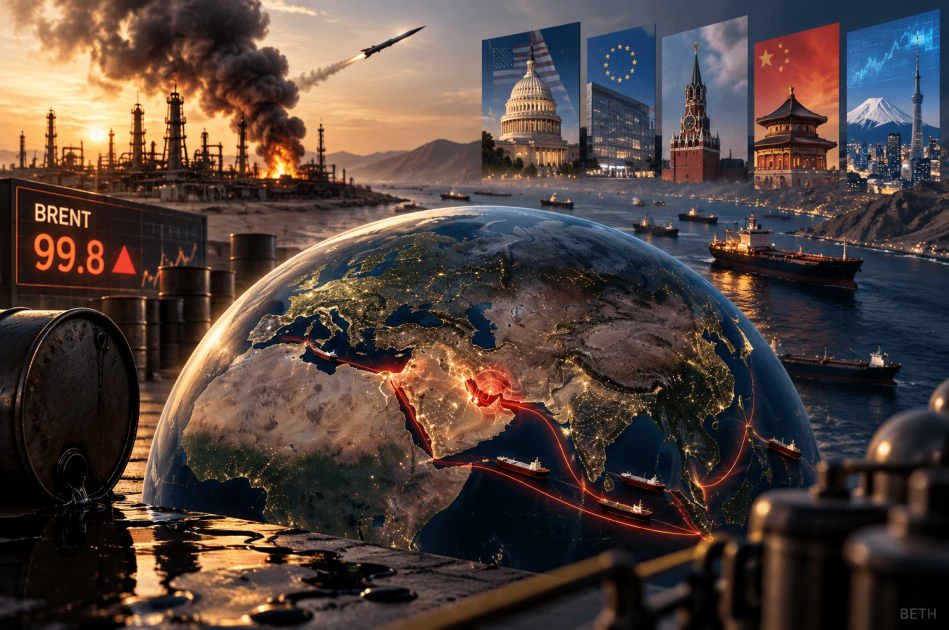
Global media coverage begins today from almost the same point: the widening cost of war. The attack on Saudi energy facilities pushed oil toward $100, while pressure on Hormuz persisted. Russia resumed striking Kyiv after the departure of US envoys, and Europe’s concern deepened over the rise of the right and the race for artificial intelligence. In Asia, China posted striking export figures even as markets retreated under the weight of energy fears.
Monitoring and Analysis | Strategic Media Department – BETH Agency
Supervision: Abdullah Al-Omairah
Washington | The War Reaches the Voter’s Pocket
In the American press, the war with Iran is no longer being viewed solely through a military lens.
Houthi attacks on Saudi energy facilities, combined with Brent crude rising toward $98–99, have pushed fuel and inflation back to the forefront of US domestic concerns, as Republicans prepare for the midterm elections and Donald Trump seeks to turn them into a referendum on his leadership and economic record.
Washington’s problem is that every success in tightening pressure on Iran may later appear in the form of higher gasoline prices, more expensive shipping, and more difficult inflation.
The American voter is therefore beginning to see the war from the gas station, not from Pentagon briefings.
Europe | Politics Shakes as War Returns to Kyiv
Europe is waking up to three simultaneous files.
The first is German. The Alternative for Germany’s result of around 44% in Saxony-Anhalt continues to shake the European political debate, placing pressure on traditional parties and testing the political “firewall” designed to keep the far right from power.
The second is Ukrainian. Russia resumed strikes on Kyiv with ballistic missiles and drones after a brief pause that coincided with the visit of US envoys Steve Witkoff and Jared Kushner, in timing that is difficult to separate from the stalled diplomatic track.
The third is technological. French company Mistral raised €3 billion, lifting its valuation to around €21 billion in the largest funding round for a private technology company in Europe, as the continent seeks to narrow the artificial intelligence gap with the United States and China.
In the background, Brussels is also moving toward Greenland through a €200 million partnership agreement, a clear sign that the island is no longer a remote geographical issue but part of the strategic competition in the Arctic.
Asia | China Exports Its Strength
The most striking Asian figure today came from Beijing.
China’s exports rose 25% year-on-year in August, while imports increased by 28.2%, driven by strong demand for technology products, electric vehicles, semiconductors, and AI-related components. The trade surplus reached around $119 billion.
The message is clear:
China’s domestic economy is still struggling, but external demand is carrying an increasing share of growth.
Meanwhile, most Asian markets declined amid the escalation of war and rising oil prices. Japan’s Nikkei fell 1.7% as the yen strengthened, despite second-quarter growth being revised upward to 1.4% on an annualized basis.
In Southeast Asia, Manila continues to interpret every adjustment in the US military presence as a potential opportunity for China. The Philippine defense secretary warned that cuts to US-South Korean exercises could encourage Beijing to expand its influence in the region.
Middle East | Energy Becomes a Front
This is where today’s biggest story lies.
Houthi attacks on energy facilities and economic targets in southern Saudi Arabia, which injured 73 civilians, have pushed international media from asking, “Will Hormuz remain open?” to a broader question:
Will the Gulf energy system remain secure?
In Hormuz, shipping activity declined again, with only seven commodity vessels passing through on Monday amid continued Iranian threats and expectations that disruptions to shipping may persist for longer.
Inside Iran, AP presents a quieter but perhaps even more revealing picture. Bandar Abbas, once one of the country’s most important commercial arteries, is facing a sharp decline in work and income as the US blockade tightens, trade activity falls, jobs disappear, and prices rise.
The press today sees the war in two places at once:
In a burning oil facility, and in an Iranian shop with no customers.
Saudi Arabia in the Global Press
Saudi Arabia’s presence in international coverage today is exceptional.
American and international media, including the Financial Times, placed the targeting of Saudi energy facilities at the center of their coverage, not only because of the local impact, but because markets treat Saudi Arabia as a stabilizing anchor for global energy.
With Brent crude nearing $100, the international question is becoming less about the current scale of damage and more about whether the attacks could become a recurring pattern that imposes a permanent risk premium on oil, shipping, and insurance.
Inside Saudi Arabia, there are parallel signs of continued expansion in the economy of the future. Al Riyadh reported that the number of commercial registrations linked to artificial intelligence has reached around 19,000, up 34%, while the Riyadh Economic Forum continues to focus on sustainable development.
The Saudi contrast today is striking:
On one side, the energy infrastructure that built the Kingdom’s economic weight is being targeted; on the other, a new economy based on artificial intelligence and technology is growing.
Arab Press Brief | From the Atlantic to the Gulf
War, energy, and maritime security dominate Arab headlines today, but domestic priorities still differ from one country to another.
In Saudi Arabia, Houthi attacks, protection of infrastructure, deterrence, and the course of operations in Yemen lead the agenda, alongside continued attention to the economy and artificial intelligence.
In the UAE, attention includes raising the decent-living threshold for Sharjah government employees to AED 20,000 per month, alongside high-level political contacts with Washington and continued focus on energy security and trade amid the Gulf crisis.
In Qatar, coverage focuses on the need to reopen Hormuz and avoid what Doha has described as an “industrial catastrophe,” reflecting the global economy’s sensitivity to continued disruption of the passage.
In Kuwait, newspapers are highlighting developments in Lebanon, the future of the south, Hezbollah, and the possibility of a European force replacing UNIFIL if its role changes.
In Iraq, concern remains focused on the state, armed factions, the consequences of the US-Iran confrontation, and the possibility of pressure from the war spilling into Iraqi territory.
In Lebanon, attention centers on Israeli escalation in the south, the question of Hezbollah’s weapons, and what might fill the vacuum if UNIFIL’s role changes.
In Jordan, economic and public-service issues remain prominent, alongside interest in religious tourism and Jordanian-Palestinian relations.
In Egypt, energy costs, markets, the exchange rate, and economic pressures remain central, with close monitoring of how higher oil and shipping costs may affect the domestic economy.
Across the Maghreb, headlines lean more toward domestic issues, from the economy, purchasing power, and public services to major local incidents such as the road accident in Algeria that killed ten people in Tizi Ouzou.
Inside the Capitals | Every Country Has Its Concern
Washington: Midterm elections, inflation, and how Trump can keep his base mobilized as the cost of war rises.
Berlin: How traditional parties should respond to the Alternative for Germany after it reached 44% in a German state, and whether political isolation can still hold.
Paris: How Mistral can become a European technological sovereignty project, and whether Europe can genuinely narrow the vast funding gap with American companies.
Kyiv: Peace arrives with envoys, then missiles return after they leave; a paradox that captures the dilemma of the diplomatic process.
Beijing: Exports are carrying growth, and technology has become one of China’s most powerful economic weapons.
Tokyo: A stronger yen and higher oil prices are weighing on stocks and exporters despite improved growth figures.
Abu Dhabi: Energy security is no longer only about protecting facilities, but also about building alternative export routes and reducing dependence on vulnerable maritime chokepoints.
Riyadh: Protecting energy infrastructure and responding to the Houthis now take precedence over everything else; but the deeper question is how the Kingdom can preserve its role as a source of stability while the region is being pushed toward further escalation.
BETH Eye
The clearest message from this Tuesday’s press is that events no longer remain where they begin.
A missile in southern Saudi Arabia becomes a fuel price in America.
A threat in Hormuz becomes an interest-rate question in Europe.
The rise of a party in a German state becomes a question about the future of the European Union.
And a chip factory in China becomes part of the global balance of power.
Saudi Arabia, meanwhile, has found itself at the center of this network today; not because it is a party to the US-Iran war, but because the stability of its energy sector has become part of the stability of the global economy itself.
The world is no longer living through separate crises; it is living through one interconnected crisis that moves from geography to economics, from economics to politics, and then returns to ordinary people.