



Day 187: Iran Redraws Hormuz
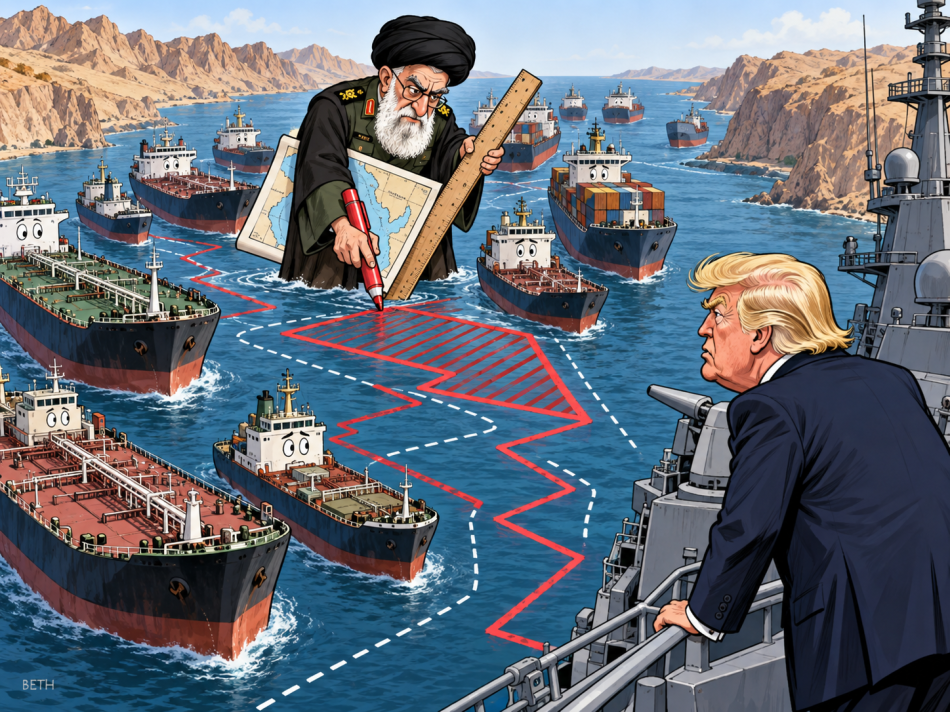
Tehran announces a restricted maritime zone and new navigation maps, while Washington signals the possibility of a war without a nuclear deal; oil approaches $100 and the Strait enters a more dangerous phase
September 7, 2026
Prepared and Analyzed | Strategic Media Department – BETH Agency
The U.S.-Iran war entered its 187th day on Monday as the confrontation in the Strait of Hormuz moved to a new level — beyond exchanging strikes toward an attempt to impose new rules of navigation.
Iran announced that it will unveil in the coming days a new restricted maritime zone in the Gulf and new navigation maps for Hormuz, warning that vessels entering the area without complying with Iranian rules could be placed on a sanctions list.
The announcement follows several days of escalating maritime clashes, including U.S. strikes on three Iranian tankers and Iranian actions against vessels and naval assets that Tehran said were using unauthorized routes.
In a parallel political development, U.S. Energy Secretary Chris Wright said a nuclear agreement with Iran may not be possible in the near future, suggesting Washington might have to wait for “a future Iranian administration.” He added that the alternative could simply be to prevent Iran, through military action, from rebuilding its nuclear capabilities.
Wright also suggested that the U.S. naval presence in the region could become a “new normal” to ensure the safe passage of commercial vessels, declining to describe Hormuz as secure without U.S. naval protection.
Meanwhile, U.S. forces rejected Iran’s claim that it had struck an unmanned American vessel in the strait, describing the report as false.
Oil Approaches $100
The escalation was immediately reflected in global markets.
Brent crude rose to around $97.5 a barrel on Monday morning, while U.S. crude climbed above $92 amid growing fears of further supply disruption.
Commodity tanker traffic through the strait has fallen to an average of roughly 10 vessels a day over the past ten days, its lowest level since May — an indication that the danger is no longer merely military, but is developing into an actual constraint on trade and energy flows.
At the same time, the U.S. blockade continues to put pressure on Iranian oil exports, which have fallen sharply, reducing Tehran’s access to foreign currency and adding further strain to its domestic economy.
Analysis
Day 187 marks an important shift:
Iran is no longer merely threatening Hormuz; it is attempting to regulate it on its own terms.
The announcement of a restricted zone and new navigation maps suggests that Tehran wants to transform its military influence in the strait into de facto authority.
Washington’s language is changing as well.
Months ago, the discussion centered on a nuclear agreement that might end the war. Today, the U.S. position increasingly opens the door to a different scenario:
No agreement — but continued pressure, blockade and strikes whenever necessary.
That raises the possibility that the war is shifting from an operation with a clearly defined political endgame into a prolonged state of confrontation.
What Comes Next?
The nearest danger is not necessarily a major air strike.
The more immediate risk will emerge when Iran begins enforcing the restricted zone.
If Tehran attempts to stop or divert a commercial vessel while the U.S. Navy chooses to escort it through by force, the result could be the direct confrontation that both sides have so far tried to keep under control.
On the other hand, if Washington avoids challenging Iran’s new rules, Tehran could portray that domestically and internationally as practical recognition of its authority over navigation in the strait.
Hormuz therefore faces an increasingly sensitive equation:
Either Iran imposes its rules, or the United States tests its ability to break them.
Between those two possibilities, the next confrontation over a single vessel could be enough to trigger a much broader round of the war.
Weakness — or a Managed War?
What is happening raises a legitimate question:
Does Iran’s growing boldness reveal American weakness, or is Washington managing the war in a way that leaves its full objectives hidden beneath the surface?
The facts so far point more toward the second possibility than the first.
The United States has the military capability to expand its strikes and has simultaneously succeeded in constraining Iranian exports and financial activity. Yet Washington is not moving toward comprehensive military resolution. Instead, it is keeping the war within a framework that allows the continuation of economic blockade, military pressure and influence over energy flows and maritime routes.
That helps explain the apparent contradiction:
Iran looks increasingly assertive in Hormuz while remaining under severe economic pressure; the United States appears reluctant to seek a decisive military conclusion while expanding its military presence and demanding a broader agreement than previous understandings offered.
The more relevant question, therefore, may not be:
Why can’t America end the war?
But rather:
Why does it not want to end it now in the way it is capable of doing?
A prolonged period of pressure can serve several strategic interests: gradually weakening Iran, reshaping Gulf security arrangements, increasing the region’s dependence on military protection, and establishing a new reality around energy security and freedom of navigation.
Iran, meanwhile, understands that the balance of power is not in its favor. It is therefore relying on the weapons it can still use effectively: time, Hormuz and the ability to raise the cost of the war for everyone else.
The picture is therefore more complex than simply saying “America is strong and Iran is weak”:
America manages power; Iran manages disruption — and the region understands that if this game continues in its current form, it too will begin recalculating its choices.