


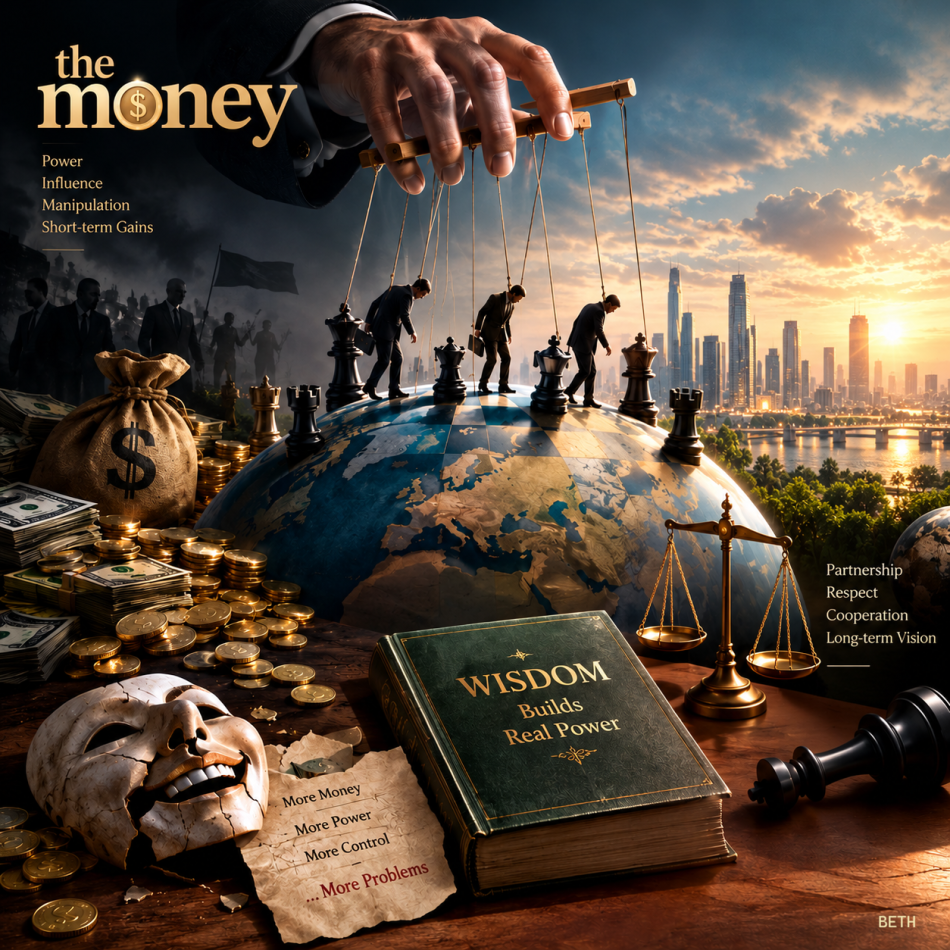
Trump .. The Businessman President
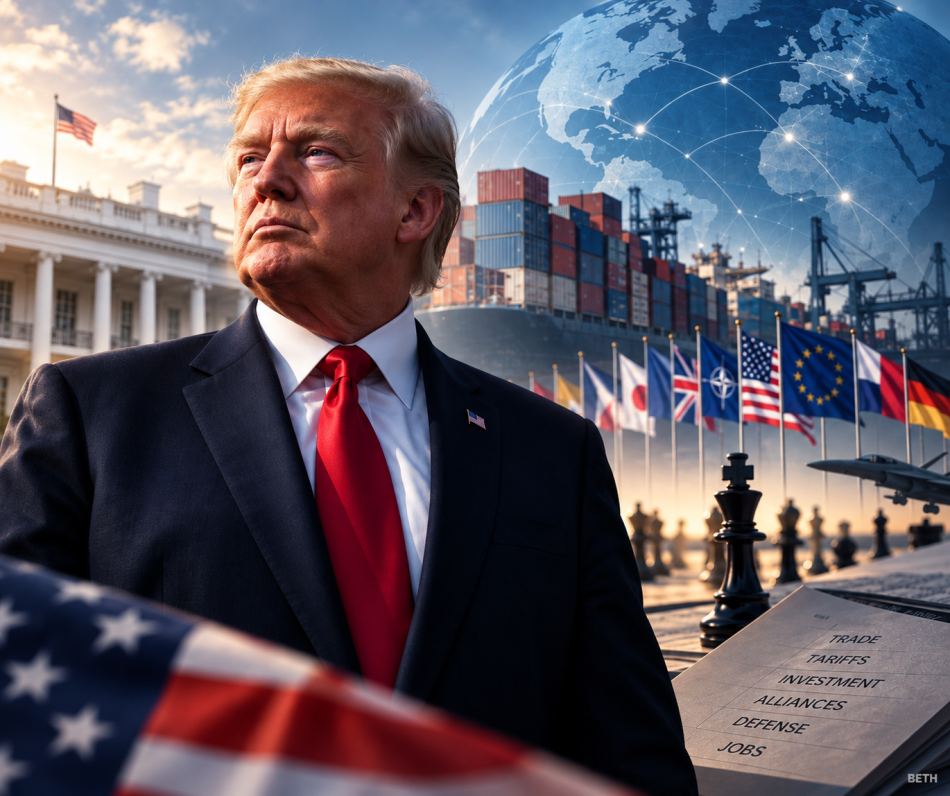
Does Donald Trump use money to serve American power, or does he use American power to extract money? And can the logic of the deal govern a country that leads the world?
Prepared and analyzed by | Strategic Media Department – BETH Agency
Supervision: Abdullah Al-Amirah
When U.S. President Donald Trump talks about war, he mentions its cost.
When he talks about allies, he asks what they are paying.
When he discusses trade, he starts with deficits and tariffs.
And when he announces an agreement, he highlights the investments, contracts and jobs that will return to the United States.
These are not scattered expressions in Trump’s rhetoric. They amount to a broader way of understanding politics:
The market is an asset, protection has a price, alliances are partnerships in cost-sharing, and influence should produce a return.
Trump believes the United States has provided the world for decades with security, market access, a global currency and military protection, while some allies paid less than they should have and some rivals benefited from the U.S. market more than they opened their own.
That is why he entered the White House with the instincts of a businessman:
Review the books, reprice the relationships, and obtain a return on power.
But a state is not quite a company.
And that is where the real question begins:
Is Trump correcting an old imbalance in the management of American power, or could excessive pricing of that power gradually reduce the value of assets that do not appear on any balance sheet?
What Did Trump Get Right?
It would be unfair to reduce Trump’s approach to greed or coercion.
He identified a genuine imbalance in the distribution of the burdens that sustain the international system.
For decades, European countries benefited from the American security umbrella while spending less on defense than Washington wanted.
As threats increased, and under pressure from Trump in particular, NATO allies committed at the 2025 Hague summit to raise defense and security spending to 5% of GDP by 2035. The original draft also notes the significant rise in European and Canadian defense spending and NATO leaders’ acknowledgment of Trump’s role in pushing that shift.
Here, the logic of money can be useful:
By making protection measurable, Trump made allies more aware that security is not a free American service.
The same approach brought other long-neglected questions back into the U.S. debate:
Why should America keep its market open while other countries place barriers in front of American exports?
And why should Washington carry a larger share of the security bill when other countries benefit from it?
These are legitimate questions, even if the answers remain contested.
Tariffs | Who Pays?
Trump presents tariffs as a way to make foreign countries pay for access to the American market.
But the economics are more complicated.
Tariffs are initially paid by the U.S. importer, after which the cost is distributed to varying degrees among companies, suppliers and consumers.
They have increased Treasury revenues and encouraged some companies to reshape supply chains, expand domestic production and increase automation.
But they have also raised prices, with Americans bearing part of the cost. The original draft cites Federal Reserve estimates showing a measurable effect on goods prices and core inflation.
That creates a notable paradox:
Trump can prove that tariffs raised money, but he cannot always prove that foreigners alone paid it.
A State Is Not a Store
A company can shut down a branch that fails to generate a return.
A great power may remain in an expensive region because leaving could create a vacuum that a rival fills, with costs that later exceed whatever was saved.
A company can replace a customer.
An ally, however, may be a military base, an intelligence source, a port, an air corridor or a political vote.
A state also cannot measure success through one year’s profits, because it holds assets that are difficult to place in a spreadsheet:
trust, deterrence, reputation and durable alliances.
An alliance that produces no direct revenue may prevent an enormously costly war, while diplomacy that generates no contract today may preserve influence for decades.
The value of a great power lies not only in what it collects, but also in what it can prevent from happening.
That is where Trump’s challenge becomes more subtle.
Asking allies to pay more may make them more responsible, which can be positive.
But if an ally begins to feel that the relationship itself is a service constantly subject to repricing, it may start building alternatives that are not merely financial, but political as well.
An ally can be pushed to spend more, but trust cannot be purchased in quite the same way.
Power and the Deal
Trump makes no secret of his admiration for arms contracts, investments and the jobs they create.
That does not mean he fights wars to sell weapons. The evidence does not support such a conclusion.
But it is clear that he also sees an economic return in military power: a larger defense industry, jobs, allied contributions and new contracts.
There is nothing inherently wrong with that.
The real question is:
Does the financial return remain a consequence of power, or does it become the standard by which the use of power is judged?
A war that produces contracts worth billions of dollars can still fail if it does not achieve its political objective.
Conversely, a financially costly operation may succeed if it prevents a much greater threat.
That is where the calculations of a state diverge from those of a company.
For Whom Is Trump Building Power?
One question cannot be answered by numbers alone:
Does Trump want to leave America stronger because that is the legacy of the 47th president, or because it is the country in which Americans will live after he is gone?
The answer may be both.
Presidents think about history as well as the present, and Trump is especially conscious of legacy, strength and achievement.
But there is an important difference between American power as an end in itself and American power as a tool to serve citizens, protect allies and sustain influence.
If power remains a means, it serves the state.
If it becomes an end in itself, it may become more successful at imposing control than at building the future.
The State’s Money and the Family’s Money
This remains the most sensitive part of the discussion and therefore deserves the greatest care.
There is a distinction between two questions:
Do Trump’s policies generate returns for the United States?
And:
Do his family’s businesses benefit from the political environment created by the presidency?
The original draft draws on reports of substantial revenues earned by Trump-linked businesses from deals in the Middle East, cryptocurrency and real estate. At the same time, it makes clear that these figures do not by themselves prove a legal violation, nor do they prove that a political decision was made in exchange for a private benefit.
That is where the analysis should stop.
This is not an accusation. It is a question of perception.
When private business interests intersect with countries and companies that are also affected by White House decisions, preserving a clear line between the interests of the state and the interests of the family becomes important to the presidency itself.
The greater risk may be to public trust before it becomes a legal question.
What Does Not Appear on the Balance Sheet
Trump’s strength lies in asking a question politics long ignored:
How much do we pay, and what do we get?
It is a healthy question.
It becomes less safe only when it turns into the only question.
A balance sheet can calculate the tariffs that entered the Treasury.
It cannot easily calculate the trust that left.
It can record the value of an arms contract, but it does not record the value of an ally beginning to search for alternatives.
It can calculate a country’s contribution to the cost of a military base, but it cannot immediately measure the value of that country continuing to stand beside Washington in a moment of danger.
And this is the central paradox:
Trump clearly sees the assets of American power that others have long benefited from at relatively low cost, and he wants a price for them.
That may be a necessary correction.
But some of America’s greatest assets do not carry price tags.
Influence has value.
Trust has value.
The ability to rally allies behind an American decision has value.
Yet these values do not always appear in the accounts until they begin to decline.
That is why a businessman’s mindset can be a major advantage for a president when it prevents him from wasting his country’s resources.
It becomes a risk only when it persuades him that anything that cannot be priced has no value.
The United States did not become a superpower simply because it was the richest country, but because many countries saw their interests in a system led by Washington.
Trump may therefore be able to run a significant part of the state with a businessman’s mind.
But managing a power that leads the world requires a broader ledger, because some of its most valuable assets reveal their true worth only after they are lost.