



Saudi Education Spending Jumps 133.9% to SAR 1.04 Billion in One Week
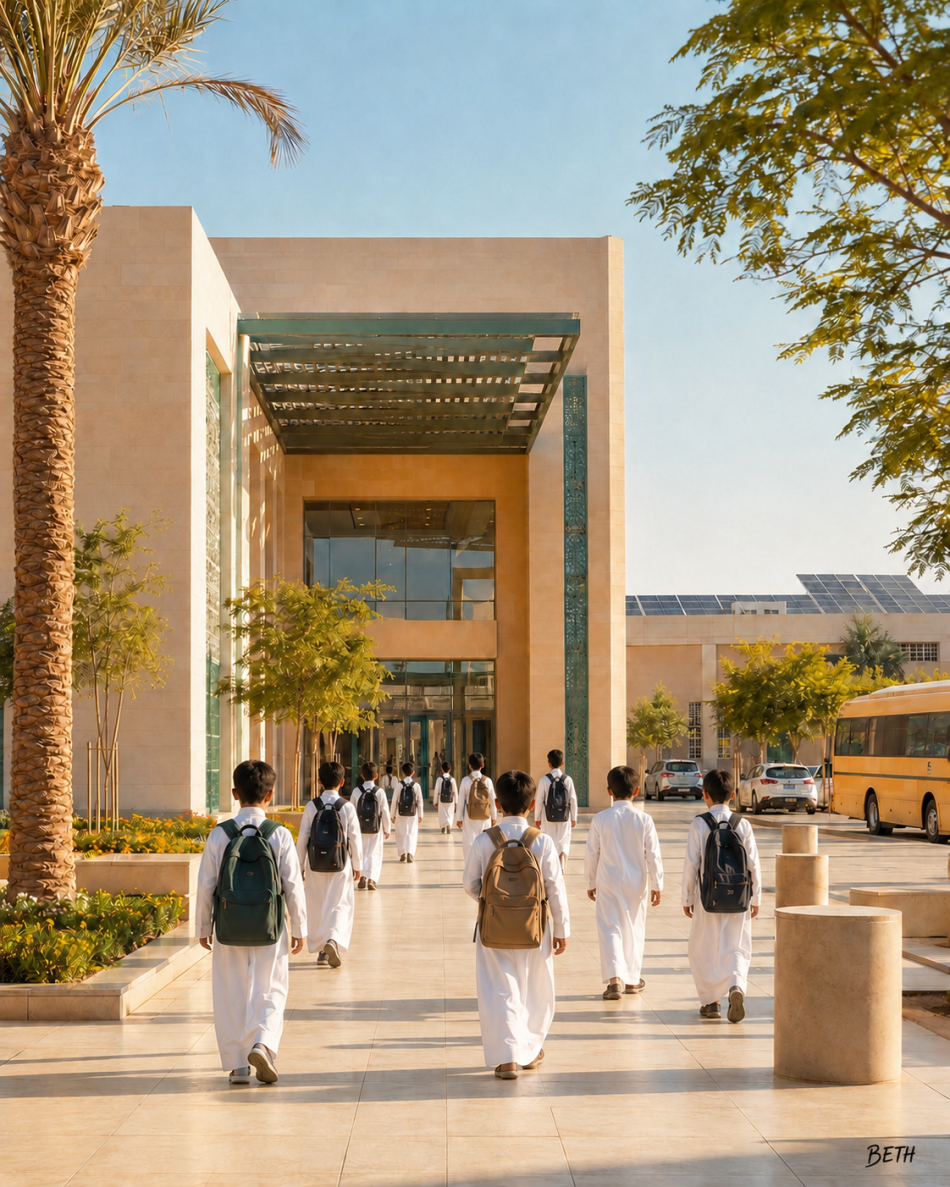
The surge comes as the total value of point-of-sale transactions remains nearly unchanged at SAR 14.17 billion, revealing a reshuffling of household priorities and showing how the seasonal effect extends across retail, transport and service sectors
Riyadh | Economic Report | BETH
A week has passed since most students across Saudi Arabia returned to school, while students in Makkah, Madinah, Jeddah and Taif begin their academic year today. Yet preparations for the new school year did not begin with the first ring of the school bell: the academic calendar had been announced well in advance, and return dates were known to families, markets and schools.
Even so, the recurring pattern of seasonal purchasing shows that advance knowledge of a date does not always translate into early preparation. A large share of purchases is concentrated in the final days, crowding shops and roads and increasing pressure on families, retail outlets and related services.
This is not a pattern confined to the return to school. It recurs during Ramadan, Eid holidays and national occasions: we know the date months in advance, then shop as though we learned of it only the night before.
The figures for the week ending August 22 do not mean that spending on the school year was confined to that week. Purchases began earlier and continued afterward. They do, however, provide a clear window into the point at which education spending reached its peak and show how families reordered their priorities as the return to school approached.
During that week, point-of-sale spending in the education sector jumped 133.9% from the previous week to SAR 1.04 billion, while the number of transactions in the sector rose 55.7%.
That billion riyals is not the full bill for the season. It is only the portion captured by point-of-sale data during a single week. It excludes spending in the preceding and subsequent weeks, as well as payments made outside point-of-sale systems.
At the same time, the total value of point-of-sale transactions across the Kingdom remained nearly unchanged at SAR 14.17 billion, slipping by just 0.1%, while the number of transactions declined 4.9% to 237.35 million.
This is where the real economic story emerges:
The spending wallet did not expand significantly; it rearranged its contents in favor of school.
A Surge amid Stability
The significance of the figure lies in the fact that it did not occur during a broad rise in consumer spending. Instead, it appeared while the overall market remained nearly stable.
This suggests that the return to school did not add entirely new spending to household budgets as much as it prompted families to redistribute their expenditure and prioritize education-related needs over other items.
Spending on books and stationery rose 30.2% to SAR 155.18 million, while expenditure on clothing, footwear and accessories increased 1.7% to SAR 1.26 billion.
By contrast, spending on food and beverages declined 4.1% to SAR 2.11 billion, while expenditure at restaurants and cafés fell 8.6% to SAR 1.67 billion.
Not every rise or decline can be attributed to the school season alone, as weekly spending is influenced by multiple factors. Nevertheless, the coincidence of the education surge with declines in other consumer sectors clearly reveals a shift in priorities within household budgets.
The return to school does not merely open the schoolbag; it rearranges the entire wallet.
More Than Stationery
The economic effect of the return to school does not stop at tuition fees, books, schoolbags and clothing.
It extends to transport, fuel stations, telecommunications, professional services, maintenance, delivery services and e-commerce, as well as small shops located near schools.
During the week, spending in the transport sector reached approximately SAR 1.04 billion. Point-of-sale transactions at fuel stations amounted to SAR 960.41 million, while spending on professional and business services reached SAR 800.66 million, and healthcare expenditure totaled SAR 798.52 million.
The similarity between some of these figures does not mean that the school season generated all of them. It does, however, illustrate the scale of the economic ecosystem moving in parallel as millions of families return to their daily school routines.
The student returns to the classroom, but alongside that student move the family car, the school bus, the fuel station, the clothing shop, the bookstore, the payment platform and the delivery service.
For this reason, the school season should not be viewed merely as a temporary sales occasion, but as a short economic cycle whose effects are distributed across multiple sectors.
Riyadh Leads Spending
Geographically, Riyadh accounted for the largest share of point-of-sale spending, reaching SAR 5.13 billion, an increase of 6%, despite a 2.3% decline in the number of transactions to 77.93 million.
Jeddah ranked second with approximately SAR 1.80 billion, down 4.4%, followed by Dammam with SAR 712.78 million, an increase of 9.3%.
Spending reached approximately SAR 534.04 million in Makkah and SAR 519.31 million in Madinah, while Al Khobar recorded SAR 426.43 million, an increase of 11.5%.
These figures reflect differences in market size, population density and purchasing schedules across cities. They also show that the season’s economic effect does not move at the same pace in every region.
A Season or a Transformation?
The 133.9% increase is substantial, but seasonal by nature. Education purchases are concentrated in the period immediately before the start of school and during its first days, before gradually declining once essential needs have been met.
The greater value, however, lies not in whether this growth rate continues, but in the type of spending it reveals.
The greater the share of digital tools, educational platforms, technology services, organized transport and locally manufactured products within the school bill, the more the return to school can evolve from a temporary consumer season into a broader economic opportunity.
If the market remains dependent on a last-minute rush to buy, part of the positive effect will be lost to congestion, supply pressure and the reduced ability of families to compare products and plan their spending.
Early purchasing does more than ease congestion on roads and in stores. It gives families time to choose better products, enables the market to distribute demand more efficiently, and reduces opportunities for exploitation and price increases associated with concentrated demand.
The problem, therefore, is not that families do not know when school begins.
The problem is that they know perfectly well, yet behave economically as though it had taken them by surprise.
A Number That Never Graduates
One of the ironies of the back-to-school season is that some media outlets, including official ones, return the figure of “six million students” to the publishing desk every year, even though the latest explicit overall figure published by the Ministry of Education in 2024 exceeded 6.7 million male and female students across more than 31,000 schools.
Students advance from one grade to the next, schools welcome new cohorts and the education system expands. Yet the media figure alone remains in its old classroom, neither advancing nor graduating.
The objective is not to inflate the number, but to update it. An old figure does not become new merely because it is placed in a new report and given a fresh publication date.
Nor does the repetition of the same figure across multiple sources make it more current. All those outlets may simply be copying from the same old clipping.
For that reason, this report does not adopt an overall figure for the number of students in the current academic year, pending a recent and clearly defined statistic from the Ministry of Education. An economy measured by the week deserves to have its student population counted within the same year.
The Billion That Matters Most
The week’s data show that education can generate more than SAR 1 billion in point-of-sale spending within a short period, and that its effect extends from the classroom to the retail, transport and service sectors.
But the most important question is not: How much did families spend?
It is: What value do they receive in return?
Higher sales are an important indicator for retailers, but they are not, on their own, a measure of education quality or the efficiency of household spending.
Good spending is directed toward a genuine need, a quality product and a fair price. It gives the student a tool that supports learning, rather than an item purchased under the pressure of congestion and forgotten a few days later.
One billion riyals moved through the education sector in a single week, but the true return on that billion will not appear on point-of-sale terminals.
It will appear in the classroom, in the student’s skills, in the quality of the school, and in education’s ability to transform what a family spends today into value that the individual adds to the economy tomorrow.
School moves the market for a season, but when it succeeds in building people, it moves the economy for generations.
---------------------------
Prepared and Analyzed by the Strategic Media Department – BETH Agency
Supervised by Abdullah Al-Omairah