



Day 177: Who Opens Hormuz?
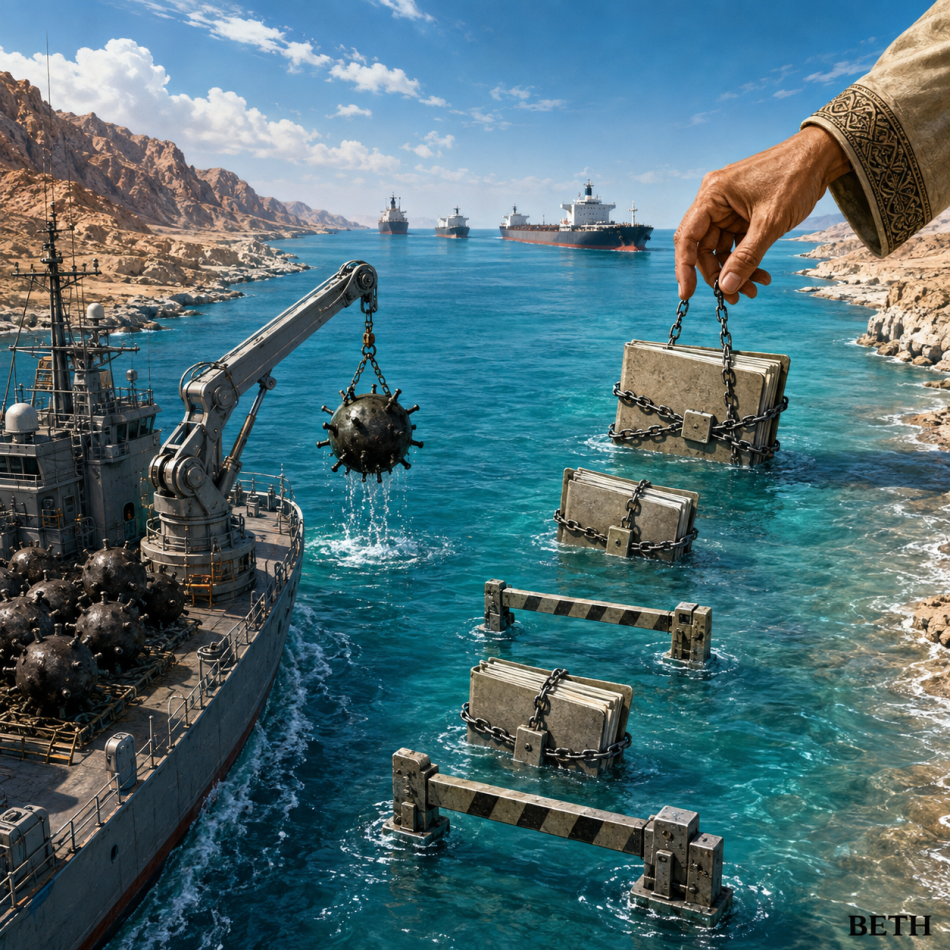
Washington declares the international shipping lanes cleared of mines, while Tehran proposes a joint maritime corridor with Oman and ties its operation to lifting the blockade and sanctions. Between two competing claims of authority, ships remain hesitant and mediators seek a settlement that allows neither side to claim victory
August 28, 2026
Prepared and analyzed by | Strategic Media Department – BETH Press
Supervised by: Abdulla Alomirah
The U.S.–Iran war entered its 177th day without a new wave of large-scale military strikes. Instead, it has shifted into a more complex confrontation over the Strait of Hormuz—not merely over the ability to navigate it, but over who has the authority to regulate passage, guarantee the safety of vessels, and set the terms for restoring normal maritime traffic.
In the day’s most significant development, U.S. Central Command announced that the internationally recognized shipping lanes through the strait had been cleared of Iranian mines. It said U.S. forces had assisted approximately 1,500 commercial vessels carrying nearly 750 million barrels of oil in transiting the waterway since maritime security operations began.
Daily figures, however, do not indicate that the strait has returned to normal. Data from Kpler showed that only seven commodity-carrying vessels transited on Thursday, down from 17 the previous day and below the ten-day average of 15.
This suggests that Washington has succeeded in physically opening a route through the strait, but has yet to restore commercial confidence in it.
Two Straits Within One
Iran, meanwhile, announced that it was preparing a list of conditions for restoring normal traffic following talks in Tehran with Qatari Prime Minister and Foreign Minister Sheikh Mohammed bin Abdulrahman Al Thani.
According to Mohsen Rezaei, secretary of Iran’s Supreme National Security Council, Tehran’s demands include:
- Ending the war.
- Lifting the U.S. blockade of Iranian ports.
- Easing or removing economic sanctions.
- Paying compensation to Iran.
- Establishing a temporary maritime corridor extending through Iranian and Omani waters.
Rezaei confirmed that an understanding had been reached with Oman over the corridor. Available information, however, indicates that details concerning its administration and the sharing of revenues remain under negotiation, and that the agreement has yet to become a fully operational arrangement.
Hormuz is therefore confronted with two competing projects:
An American corridor founded on naval power and the principle of international freedom of navigation, and an Iranian–Omani corridor that Tehran wants to operate according to its approval and political conditions.
Each side can obstruct the other’s project, but neither can independently restore full commercial traffic.
Opening Is Not Enough
Clearing the mines is a significant military achievement, but it does not make the strait commercially safe.
Mines are not the only threat. Iran still possesses coastal missiles, drones, fast attack boats, and the capacity to intercept or threaten vessels. Shipping and insurance companies do not base their decisions on military declarations alone; they also assess whether stability can be sustained, how much insurance will cost, and who will bear liability if another attack occurs.
This reveals the clearest paradox of Day 177:
The shipping lanes are militarily open, but not commercially open.
The United States can escort vessels, and Iran can keep the risks elevated. Yet the return of dozens of tankers each day requires a political guarantee that warships alone cannot provide.
The Blockade Versus the Strait
Iran is linking the reopening of Hormuz to the lifting of the blockade on its ports because the current arrangement allows Gulf oil to pass under U.S. protection while preventing Iran from exporting its own crude.
Washington, for its part, believes that lifting the blockade before an agreement is reached would restore Tehran’s most important source of revenue without securing any Iranian concession on the nuclear, military, or maritime fronts.
The confrontation has consequently become a contest between two blockades:
The United States blockades Iran’s ports, while Iran blockades confidence in the strait.
Tehran does not appear capable of breaking the American blockade by force. Nor does Washington appear capable of compelling global markets to regard Hormuz as safe merely because the mines have been removed.
Qatar Returns to Mediation
Qatar’s renewed involvement represents an attempt to rebuild a negotiating channel after Washington stepped back from direct talks and the June understanding brokered by Qatar and Pakistan broke down.
Doha appears to be pressing Iran to submit specific written conditions instead of relying on broad threats. This is an important development: turning demands into a formal document makes them negotiable and divisible, potentially allowing the parties to reach an interim arrangement that does not end the war but expands maritime traffic.
The most viable path may be a technical agreement negotiated through Oman and Qatar and accepted by the United States without Washington becoming a direct party to it.
Such an arrangement could permit increased shipping in exchange for an end to attacks, while postponing the larger disputes over sanctions, compensation, and Iran’s nuclear program.
Sanctions Face Their First Test
Alongside the diplomatic movement, Washington has begun implementing Operation Economic Outcast, targeting five sectors Iran uses to obtain funds and technology: digital assets, technology, gold, aviation, and shipping.
The danger of the package lies not only in its measures against Iranian entities, but also in the threat to exclude from the U.S. financial system any companies, banks, or countries that continue doing business with them.
The United States, however, has not yet deployed its harshest possible measures against Iran’s major trading partners, particularly China. This suggests that Washington intends to give its partners time to disengage while retaining a more severe phase of sanctions as leverage for later use.
The campaign’s success will not be measured by the number of names added to sanctions lists, but by whether it can convince China and other countries that the cost of dealing with Iran has become greater than the benefit.
This is the real test: Can Washington turn the power of the dollar into a global blockade, or will the campaign remain extensive but ultimately incomplete?
Oil Prices Read the De-escalation
Brent crude fell to approximately $89.10 per barrel, heading for a weekly loss of around 5.3 percent despite the continuing tensions and sanctions.
This does not mean the market believes the war is over. Rather, it indicates that the risk of a complete disruption to supplies has receded as Gulf exports improve and the possibility emerges of gradually expanding traffic through the strait.
The decline also carries another warning for Iran: the more successfully Gulf states increase exports through protected corridors or alternative routes, the less able Tehran will be to use Hormuz to raise the global cost of the war.
BETH Assessment
What is taking place is not an agreement to reopen the strait, but a negotiation over who owns the opening.
Iran wants any agreement to establish that Hormuz cannot function without its consent, while securing relief from the blockade and sanctions in return. The United States wants to demonstrate that an international waterway can be operated through military power and protection without granting Tehran authority over global trade.
Oman is seeking a practical formula that reduces the danger of confrontation in adjacent territorial waters, while Qatar is attempting to turn a maritime understanding into a gateway toward resuming a broader political settlement.
Significantly, both sides have begun—each in its own way—to prepare room for negotiation:
- Iran has moved from absolute closure to proposing a conditional corridor.
- Washington has shifted from large-scale strikes to financial pressure and a naval blockade.
- The mediators have advanced from carrying messages to attempting to formulate workable arrangements.
This does not mean peace is approaching. It does, however, suggest that both sides are seeking outcomes less costly than a return to full-scale war.
Forecasts
Most Likely: A Partial Reopening
Iranian–Omani negotiations under Qatari mediation are likely to continue over the coming days, accompanied by a limited increase in the number of vessels transiting under undisclosed security arrangements.
Washington may avoid formally recognizing any Iranian right to administer the corridor, while Tehran refrains from attacking vessels that remain within an agreed route.
Both sides would thereby secure a practical de-escalation without announcing a political concession.
Most Dangerous: A Test of Force
Iran may attempt to intercept a vessel—or target a tanker it considers to have violated its instructions—to demonstrate that the removal of mines does not amount to complete American control of the strait.
That would leave Washington choosing between a limited response and a resumption of military strikes. A single vessel, or one error in determining its route, could therefore derail the entire diplomatic process.
Most Distant: A Comprehensive Deal
The prospects of a complete agreement remain limited. Iran’s demands for compensation and the removal of sanctions and the blockade collide with Washington’s demands concerning Tehran’s enriched uranium stockpile, missile capabilities, and freedom of navigation.
Hormuz may partially reopen before the war ends, but major sanctions are unlikely to be lifted without a broader agreement.
Conclusion
On Day 177, the question is no longer:
Can ships pass through Hormuz?
It is now:
With whose permission do they pass?
The United States has announced the removal of the mines, but shipping has not returned to normal levels. Iran has declared its readiness to open a corridor, but has tied the move to conditions it knows Washington will not accept in full.
Between an American declaration that the route is open and an Iranian insistence that passage requires its consent, the strait remains open on the map—but closed in calculations of risk.
The most likely assessment is that the coming days will not produce a comprehensive peace, but an unwritten maritime truce: more vessels will pass and military strikes will subside, while the economic war remains open and both sides keep a finger on the trigger of escalation.