



Riyadh Air Expands Domestically
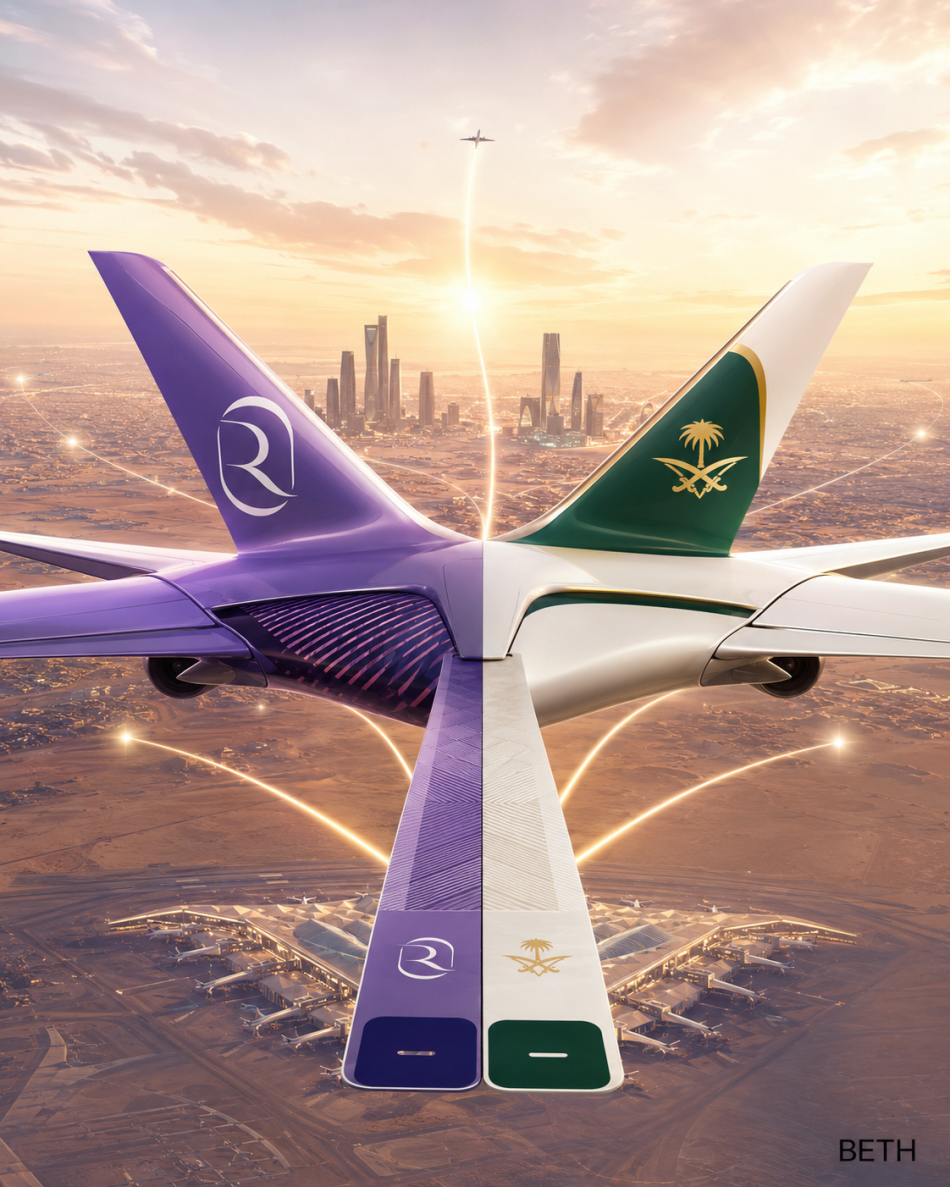
One Network, Two Wings
The new carrier will place its code on Saudia flights to six cities, combining domestic and international journeys on a single ticket in the first practical implementation of the partnership between the two airlines
Riyadh | BETH
Riyadh Air and Saudia have launched the first phase of their strategic cooperation agreement, introducing codeshare services on domestic flights from Riyadh to six cities and transforming a partnership announced in 2023 into an integrated travel network ready for booking and operation.
Under the agreement, Riyadh Air will place its “RX” code on flights operated by Saudia from King Khalid International Airport to Abha, Al-Qassim, Dammam, Jeddah, Madinah, and Tabuk.
This means passengers will be able to purchase their entire journey through Riyadh Air, even when Saudia operates the domestic segment, under a single booking and ticket, with baggage checked through to the final destination.
Domestic Routes Feed International Flights
The agreement does not add new aircraft between Riyadh and the six cities, but it gives Riyadh Air immediate access to a domestic network without waiting to build its own routes or allocate aircraft to them.
The new carrier will use Saudia’s daily flights to bring passengers from across the Kingdom to its Riyadh hub before transferring them to its international services.
A passenger departing from Dammam, for example, can fly to Riyadh on a Saudia-operated service and continue to Madrid with Riyadh Air on a single ticket, with baggage checked through to the final destination.
In the opposite direction, a passenger arriving from Kuala Lumpur on Riyadh Air can transfer in Riyadh to a Saudia-operated domestic flight to Madinah without making two separate bookings or checking in baggage again.
Saudia’s domestic flights will thus become arteries feeding Riyadh Air’s international network, while the new carrier’s overseas services will generate additional passengers for Saudia’s domestic routes.
Cooperation, Not a Merger
The agreement does not merge the two carriers or unify their operations. Each company retains its own aircraft, management, pricing, loyalty program, and commercial identity.
It does, however, shift their relationship away from the prospect of competing on every route toward a more flexible division of roles. Saudia possesses an extensive domestic network and decades of operational experience, while Riyadh Air is building a new international hub in the capital.
This arrangement reduces the need to operate inefficient parallel services for the same purpose and enables each carrier to sell seats on the other’s connecting flights while maintaining commercial and operational independence.
The partnership also helps strengthen King Khalid International Airport as a hub. An international carrier depends not only on the number of overseas destinations it serves, but also on its ability to gather passengers from multiple cities and redistribute them across departing flights.
A Smoother Journey
With both carriers operating from Terminals 1 through 4 at King Khalid International Airport, connecting passengers will face shorter transfers and fewer complications associated with changing terminals or reclaiming and rechecking baggage.
Riyadh Air Business Class passengers will be able to use Saudia lounges at their departure airports within the Kingdom. They will also benefit from priority security lanes and priority boarding on Saudia flights wherever those services are available.
The true value of a codeshare becomes most evident when one segment of a journey is disrupted. Because the itinerary is issued on a single ticket, handling delays, rebooking passengers, and protecting onward connections becomes the airlines’ responsibility instead of leaving travelers stranded between two separate reservations.
Three Years of Technology
Launching the first phase required three years of development and testing involving the two carriers and their technology partners, FLYR, INK, and Amadeus.
Riyadh Air established a direct connection with Saudia’s passenger service system, enabling the exchange of flight, seat, booking, and baggage data and allowing a single journey composed of segments operated by two airlines using different technology environments to be sold as one itinerary.
This infrastructure does not appear to be intended for the domestic partnership alone. Riyadh Air has signed memoranda of understanding with nearly 15 international carriers, making the current integration a practical test for activating future codeshare and interline agreements with other airlines.
The technological achievement therefore represents a platform for expanding Riyadh Air’s global network—not merely a solution for selling six domestic destinations.
Loyalty Programs Move Closer
During the coming months, the two airlines intend to introduce reciprocal benefits between Riyadh Air’s Sfeer loyalty program and Saudia’s AlFursan program.
The benefits are expected to include earning and redeeming points, along with lounge access for eligible passengers at key domestic and international locations.
This development carries competitive significance because travelers will choose flights not only according to price and schedule, but also according to their ability to retain benefits and accumulate points while moving between the two carriers.
At a later stage, Saudia will place its “SV” code on selected flights operated by Riyadh Air, giving Saudia customers access to additional destinations and more flexible schedules through the new carrier’s network.
What Has Not Been Announced
The announcement did not specify when codeshare bookings will open or when the first flight covered by the agreement will operate. Nor did it disclose how many daily flights on each route will be included.
The list of Riyadh Air-operated services on which Saudia will place its “SV” code has not yet been announced. Neither have the launch date for reciprocal earning and redemption of loyalty points nor the international locations to be included in the lounge-access agreement.
The operational experience will also need to prove its ability to handle baggage, delays, booking changes, and customer service seamlessly. A codeshare’s success is not measured by the appearance of two codes on a ticket, but by the disappearance of operational boundaries between the airlines from the passenger’s perspective.
Conclusion
The agreement gives Riyadh Air what every new international carrier needs: a domestic network capable of feeding its flights from the outset, without requiring it to build that network one city at a time.
Saudia, in return, gains additional traffic on its domestic services and becomes a partner in the new carrier’s expansion rather than remaining outside it.
This is neither the unification of two companies nor a concession by one to the other. It is the construction of a network in which an aircraft bearing Saudia’s identity can begin the journey and another carrying Riyadh Air’s colors can complete it.
Saudi Arabia is thus beginning to turn the presence of two national carriers into an advantage: two airlines competing on quality while cooperating to connect the Kingdom with the world.