



Day 176: Iran Puts a Price on Hormuz
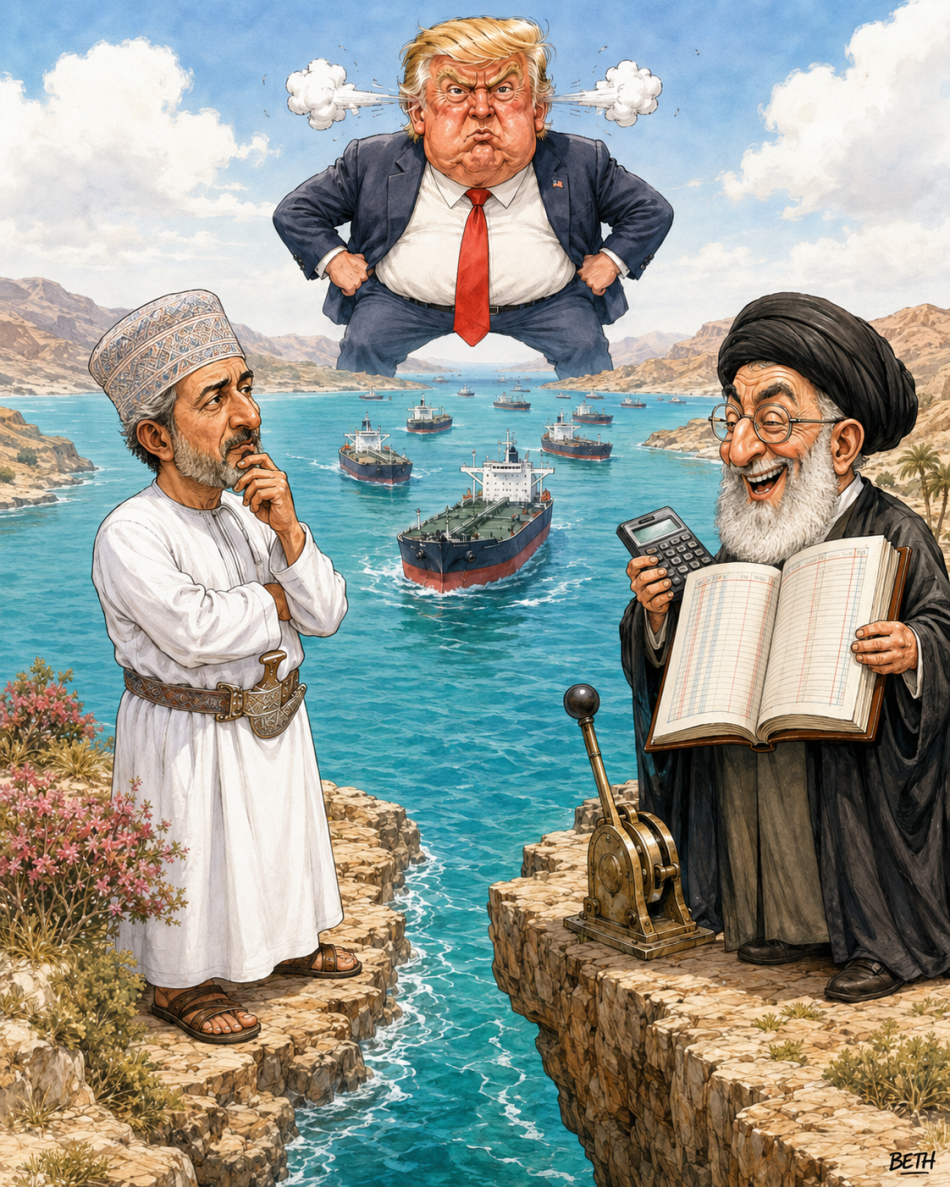
The Revolutionary Guards add revenue-sharing and a ban on warships to the temporary corridor understanding with Oman—details Muscat has not confirmed—while Qatar steps into the mediation effort, seeking to move negotiations from navigation to ending the war
August 27, 2026
Prepared and analyzed by | Strategic Media Department – BETH Agency
Supervised by: Abdullah Alomaira
The confrontation over the Strait of Hormuz has shifted from the search for a temporary shipping corridor to a broader struggle over who has the right to administer the waterway, determine which vessels may pass and benefit from potential revenues generated by regulating navigation.
Iran’s Islamic Revolutionary Guard Corps announced that negotiations with the Sultanate of Oman had produced understandings on each country’s share of the strait’s waters and the distribution of revenues derived from it. It also said warships would not be allowed to use the proposed corridor and that a full reopening of Hormuz would remain conditional on the United States meeting Iranian demands.
The Guards’ announcement, however, goes beyond the joint statement issued after talks in Tehran between Iranian Foreign Minister Abbas Araghchi and his Omani counterpart, Badr Albusaidi.
The joint statement referred to efforts to establish a temporary navigational corridor, cooperation on mine clearance and continued technical negotiations over a permanent corridor and the future administration of the strait. It did not announce a final agreement on revenue-sharing or the imposition of transit fees.
Here lies the distinction between what Tehran and Muscat actually discussed and agreed upon and what Iran wants to portray as an accomplished agreement.
Seven Miles
Iranian Deputy Foreign Minister Kazem Gharibabadi said the proposed corridor would be seven nautical miles—or approximately 11.3 kilometers—wide. Vessels entering the Arabian Gulf would pass through Iranian territorial waters, while part of the outbound route would also run through Iranian waters.
He stressed that the understanding did not amount to reopening the Strait of Hormuz, but merely establishing a temporary route for commercial vessels while negotiations over permanent arrangements continued.
Oman’s foreign minister, meanwhile, expressed hope that the temporary corridor and practical arrangements for restoring safe navigation would soon be announced. Discussions over the future administration of the strait and a permanent solution, he said, would follow later.
The difference between the two formulations is revealing: Muscat speaks cautiously of a safe corridor and the restoration of navigation, while Tehran presses toward sovereignty, administration and revenue.
The corridor’s coordinates, operating date, vessel-protection mechanisms, inspection authority and the countries whose ships might be barred from passage all remain undisclosed.
The Guards’ Version
IRGC spokesperson Hossein Mohebbi introduced elements absent from the joint statement, saying the two countries had reached understandings on their respective shares of the strait’s waters and revenues.
He also announced that the corridor would be limited to commercial shipping, that warships would not be permitted to pass and that the strait would not fully reopen unless the United States ended its blockade of Iranian ports, lifted sanctions and returned to the commitments of the temporary ceasefire.
Mohebbi accused Washington of attempting to obstruct the negotiations with Oman, arguing that American interference had delayed the agreement.
Another Iranian source, however, said no agreement had yet been finalized and that talks were continuing over its details. This suggests that the Revolutionary Guards announced outcomes that went beyond the stage officially reached in the negotiations.
The inconsistencies within Iran’s own account require a distinction between three separate levels:
- A temporary corridor and mine clearance, formally discussed by both sides.
- The permanent administration of the strait, which remains subject to future negotiations.
- Revenue-sharing and a ban on warships, announced unilaterally by the Revolutionary Guards and not confirmed by Oman.
Qatar in Tehran
Qatari Prime Minister and Foreign Minister Sheikh Mohammed bin Abdulrahman Al Thani arrives in Tehran today, Thursday, to continue mediation efforts and revive contacts between Iran and the United States.
Qatar is operating within a broader space than the Omani negotiations. Muscat is discussing the technical and security arrangements governing the strait, while Doha is attempting to move from opening the corridor to de-escalation, renewed negotiations and the revival of the process that produced June’s temporary ceasefire before it collapsed.
The simultaneous movement along both tracks points to a regional division of roles: Oman for Hormuz, Qatar for the war.
The success of Qatari mediation, however, depends on finding a formula that combines Washington’s demand for freedom of navigation with Iran’s insistence on ending the blockade and sanctions—without either side appearing to have retreated under pressure from the other.
Limited Movement
The number of commodity vessels visibly transiting the strait rose to 10 on Wednesday, from eight on Tuesday, but remained below the 10-day average of approximately 15.
The increase does not signify a return to normal navigation. Oil flows through the strait have fallen from around 20 million barrels per day before the war to nearly five million, meaning that the waterway is still operating at roughly one-quarter of its previous level.
An unidentified projectile also struck a tanker near the Omani coast and caused a fire that was later extinguished. The incident underscores that any political agreement, even if completed, will require security guarantees and a clear mechanism for removing mines and preventing attacks on vessels.
The available figures do not include ships that may cross with their identification systems switched off. They therefore reflect observed traffic, not necessarily the complete number of transits.
The Market Moves Before the Agreement
Brent crude fell to around $86 per barrel, extending its losses as hopes grew that the Iranian-Omani understanding and Qatari mediation could lead to increased oil flows.
The price decline, however, reflects market expectations more than a completed change on the ground. The corridor has not yet entered organized operation, no final agreement has been announced and American restrictions on Iranian ports remain in place.
Markets have therefore begun pricing in the possible return of vessels before the vessels themselves have received guarantees that they can return.
Iran also benefits from this premature effect. Merely announcing progress in the negotiations reduces international pressure for military action to reopen the strait and gives Tehran additional time without requiring it to relinquish its maritime leverage.
From Closure to Administration
At the beginning, the battle centered on Iran’s ability to close the Strait of Hormuz. It then shifted to its ability to choose which ships could pass and which would be denied passage.
The new proposal goes a step further. Tehran is attempting to transform temporary military control into a permanent or semi-permanent administrative system that gives it a role in setting routes, classifying vessels, controlling passage and potentially collecting revenue.
Iran is therefore not offering to restore the strait to its prewar status. It is offering to reopen it under new rules written by the war.
Involving Oman could provide the arrangement with regional cover and make it appear less like unilateral Iranian control. Yet it also places Muscat in an extremely sensitive position. Oman is a trusted mediator for both sides and remains committed to maritime security. It does not want a temporary corridor to become international recognition of Iran’s right to impose fees or bar the ships of particular countries.
Oman’s silence on the question of revenues may therefore be deliberate. Muscat supports opening a safe corridor, but it has not declared its acceptance of the political narrative the Revolutionary Guards have added to the technical understanding.
Sanctions and the Strait
The announcement followed the expansion of US sanctions on Iran and Washington’s threat to subject countries and companies continuing to deal with Tehran to isolation and secondary sanctions.
While Washington seeks to deprive Iran of resources and isolate it from international markets, Tehran is responding by attempting to convert its geography into a political and financial asset—creating an equation in which passage through the world’s most important energy corridor becomes conditional on Iranian terms.
The confrontation is thus turning into two opposing blockades:
Washington is blockading Iranian ports and its economy, while Tehran is restricting the strait on which Gulf exports and global energy supplies depend.
Between the two blockades, Iran is offering a trade-off: Lift the pressure on us, and we will lift the pressure on navigation.
Maneuvering Under Fire
Iran’s latest moves cannot be separated from the delaying tactics Tehran has employed throughout earlier stages of the crisis. It neither rejects reopening the strait outright nor actually opens it. At each stage, it presents a temporary formula requiring a new round of negotiations, then adds conditions that had not previously been raised.
The discussion began with a safe corridor for vessels. It then expanded to the division of inbound and outbound routes, shared administration and revenues, a ban on warships, and linking a full reopening to a ceasefire, the end of the blockade and the lifting of sanctions. Every announced advance consequently becomes the beginning of another round rather than the end of the crisis.
This maneuvering gives Iran three benefits simultaneously: buying time to withstand the sanctions, preserving the Hormuz card and presenting itself to mediators and markets as the party offering solutions—while blaming Washington for obstructing them if it rejects the conditions.
There is also an element of political mockery of the United States in Iran’s behavior. Washington began the war seeking to weaken Tehran and guarantee freedom of navigation. Six months later, it finds itself waiting for Iran’s consent to reopen an international waterway and discussing arrangements that could grant Tehran revenues from it, while Iran declares that American warships themselves will not be allowed through.
This does not mean that Iran has emerged victorious. It has suffered substantial military and economic losses, faces a tighter blockade and is increasingly isolated. Yet it is attempting to construct a scene in which American force could destroy targets but could not seize the decision—and in which the state Washington sought to subdue is now negotiating the price of restoring what had been open before the war.
Tehran may not, in fact, want to reach a final agreement quickly. A restricted strait gives it leverage that an open one cannot. Continuing negotiations postpone military confrontation, pressure energy markets and maintain channels with mediators that help Iran resist American isolation.
Washington’s handling of these developments, meanwhile, presents striking contradictions:
- Trump threatens Oman if it obstructs his plan, yet does not intervene to prevent its negotiations with Iran from advancing.
- He insists that the strait is open and the mines have been removed, while negotiations continue over opening a temporary corridor and carrying out a joint mine-clearance project.
- He says he is “in no hurry” to resume negotiations, just as his administration moves to tighten the economic noose around Tehran.
- The Revolutionary Guards escalate their demands from a temporary corridor to administration, revenues and the exclusion of American warships, while Washington—so far—limits itself to economic pressure without a direct military response.
These contradictions do not offer a single definitive explanation for American behavior, but they make the next move more important than the public statements now being made.
The Iranian-Omani understanding should therefore not be read as conclusive evidence that the reopening of Hormuz is approaching. It may instead be another round in a more calculating Iranian policy: negotiating over the solution without relinquishing the crisis that gave it the power to impose one.
What Comes Next?
Four possible paths lie ahead:
First: Operating the Temporary Corridor
A limited number of commercial vessels may begin transiting once agreement is reached on the coordinates, security arrangements and mine clearance—without this being considered a full reopening of the strait. This would provide markets with some reassurance while leaving the ultimate decision in Iran’s hands.
Second: A Maritime Understanding Without Peace
The corridor could operate while the war, sanctions, blockade and nuclear program remain outside the solution. The agreement would then amount to little more than a maritime truce vulnerable to collapse at the first disagreement.
Third: A Broader Deal
Qatar may succeed in linking operation of the corridor to a temporary ceasefire and the easing of some blockade measures, paving the way for political negotiations to resume. This would be the most beneficial path for the global economy, but it would require concessions that neither Washington nor Tehran has yet declared itself willing to make.
Fourth: Collapse of the Understanding
If Iran insists on revenues and the exclusion of warships, while Washington demands complete freedom of navigation and rejects any Iranian sovereignty over the corridor, the negotiations could break down. The confrontation would then return to the sea—through attacks on vessels or an attempt to impose passage by force.
Conclusion
The question on Day 176 is no longer: Can Iran close Hormuz?
It has demonstrated its ability to disrupt most of the strait’s traffic and raise the cost of the war for the global economy.
The new question is: Can it transform disruption into a right to administer the waterway, control into revenue, and reopening the strait into a price Washington must pay?
So far, Oman has not signed on to the narrative announced by the Revolutionary Guards, the strait has not reopened and the United States has not lifted its blockade.
What has actually been achieved is a corridor still under negotiation, an optimistic market, an active Qatari mediator and an Iran presenting every small step as a major transformation.
That is the clearest maneuver of all: Tehran is convincing the world that a solution is approaching while retaining every reason preventing it from arriving.