



Day 175: The Corridor Comes Before Peace
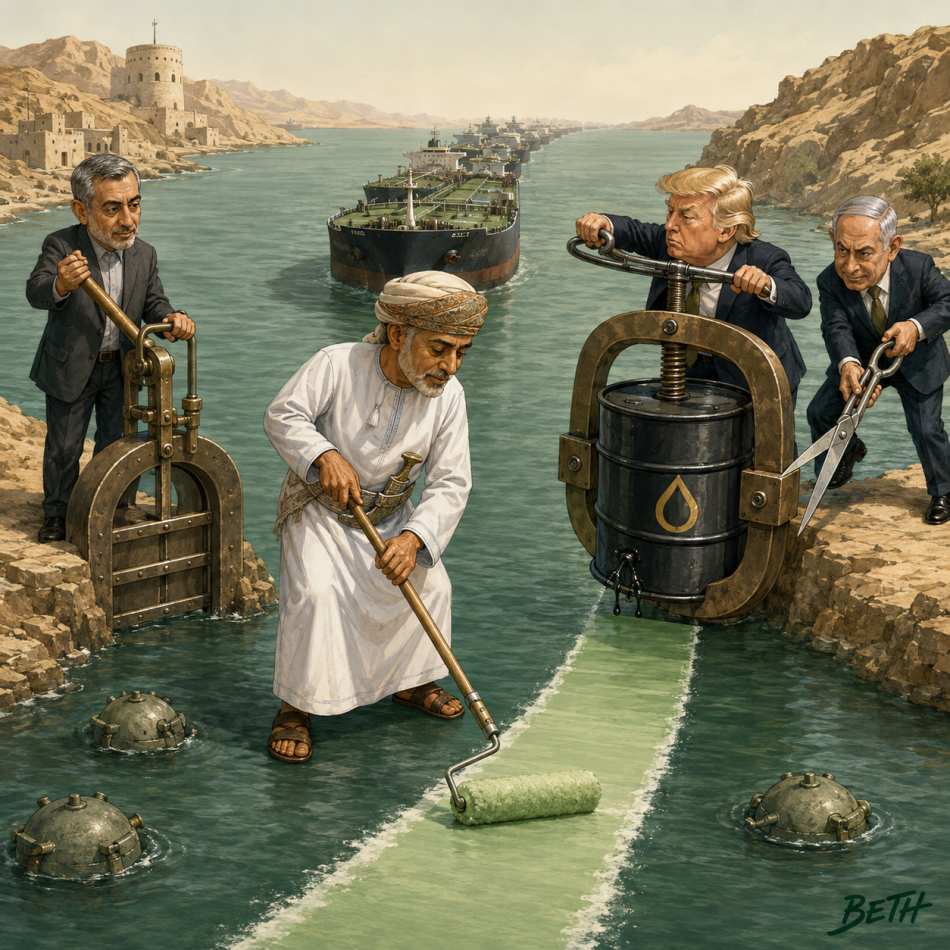
Oman and Iran move toward an operational framework for a temporary corridor through Hormuz, Washington freezes its strikes while maintaining economic pressure, and Israel rejects the possibility of reaching an agreement with Tehran
August 26, 2026
Prepared and Analyzed by the Strategic Media Department – BETH Agency
On the 175th day of the U.S.-Iran war, the Strait of Hormuz crisis moved from an exchange of political conditions to discussions over practical navigation arrangements, after Iran and the Sultanate of Oman announced a phased framework for establishing a joint temporary shipping corridor and carrying out a project to clear mines from the strait.
The development, however, does not mean that Hormuz has reopened. Tehran continues to link the restoration of navigation to an end to the war, while Washington has kept its blockade and sanctions in place, despite informing its allies that it does not currently expect to launch new strikes against Iran.
A Temporary Corridor
Iranian Foreign Minister Abbas Araghchi and his Omani counterpart, Badr Al Busaidi, discussed during talks in Tehran a framework they described as “practical and implementable” for regulating passage through the strait.
The framework includes:
- Establishing a joint temporary shipping corridor.
- Implementing a joint mine-clearance project.
- Continuing technical negotiations to establish a permanent corridor.
- Developing future arrangements for managing maritime traffic.
- Creating a mechanism for exchanging information and providing navigational and security services.
Reports indicate that the proposed temporary corridor would be seven nautical miles wide—approximately 13 kilometers—and would involve reorganizing the routes currently in use.
What has been announced, however, remains a negotiating framework. It does not specify when the corridor will begin operating, how many vessels will be permitted to transit, or which party will guarantee their safety.
Two Political Mines
The Omani-Iranian framework faces two fundamental obstacles.
The first is Iran’s insistence that it will not fully reopen the strait unless the United States ends the war and eases its port blockade and sanctions.
The second is Washington’s position that navigation through Hormuz is an international right that cannot be subjected to Tehran’s conditions or fees, along with its insistence that U.S. forces are responsible for securing the waterway.
The proposed mine-clearance project reveals a deeper struggle over who holds authority. President Donald Trump has announced that U.S. forces removed all mines from the international shipping lane, while Iran and Oman are proposing a joint project to clear the strait.
The dispute, therefore, is not merely about whether mines remain. It is also about who has the authority to declare the strait safe and who controls the regulation of passage through it.
Only Five Vessels
The negotiations have yet to produce any visible improvement in maritime traffic.
Only five commercial vessels transited the strait on Tuesday, compared with a daily average of 15 over the previous ten days. Traffic before the war was significantly higher.
The vessels included two liquefied petroleum gas carriers and one bitumen tanker leaving the Gulf, as well as two empty product tankers entering from the Gulf of Oman.
The decline confirms that shipping companies have not yet treated the proposed framework as a practical guarantee and that the political announcement has moved ahead of maritime confidence.
Strikes Put on Hold
U.S. Secretary of State Marco Rubio informed several allied foreign ministers that the United States does not currently expect to launch new strikes against Iran and will instead prioritize other forms of pressure.
This does not constitute a formal cessation of hostilities or a definitive commitment not to use force. It does, however, indicate that the center of U.S. operations is shifting from military strikes to the naval blockade and economic sanctions, while retaining the military option should U.S. vessels or forces come under attack.
The Economic War
Washington, meanwhile, continues to expand the sanctions announced by Treasury Secretary Scott Bessent, targeting Iranian revenue sources and networks involved in oil, shipping, finance, and weapons procurement.
Bessent threatened to “choke Iran economically,” calling on countries and companies to sever their dealings with Tehran or risk sanctions and the loss of access to the dollar-based financial system.
The United States has not yet moved to isolate major Chinese banks, however. This means that the sanctions have begun striking the outer edges of Iran’s economic network without fully severing its most important commercial center.
Netanyahu Closes the Door
In a move running counter to the diplomatic effort, Israeli Prime Minister Benjamin Netanyahu dismissed the possibility of reaching an agreement with Iran’s leadership.
He said he had discussed three possible courses with Trump: diplomacy, military action, and tightening the economic blockade. He nevertheless questioned whether negotiations could produce a sustainable agreement.
His position reveals a difference within the camp applying pressure on Iran. Washington is temporarily freezing its strikes to test sanctions and mediation, while Israel believes negotiations will not alter the Iranian regime’s behavior and that the pressure should not end with a settlement that allows Tehran to rebuild its strength.
Oil Markets Believe Oman
Despite the conflicting conditions, oil markets responded positively to the Omani-Iranian initiative.
Brent crude fell to approximately $86.62 per barrel, while West Texas Intermediate declined to around $80.12, indicating that markets view the temporary corridor as a possible means of reducing supply risks, even though it has yet to become an actual reopening of the strait.
Conclusion
Day 175 produced the first clear transition from discussing whether Hormuz should reopen to considering how a corridor within it could operate.
The framework, however, remains surrounded by three conflicting conditions: Iran wants the war to end, the United States demands freedom of navigation without Iranian conditions, and Israel does not believe a diplomatic settlement can be reached.
What is taking shape, therefore, is not a peace agreement, but an attempt to build a small corridor inside a large war.
The true sign of change will come when large tankers begin transiting the strait, shipping traffic increases, and direct or indirect U.S.-Iranian negotiations begin on a clearly defined basis.
The corridor now exists on paper, but reopening Hormuz still awaits a decision on the war.