

BETH’s Eyes in the Capitals of Decision
August 25, 2026
From Washington, which is testing the transformation of the dollar into a global weapon, to Beijing, which refuses to choose between its trade and the US financial system; from Europe, which is searching for money and weapons for Ukraine, to Tehran, which conceals petrol queues behind the rhetoric of resilience—while Saudi Arabia leads global press coverage as an investor creating jobs within France
Monitoring and Analysis | Strategic Media Department – BETH Agency
Supervised by: Abdullah Al-Amirah
The attention of the global press this Tuesday is divided between two wars that are gradually moving from the battlefield into the economy and infrastructure.
In the Middle East, the United States is attempting to shift its war with Iran from bombing to financial isolation. However, it launched the first stage of sanctions without directly targeting major Chinese banks, revealing that transforming the dollar into a global blockade requires calculations extending far beyond Tehran.
In Europe, the war in Ukraine has entered a phase in which factories, refineries, ports, and logistics centers are being targeted. Kyiv is searching for money and missiles, while European states are considering whether frozen Russian assets can be used without triggering a legal and financial crisis within the European Union.
In the domestic press of the world’s capitals, the consequences of war appear in different forms: fuel shortages and inflation in Iran, energy security in China, India, and Japan, financing in Europe, the cost of supporting Ukraine in Britain, borders and terrorism in New Delhi, and the future of trade relations with Iran in Ankara.
Washington | Sanctions Begin Below Expectations
The “Economic Outcast” campaign against Iran dominated the American press, but the administration’s description of it as an “economic D-Day” encountered a more cautious reading in the newspapers.
The New York Times focused on the gap between the immense rhetoric preceding the announcement and the measures that were actually unveiled. Washington targeted more than 60 individuals, entities, and vessels and expanded its threat of secondary sanctions, but it did not specify implementation dates or identify the countries and major banks it intended to punish.
The newspaper reported that Treasury Secretary Scott Bessent subsequently described the announcement as a “warning shot” preceding a period of “quiet diplomacy” with governments and institutions around the world. This means Washington has not yet begun the full blockade; it has begun an attempt to secure compliance before imposing punishment.
The Washington Post linked the shift toward economic warfare to declining public support for the war, the approach of the November midterm elections, rising energy prices, and the depletion of certain weapons stockpiles.
Under this reading, financial pressure is not merely a weapon against Iran. It is also a political exit that the US administration needs to reduce the cost of a war it has been unable to end militarily.
The markets delivered a swift verdict. Oil prices fell by more than 3% to their lowest levels in a week, with Brent crude declining to approximately $89.21 per barrel. Investors interpreted the absence of targeted countries and implementation dates as evidence that the announcement was less severe than expected and that Washington’s shift from military operations to economic pressure would temporarily reduce the risk of supply disruption.
Key Reading: The United States has demonstrated the power of the dollar, but it has yet to test its willingness to use that power against China, India, Turkey, and Russia. The real test is not Washington’s ability to punish a small company, but its readiness to bear the cost of punishing a major economy.
London | Can Washington Enforce It?
The British press focused on the question Washington left unanswered: does the United States have the political will to enforce sanctions against Iran’s largest partners?
The Financial Times said the package expanded the threat to include digital assets, technology, gold, aviation, and shipping, but imposed no immediate measures on Iran’s main trading partners, including China, Turkey, Iraq, and the UAE.
It noted that applying maximum sanctions against major economies could disrupt the global financial system. The campaign’s success will depend on whether Washington is prepared to move from verbal pressure to actually excluding institutions from the dollar system. Financial Times
In the domestic and foreign affairs coverage concerning Britain, Prime Minister Andy Burnham’s position during his visit to Kyiv received particular attention. He announced continued support for Ukraine, the sharing of technical blueprints for producing long-range missiles, and cooperation with France to establish assembly lines inside Ukraine.
Russian threats against London sparked debate over whether Britain is moving beyond supplying weapons to participating directly in building Ukraine’s offensive capabilities—and what Russian response this may provoke.
Key Reading: Britain is attempting to prove that a change of leadership has not altered its commitment to Ukraine. At the same time, it is moving to a more sensitive level: helping Kyiv manufacture weapons rather than merely delivering them.
Paris | Investment Precedes War
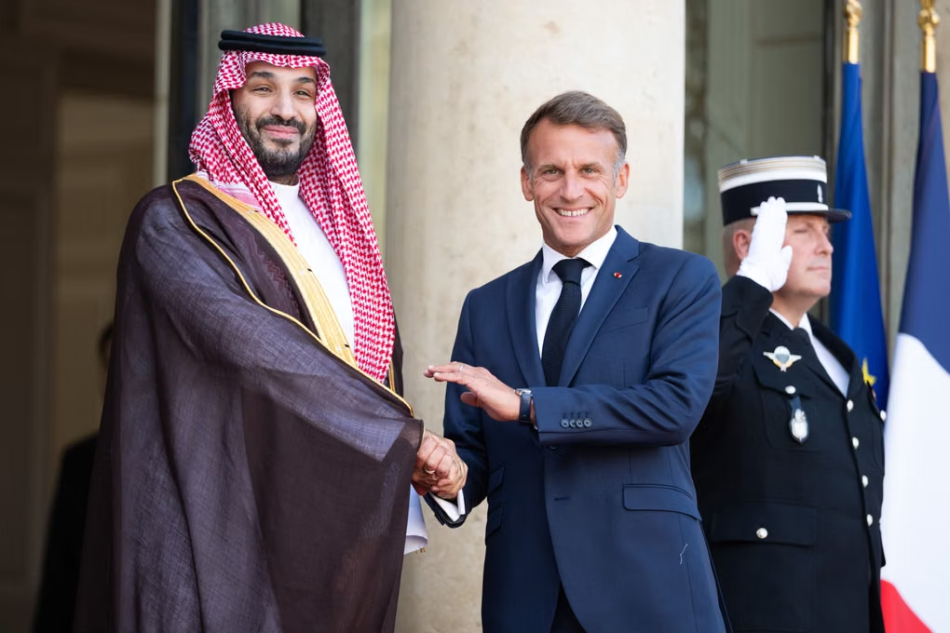
The French press continued to place the Qiddiya project at the forefront of the results of Crown Prince Mohammed bin Salman’s visit, ahead even of discussions concerning the war with Iran and the Strait of Hormuz crisis.
Le Monde described the three theme parks planned for Cergy-Pontoise as a “colossal” project and quoted President Emmanuel Macron as calling it France’s largest entertainment development since Disneyland Paris, with an investment of up to €6 billion and approximately 22,000 jobs.
French coverage regarded the project as evidence Paris needs to demonstrate that it remains capable of attracting foreign investment at a time when new investment projects across Europe have declined.
Criticism concerning human rights and the killing of Jamal Khashoggi did not disappear, but it came after employment, investment, and contracts. This time, the old political angle was unable to monopolize the image of the visit or obscure France’s direct interests.
Domestically and within Europe, Paris was also preoccupied with the growing Russian threat. Macron warned that Moscow could increase provocations against NATO states to deter them from supporting Ukraine and called for faster deliveries of air-defense missiles.
Key Reading: The French press no longer portrays Saudi Arabia merely as a market for French contracts, but as an investor capable of creating jobs within France. This transformation is the development that most significantly changed the image of the visit.
Brussels | Ukraine Wants the Money Now
European press attention focused on the gathering of European leaders in Kyiv to mark Ukraine’s Independence Day, but the symbolic scene quickly returned to the issue of financing.
Kyiv says it faces an additional funding gap of €23.5 billion, despite the European Commission’s disbursement of a new €6.1 billion installment from its financial support package.
This reopened the issue of approximately €200 billion in frozen Russian sovereign assets held in Europe, the largest share of which is deposited with Euroclear in Belgium.
Belgium remains the most reluctant country to support confiscation because of the legal and financial risks and the possibility of claims or retaliatory measures. Other states argue that declining bilateral assistance has made the use of Russian money a necessity rather than an option.
Key Reading: The European dispute is no longer about whether Ukraine should be supported, but about who will pay, how much they will pay, and whether the burden can be transferred from European national budgets to frozen Russian assets.
Moscow | War Enters the Warehouses
Coverage concerning Russia focused on the expansion of Ukrainian strikes from military and energy facilities to logistics networks and the civilian economy.
Drones targeted facilities belonging to Ozon, Russia’s second-largest e-commerce company, across six regions in three days, causing fires, disrupting operations, and triggering a sharp decline in the company’s share value.
The targeting of warehouses and distribution centers shows that Kyiv is attempting to bring the war into everyday economic life and raise the cost of insufficient protection among private companies. The Russian government, meanwhile, is considering expanding its authority to intervene in the management of facilities deemed inadequately protected.
Another problem is accumulating domestically: strikes on refineries and Black Sea ports have weakened oil refining and grain exports despite Russia’s abundant harvest.
Export disruptions have filled storage facilities, reduced domestic wheat prices, and threatened farmers’ ability to finance the next agricultural season.
Key Reading: Moscow is no longer facing a war confined to the front. It faces a war against the economic chain—from refinery to port, and from e-commerce warehouse to grain silo.
Beijing | The Dollar Approaches Chinese Oil
China’s official press rejected the US sanctions as unlawful unilateral measures and warned that they would escalate tensions and threaten global financial and economic stability.
The Foreign Ministry affirmed that China’s cooperation with Iran is conducted within the framework of international law and that Beijing will take the necessary measures to protect its rights and interests.
Behind this firm political position, however, lies a more complex economic equation. China is the largest buyer of Iranian oil, but its imports have fallen—from approximately 1.57 million barrels per day in February to around 534,000 barrels per day in August, according to estimates published by the British press.
Independent refineries have continued importing some oil by disguising the origin of shipments and using the yuan and indirect networks. Yet the US threat against major banks raises the level of risk from the oil trade to China’s financial system itself.
In its domestic and Asian coverage, Beijing followed the 25th round of border talks with India after Indian National Security Adviser Ajit Doval arrived to meet Foreign Minister Wang Yi. China wants to prevent US sanctions and the Iran war from disrupting the easing of tensions with New Delhi.
Key Reading: Beijing can resist sanctions politically and purchase oil through alternative methods, but the question is whether it will risk its major banks to preserve trade with Iran.
Tokyo | Two Wars on One Map
The Japanese press highlighted Prime Minister Sanae Takaichi’s confirmation that Japan would continue imposing sanctions on Russia and supporting Ukraine. She also linked European security with the security of the Indo-Pacific region.
Tokyo believes that growing military cooperation among Russia, China, and North Korea makes the war in Ukraine part of Japan’s security environment rather than a distant European conflict.
The war with Iran, however, places more direct pressure on Japan. Most of its oil requirements come from the Middle East and pass through Hormuz, explaining Tokyo’s intensified contacts with Oman and its demands for the restoration of free and safe navigation without additional fees.
Domestically, attention focused on using artificial intelligence and sensors in indoor agriculture to address the severe shortage of farmers, under a plan to attract ¥4.6 trillion in public and private investment by 2040.
Key Reading: Japan reads its security through a single map extending from Ukraine to Hormuz. Russia, China, and North Korea threaten the military balance, while the war with Iran threatens fuel supplies and the daily economy.
New Delhi | Borders, Oil, and Terrorism
The arrival of Indian National Security Adviser Ajit Doval in Beijing dominated the Indian press as the 25th round of special talks on the Chinese-Indian border began.
The two countries are attempting to build upon recent indications of détente while separating border stability, as far as possible, from their broader strategic competition.
At the same time, the economic press began calculating the effect of US sanctions on India’s trade with Iran. Indian exports to Iran fell from $3.5 billion in 2019 to approximately $1.2 billion in the 2026 financial year.
Despite the decline in trade, New Delhi does not view Iran through commercial figures alone. It considers energy security, routes toward Central Asia, the Chabahar Port project, and the danger that secondary sanctions could become a US instrument for determining India’s regional relationships.
Domestically, the press focused on the launch of India’s first integrated counterterrorism and counter-radicalization doctrine, known as “Prahaar.” The strategy includes using artificial intelligence to analyze security information and accelerating trials in cases involving cross-border links.
Key Reading: India is negotiating with China over the border, monitoring Washington on sanctions, and attempting to protect its corridors through Iran. It is therefore managing three simultaneous pressures without wishing to align completely with any side.
Islamabad | The Mediator Wants a Return
The Pakistani press welcomed the announcement of “significant progress” in talks conducted by Field Marshal Asim Munir and his delegation with the Iranian leadership.
Coverage focused on three objectives: reopening the Strait of Hormuz, preventing further escalation, and accelerating an end to the war. However, the newspapers could not determine what Iran had agreed to or whether the progress meant that a new round of negotiations with Washington was approaching.
The Pakistani initiative gains importance from the fact that Munir spoke with US President Donald Trump before visiting Tehran, placing Islamabad in the position of carrying messages between the two sides.
In the economic background, Pakistan is seeking to use its diplomatic role to improve its financial relationship with Washington, amid reports of a request for a swap line worth up to $10 billion and an effort to reduce its exclusive dependence on Chinese financing.
Key Reading: Pakistan is not presenting mediation as a free service. It wants to transform its political position between Washington and Tehran into financial and diplomatic gains and a stronger return to international capital markets.
Tehran | Resilience at the Petrol Stations
Iranian media presented the new sanctions as a repetition of a policy that has failed for decades. They focused on Economy Minister Ali Madanizadeh’s statements concerning a two-year plan and Iran’s transition from economic defense to offensive retaliation.
They also highlighted Field Marshal Asim Munir’s visit as evidence that the doors of mediation remain open and that Iran can still negotiate while retaining the Hormuz card.
The domestic picture presented by the international economic press is different. Vehicle queues have begun stretching outside petrol stations in Tehran and other cities, with a daily shortfall estimated at approximately 15 million liters out of total demand of 135 million liters.
The government faces a petrol subsidy dilemma. Low prices drain public finances, but raising them carries the risk of a social explosion reminiscent of the 2019 protests, particularly with general inflation approaching 90% and food prices rising even faster.
Key Reading: Tehran’s rhetoric says the sanctions will fail, but the real test is not taking place in official statements. It is occurring at petrol stations and in the Iranian citizen’s ability to bear rising prices and shortages.
Ankara | Trade Between Two Systems
The Turkish press focused on a direct question: what do the new US sanctions mean for Turkey, one of Iran’s largest trading partners?
The strongest sanctions did not take effect immediately, but Washington gave countries a period in which to end their dealings, threatening to exclude institutions that continue trading from the dollar-based financial system.
For Turkey, the issue is not merely a choice between Iran and the United States. It concerns energy, cross-border trade, financial transfers, and banks at a time when the Turkish economy is already facing inflationary pressure and high energy prices.
Economic coverage said global markets are facing three simultaneous pressures: the transition of the Iran war into sanctions, the possible return of tariff wars, and uncertainty surrounding US intervention in the bond market.
Key Reading: Ankara may reject dictates politically, but economically it cannot ignore the dollar or easily abandon its trade and long border with Iran.
Tel Aviv | Disarmament Does Not End the Dispute
The Israeli press focused on the continuing disagreement between Benjamin Netanyahu’s government and the US-backed plan for Gaza.
Netanyahu accepts the principle of disarming Hamas, but rejects an Israeli military withdrawal conducted in parallel with the disarmament process. He insists there will be no withdrawal before all weapons are surrendered and the process is fully verified.
He also rejects the establishment of a Palestinian state, placing him in clear opposition to the Saudi-French position, which combined the disarmament of Hamas with establishing a Palestinian state along the 1967 borders and ending settlement activity.
This reveals the central difficulty of the next stage: agreement on disarmament does not mean agreement on what follows.
Saudi Arabia and France believe the result should be a unified Palestinian authority and an independent state. The Israeli government wants to retain freedom of military action while rejecting the political process.
Key Reading: The real disagreement is no longer confined to Hamas’s weapons, but concerns whether disarmament will open the road to a Palestinian state or consolidate Israeli control over Gaza.
Cairo and the Arab Capitals | Sudan Returns to the Security Council
Alongside Gaza and the war with Iran, Sudan returned strongly to international and Arab attention after the United States pushed to expand UN sanctions and the arms embargo to cover the entire country.
Estimates presented to the Security Council indicate that the war has killed more than 59,000 people, displaced approximately 13 million, and pushed some regions into famine, while external military, financial, and political support for the warring parties continues.
The US proposal places Arab capitals before a difficult test. It calls for ending all forms of external support, including drones, but has not yet presented a clear political path that guarantees negotiations or protects state institutions from collapse.
In Cairo, attention remains focused on preventing Sudan’s partition, protecting its institutions, and ending foreign interference, while continuing contacts to reduce escalation in the Iran war and implement previous understandings instead of moving into an open economic confrontation.
Key Reading: Sanctions may raise the cost of war, but they do not create a negotiating table by themselves. The Arab fear is that both sides will be punished while the state continues to disintegrate.
Saudi Arabia in the Global Press
Crown Prince Mohammed bin Salman’s visit to France and the Qiddiya project near Paris led global press coverage of the Kingdom today.
American, European, and Asian media focused on five dimensions:
The Visit in the French Press
The French press devoted extensive coverage to Crown Prince Mohammed bin Salman’s visit. What stood out, however, was not merely the volume of coverage, but the change in the language used to describe the Kingdom and its position within French calculations.
French media selected a clear phrase to explain the visit: “France can no longer afford to ignore Saudi Arabia.”
They presented the Crown Prince as a partner whose presence has become essential to Paris in regional security, energy, investment, defense, and technology—not merely a guest whose reception is governed by protocol.
Le Monde said the “colossal” Qiddiya project overshadowed even discussions concerning the Iran war and the Strait of Hormuz crisis.
It focused on the €6 billion investment and 22,000 jobs, but also placed the project within a broader picture: Saudi Arabia has become a gateway for French companies to energy, transportation, and logistics projects across the Gulf and the wider region.
Le Point made the meeting between Macron and the Crown Prince its “photo of the day.” It said the two leaders had determined the future of the former Mirapolis site, which will be brought back to life through three Qiddiya-led parks after remaining closed since 1991.
The magazine did not treat the project merely as an entertainment facility, but as the transformation of an entire French region through investment, employment, and tourism.
Le Nouvel Obs emphasized that Macron himself chose to place the Saudi investment under the spotlight. It described the project as a “historic opportunity” for Cergy-Pontoise amid France’s need for jobs, investment, and the development of transportation networks and services surrounding the site.
It also noted that the project remains at the preliminary agreement stage and that the final timetable and designs have not yet been announced.
Other French television channels and websites examined the details that matter to local readers: the parks’ design and location, employment opportunities, transportation, hotels, and the potential themes of the three facilities.
Coverage therefore moved rapidly from foreign policy to French daily life: what will be built, how many jobs will it create, and how will it transform the region? TF1
Politically, some newspapers and journalists’ unions continued to revisit the killing of Jamal Khashoggi and used the phrase “from pariah to strategic partner.”
However, this narrative no longer led the coverage as it had during previous visits. This time, it was preceded by discussion of French interests, employment, energy security, and the Kingdom’s role in the crises concerning Iran, Hormuz, Palestine, Lebanon, and Syria.
The most important transformation is that the French press is no longer asking only: Why is Paris receiving the Crown Prince?
It is now asking: What will France gain from its partnership with Saudi Arabia?
This change in the question demonstrates that the visit did not prove the Crown Prince’s return to the international stage; that had already become an established reality. Instead, it confirmed Saudi Arabia’s transition in French perceptions from an important state with which cooperation is possible to a partner France cannot dispense with in economics, security, and regional politics.
Saudi Arabia as an Investor Within Europe
The press presented Qiddiya’s project, valued at up to €6 billion, as one of Europe’s largest entertainment developments rather than merely an extension of a Saudi domestic project.
Coverage focused on the figure with the greatest impact on French public opinion: an expected 22,000 jobs, exceeding the number associated with Disneyland Paris, according to comparisons published by the press.
The traditional image has therefore changed. Saudi Arabia is no longer only the market receiving European contracts; it has become a source of investment and employment within Europe.
Aramco Supports the Opposite Direction
Alongside Saudi investment in France, the press highlighted Aramco agreements worth more than $3.7 billion with French companies, covering drilling equipment, pipelines, and cooperation in industrial artificial intelligence.
The economic relationship therefore appeared in both directions: Qiddiya is investing inside France, while French companies are entering Saudi supply chains and projects.
Saudi Arabia as a Secure Energy Gateway
In coverage of the global oil crisis, the Kingdom emerged as the state possessing infrastructure capable of transporting part of the Gulf’s exports away from Hormuz through the East-West Pipeline and Red Sea ports.
This role is gaining importance amid estimates that nearly half of the world’s oil supplies now come from regions affected by war or conflict and that disruptions have reduced global refining capacity and driven up fuel prices and inflation.
From Hosting the Event to Exporting It
The press connected the Esports World Cup in Paris, Qiddiya’s investment, and the joint presence of the Crown Prince and Macron at the tournament’s closing ceremony.
This was interpreted as a transition in Saudi soft power: the Kingdom is no longer merely hosting events but transferring its events, investments, and expertise to other capitals.
The Broader Picture
Some coverage attempted to return the human rights issue to the forefront, but the media’s center of gravity remained on investment, employment, contracts, and the Strategic Partnership Council.
Most importantly, the French president himself led the defense of the project and thanked Saudi Arabia and Qiddiya for their confidence in France, its talent, and its future.
This is the conclusion drawn by the global press today: Saudi Arabia did not go to Paris merely to buy; it went to invest. It did not appear only as an oil-producing state, but as a partner in entertainment, technology, transportation, artificial intelligence, and the creation of European jobs.