

Day 174: Mediation Under Sanctions
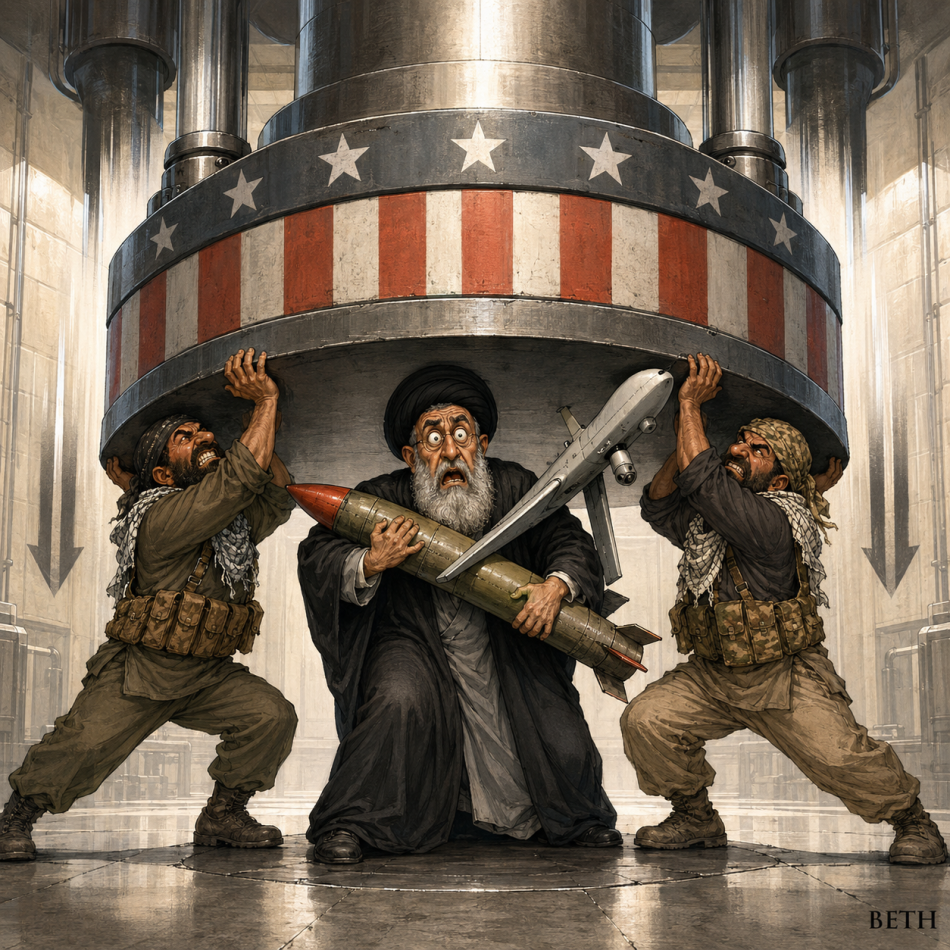
Pakistan announces “significant progress” toward ending the war and reopening Hormuz, while Iran threatens to retaliate against the economic blockade and Washington begins with 60 targets but postpones using the weapon of exclusion from the dollar system
August 25, 2026
Monitoring and Analysis | Strategic Media Department – BETH Agency
The first diplomatic development following the announcement of the expanded US sanctions emerged from Tehran, where Pakistan announced that “significant progress” had been achieved in talks held by Pakistani Army Chief Field Marshal Asim Munir with the Iranian leadership. The discussions sought to prevent further escalation, reopen the Strait of Hormuz, and accelerate an end to the war.
Pakistani Interior Minister Mohsin Naqvi, who accompanied Munir on his visit, said the talks with Iranian President Masoud Pezeshkian were “positive and productive,” and that the president had openly presented his government’s position and concerns.
A statement issued by the Pakistani military said that, in addition to the Iranian president, Munir met Parliament Speaker Mohammad Bagher Ghalibaf, Foreign Minister Abbas Araghchi, Interior Minister Eskandar Momeni, and Mohsen Rezaei, the Supreme Leader’s representative on the Supreme National Security Council.
The meetings focused on three issues: preventing further escalation, reopening the Strait of Hormuz, and swiftly reaching a negotiated settlement to end the war. However, the Pakistani side did not disclose the nature of the progress achieved or the concessions Iran had shown a willingness to make. Washington also issued no immediate comment on the outcome of the visit.
Before arriving in Tehran, Munir spoke with US President Donald Trump, strengthening his position as a messenger between the two sides.
Iran Threatens Retaliation
Iran, meanwhile, threatened to retaliate against the expanded US economic sanctions, which Washington said would sever the Islamic Republic’s economic lifeline. Tehran expressed confidence that its main trading partners would resist the US pressure campaign.
Iranian Economy Minister Ali Madanizadeh said the government had anticipated these measures and prepared a two-year plan to deal with them. He spoke of moving from economic defense to what he described as offensive action.
This was accompanied by military threats from Iranian officials to target US interests if Iranian infrastructure came under renewed attack, in an attempt to link financial pressure to the prospect of military escalation.
Sixty Targets
US Treasury Secretary Scott Bessent unveiled the first stage of the measures, targeting approximately 60 individuals, entities, and vessels connected to Iranian oil revenues, weapons procurement, cyber operations, and shipping and financing networks.
The measures covered companies and assets in China, Hong Kong, Singapore, the UAE, and Europe, including businesses linked to the oil trading and shipping network operated by Iranian businessman Mohammad Hossein Shamkhani.
However, Bessent stopped short of the most severe measures he had previously threatened. He did not announce the exclusion of countries or major Chinese banks from the dollar-based financial system, nor did he identify the countries that would be subjected to secondary sanctions or specify when those sanctions would take effect.
He said countries continuing to trade with Iran risked having their institutions excluded from the dollar-based financial system, but indicated that they would be given a period in which to comply with the new directives.
This reveals a distinction between the sanctions that have already taken effect, targeting the 60 individuals, companies, and vessels, and the broader financial blockade, which remains a threat directed at countries and institutions dealing with Iran.
Monday’s announcement was therefore not the “full economic strike” that had been promoted in advance, but the gradual beginning of a campaign through which Washington is seeking to push Iran’s partners to withdraw before moving to punish them.
More details from BETH: Washington Launches the “Economic Pariah”
China Outside the First Strike
Bessent explained that the United States had avoided targeting major Chinese banks during the first stage to prevent widespread disruption to the global financial system, even though China is the largest buyer of Iranian oil.
This reveals the first limitation of the US campaign: the United States can sanction vessels, companies, and intermediaries, but if it wants to stop Iranian trade entirely, it will need to confront China and other economies that reject unilateral sanctions.
Beijing renewed its rejection of the US measures and affirmed that it would protect its legitimate interests. Tehran, meanwhile, is relying on China and its other trading partners to resist full compliance with Washington’s demands.
Pressure in Two Directions
While Washington is placing pressure on the Iranian economy, Tehran is attempting to transfer that pressure to global energy flows through the Strait of Hormuz.
Iran has placed 45 tankers on a list of vessels it says violated the transit rules it imposed in the Strait. It threatened to fine or detain them, or confiscate their cargoes, while extending the penalties to vessels cooperating with them in ship-to-ship cargo transfers.
The list includes large oil and gas tankers, some linked to Gulf and Asian companies. This means that Tehran has begun transforming its general threats into lists of specific maritime targets.
What Does “Progress” Mean?
Pakistan’s announcement of progress in the negotiations comes amid two opposing movements: Washington is beginning to economically suffocate Iran, while Tehran is expanding its ability to threaten vessels and the oil trade.
The real test of Field Marshal Asim Munir’s visit will therefore not be whether the talks are described as positive, but whether measurable steps begin to emerge:
- Iran agrees to increase vessel traffic through the Strait of Hormuz.
- Implementation of threats against blacklisted tankers is suspended.
- A date is set for a new round of US-Iranian negotiations.
- Agreement is reached on an interim formula to restore the June understanding.
- Washington temporarily refrains from extending sanctions from companies to countries and major banks.
Conclusion
On its 174th day, the war has entered a phase combining mediation and threats at the same moment.
Pakistan speaks of significant progress, but Tehran has not announced the reopening of the Strait. Washington has announced new sanctions, but it has yet to deploy its most powerful weapons against the countries and banks dealing with Iran.
This means that both sides have preserved a small margin for maneuver: the United States has reserved exclusion from the dollar system for the next stage, while Iran has threatened retaliation but continues to receive mediators.
Economic pressure has begun, but the “economic D-Day” remains incomplete. Mediation has begun to move, but the road to peace has not yet opened.