



Day 173: Sanctions Approach as Iran Buys Time
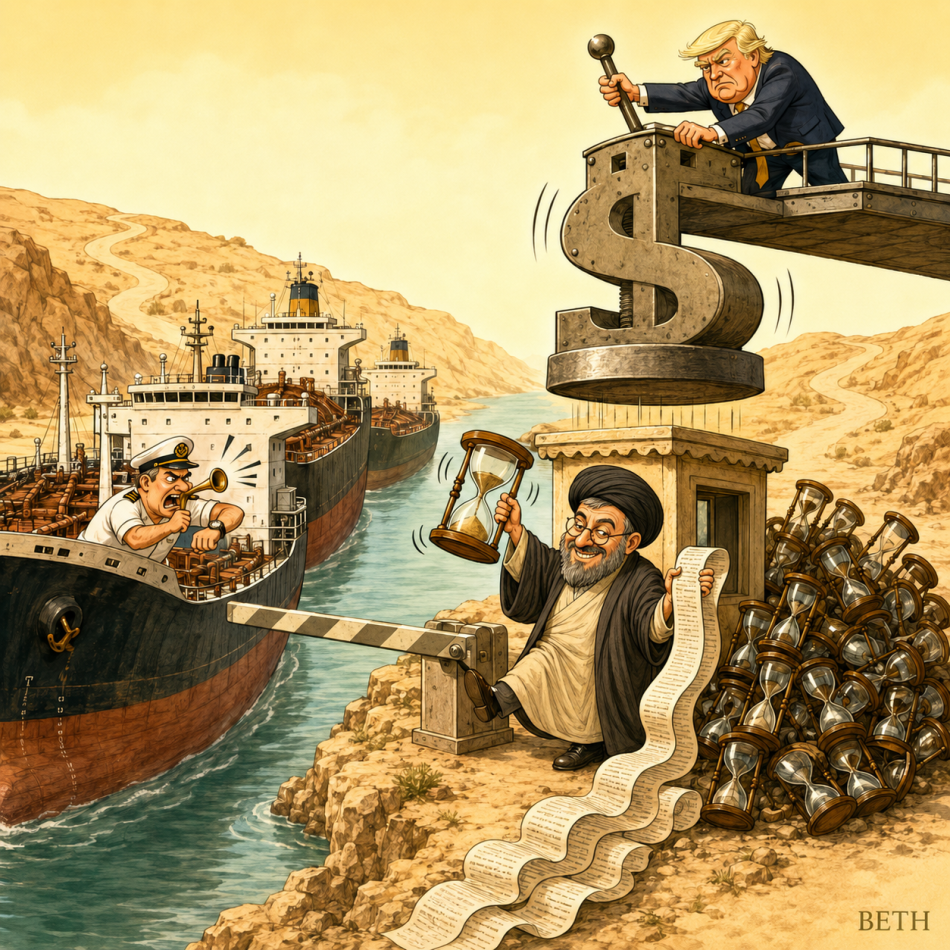
Washington prepares to announce its broadest financial blockade of Tehran, while Iran confronts it on four simultaneous fronts: threatening countries, regulating passage through Hormuz, bringing in mediators, and keeping the door to negotiations open
August 24, 2026
Prepared and analyzed by | Strategic Media Department – BETH Agency
Supervised by: Abdullah Alomairah
Iran and the world are awaiting an announcement this Monday evening by U.S. Treasury Secretary Scott Bessent detailing what Washington has described as the toughest package of sanctions ever imposed on Tehran.
Bessent is expected to hold his press conference at 2:00 p.m. U.S. Eastern Time, 9:00 p.m. Riyadh time. The new phase of the United States’ economic war has therefore not yet begun in practice. What is available so far is the announcement of an economic offensive whose instruments, designation lists, and enforcement mechanisms have yet to be disclosed.
Iran, however, has not waited for the details.
In the hours preceding the announcement, Tehran has distributed its response across four tracks that may appear contradictory but serve a single objective: delaying the blockade, raising its cost, and preventing the formation of a unified international front around it.
It is threatening countries that may join the sanctions.
It is establishing Iranian rules for passage through the Strait of Hormuz.
It is receiving Pakistan’s army chief as a mediator.
At the same time, it is speaking of dialogue and a return to the June memorandum of understanding.
These are not isolated positions. They constitute an Iranian strategy for managing time in the hours preceding its most serious economic test since the outbreak of the war.
The Sanctions Have Not Yet Begun
What Washington has announced so far is its intention and the anticipated political scale of the measures, not the full operational list.
Bessent’s statements suggest that the package will not be limited to targeting institutions inside Iran. It will pursue what remains of Tehran’s external connections: oil buyers, shipping and insurance companies, intermediary banks, transfer networks, and countries that provide Iranian trade with outlets for survival.
This is a fundamental distinction.
Previous sanctions constrained Iran but left room for circumvention through China, regional trade networks, the shadow fleet, digital currencies, and indirect financial transfers.
According to Washington’s rhetoric, the forthcoming package seeks to shift the burden of punishment from the Iranian party alone to everyone who assists it.
The strength of the package, however, will not be measured by the number of individuals and companies placed on its lists, but by the answers to three questions:
Can the United States force China to reduce its purchases of Iranian oil?
Will other countries accept the application of U.S. sanctions to their own trade and banking systems?
And does Washington possess the long-term capacity to monitor tankers, financial transfers, and channels of circumvention?
The expected announcement is therefore not the end of the Iranian economy. It is the beginning of a test of the United States’ ability to turn the influence of the dollar into an international coalition against Tehran.
China has already begun resisting this approach. It has declared that it will take the necessary measures to protect its interests and rejected sanctions and pressure as instruments for resolving the crisis.
This reveals the package’s first limitation even before it is issued: Washington can announce sanctions unilaterally, but it cannot guarantee a comprehensive blockade on its own.
Iran Threatens Its Neighbors
Tehran escalated its rhetoric ahead of the announcement. Mohsen Rezaei, head of Iran’s Supreme National Security Council, said that supporting the new U.S. sanctions could be regarded as an “act of war.”
The warning is not directed at Washington alone. Its intended targets are countries that may prevent Iranian transactions, close financial and commercial outlets, or assist the United States in enforcing the blockade.
Iran is attempting to change the question facing the countries of the region from:
Will you join the sanctions?
To:
Are you prepared to bear the Iranian response if you do?
It is an attempt to raise the cost of cooperation with Washington before that cooperation is formally requested, while widening fears that financial measures could turn into military or security targets.
The threat, however, also exposes an Iranian predicament.
A state seeking to reduce its isolation cannot easily threaten its neighbors because it fears their participation in isolating it, and then expect them to defend its right to trade.
The more Tehran expands the circle of its threats, the more it gives Washington an additional argument for building an economic front against it.
Hormuz Becomes a Permit System
On the second track, Iran did not announce the reopening of the Strait of Hormuz. Instead, it announced rules for punishing ships that fail to comply with its new system, including fines, detention, confiscation, and the placement of vessels and those dealing with them on lists of violators.
What may appear to be a maritime procedure is, in reality, an attempt to create a new political reality.
Iran wants to move from closing the strait by force to managing passage through permission, and from targeting ships to subjecting them to a system of licensing and punishment established unilaterally by Tehran.
This is more dangerous than a temporary closure.
A closure is a condition of war that can be brought to an end. A system of permits, fees, and lists, however, seeks to turn the outcome of the war into permanent authority.
Data from Kpler shows that the 60-day memorandum of understanding did not restore normal conditions in the strait. It enabled the clearance of approximately 374 million barrels of accumulated cargo and raised crude flows to an average of 6.1 million barrels per day, but that remained at only around 40% of the 2025 average of nearly 15 million barrels per day.
In other words, the memorandum released stranded oil, but it did not restore freedom of navigation.
This is a different reading from counting ships day after day: the problem is not how many vessels crossed, but that passage itself has become an exception requiring an arrangement, rather than a stable international norm.
Munir Is Not Starting from Scratch
Field Marshal Asim Munir is arriving in Tehran on his third mediation-related visit since the outbreak of the war.
His latest mission does not begin from nothing. Pakistan carried the June memorandum of understanding, which established a 60-day window that expired on August 17 without a final agreement or an extension.
Munir is therefore not merely seeking to formulate a new agreement. He is attempting to prevent the collapse of what remains of the previous one.
His visit comes only hours before the sanctions announcement, giving it significance beyond routine consultation. He may be carrying a final opportunity for Tehran to soften the package or delay some of its effects, or he may return with an assessment of the Iranian response that will follow.
Pakistan’s mediation capacity, however, faces a clear obstacle.
Washington wants an Iranian commitment before easing the pressure.
Iran wants the pressure eased before offering a new commitment.
Each party is using the mediator to transmit its conditions, not to modify them.
Munir may therefore succeed in preventing an imminent strike or keeping the communication channel open, but he cannot alone resolve a dispute that expands every day—from the nuclear file to the strait, and from the naval blockade to international sanctions.
Oman Prepares the Ground
The Omani initiative is not a sudden visit beginning tomorrow.
On August 21, U.S. Secretary of State Marco Rubio met Oman’s ambassador in Washington. On the same day, Omani Foreign Minister Badr Albusaidi held a telephone conversation with his Iranian counterpart, Abbas Araghchi, to discuss creating suitable conditions for the resumption of dialogue and negotiations.
Muscat was therefore moving between the two parties before Albusaidi’s visit to Tehran was announced.
These details change the reading of the visit.
The Omani foreign minister is not heading to Iran merely to discuss shipping routes. He carries the outcome of two parallel contacts with Washington and Tehran and is attempting to find space between U.S. sanctions and Iranian conditions.
Oman’s declared position upholds freedom and safety of navigation in accordance with international law. This differs fundamentally from Iran’s attempt to subject passage to rules it has established unilaterally.
Muscat’s mission is therefore not limited to drawing a corridor between Iranian and Omani waters. It extends to protecting the principle that an international waterway must not become a gateway requiring Iranian permission.
Two Iranian Narratives
While Iranian officials have described the sanctions as an act of war, President Masoud Pezeshkian has defended the June memorandum of understanding and called it the best path out of the war.
Foreign Minister Abbas Araghchi has also described the U.S. threats as desperate, while simultaneously speaking of the possibility of dialogue if it is based on respect.
Tehran is not merely positioned between war and peace. It is caught between two conflicting needs:
It needs a hard-line narrative that prevents it from appearing to have submitted to sanctions.
It also needs a diplomatic narrative that keeps mediators and hesitant countries away from the U.S.-led front.
Rezaei therefore leads with threats, Pezeshkian speaks of the memorandum, and Araghchi attacks the sanctions while leaving the door to dialogue open.
This is not complete disorder in Iran’s messaging. It is a distribution of roles: a message of deterrence abroad, a message of resilience at home, and a narrow opening for mediators.
Why Is Iran Buying Time?
Every day that passes before the sanctions are fully enforced gives Iran an opportunity to move funds, change the ownership of vessels, reorganize intermediary companies, redirect cargoes, and establish new channels of circumvention.
Every day that Hormuz remains unstable also preserves a bargaining card that Washington and the world fear losing control over.
At this stage, Iran does not need a comprehensive agreement as much as it needs to prevent the United States from achieving three objectives simultaneously:
Closing its financial outlets.
Restoring navigation without paying a political price.
Bringing China, the countries of the region, and energy companies together in a single front against it.
This explains the diversity of Iran’s positions.
Threats discourage countries from moving closer to the blockade.
Mediation delays escalation.
The rules in Hormuz establish a new authority.
And talk of dialogue prevents Tehran from bearing sole responsibility for the failure of peace.
Saudi Arabia Faces a Different Test
The Kingdom does not face a binary choice between U.S. sanctions and the Iranian position.
Saudi interests require preventing Iran from threatening the countries of the region or turning Hormuz into a political gateway, while also preventing the economic war from rebounding against energy markets, trade, and the region’s populations.
Iran’s threat to regard support for the sanctions as an act of war cannot be treated as mere political rhetoric. It expands Tehran’s definition of the enemy from the United States to every country that enforces financial measures against it.
The attempt to impose fees, permits, and lists on vessels also affects the principle of freedom of navigation, not merely the interests of one state.
This is where the importance of the Saudi approach becomes clear: protecting maritime routes, diversifying export channels, and supporting a political solution, while rejecting any attempt to make the Gulf states pay the price for a crisis Iran created with the United States.
What Are We Awaiting Tonight?
The importance of Bessent’s announcement does not lie in describing the sanctions as the toughest ever, but in their details:
Will they target China directly or leave it an exit?
Will they include non-Iranian banks, insurance companies, and ports?
Will they grant grace periods or take effect immediately?
Will they automatically penalize buyers of Iranian oil, or leave enforcement to Washington’s discretion?
And will they include exemptions for energy, food, and medicine?
The answers will determine whether the U.S. announcement constitutes an enforceable blockade or a massive package on paper that collides with Chinese opposition, allied concerns, and the world’s need for energy.
For this reason, once the sanctions are announced, their details will be examined in a separate, expanded report assessing their instruments, enforceability, the countries affected, and Iran’s potential response.
Conclusion
On Day 173, Iran is not passively awaiting the sanctions.
It is threatening countries, placing its hand on the gateway to Hormuz, receiving a Pakistani mediator, preparing to welcome the Omani foreign minister, and simultaneously declaring its commitment to dialogue.
This is not a single Iranian response, but an attempt to disperse the U.S. offensive across several fronts before it begins.
Washington wants to turn every economic relationship with Iran into a liability.
Tehran wants to make every participation in the blockade a risk, every passage through Hormuz a privilege, and every delay in the sanctions a gain.
The sanctions arrive tonight, but Iran has already begun its most important battle: preventing the world from enforcing them alongside Washington.