



Day 172 | Tehran Speaks with Two Voices
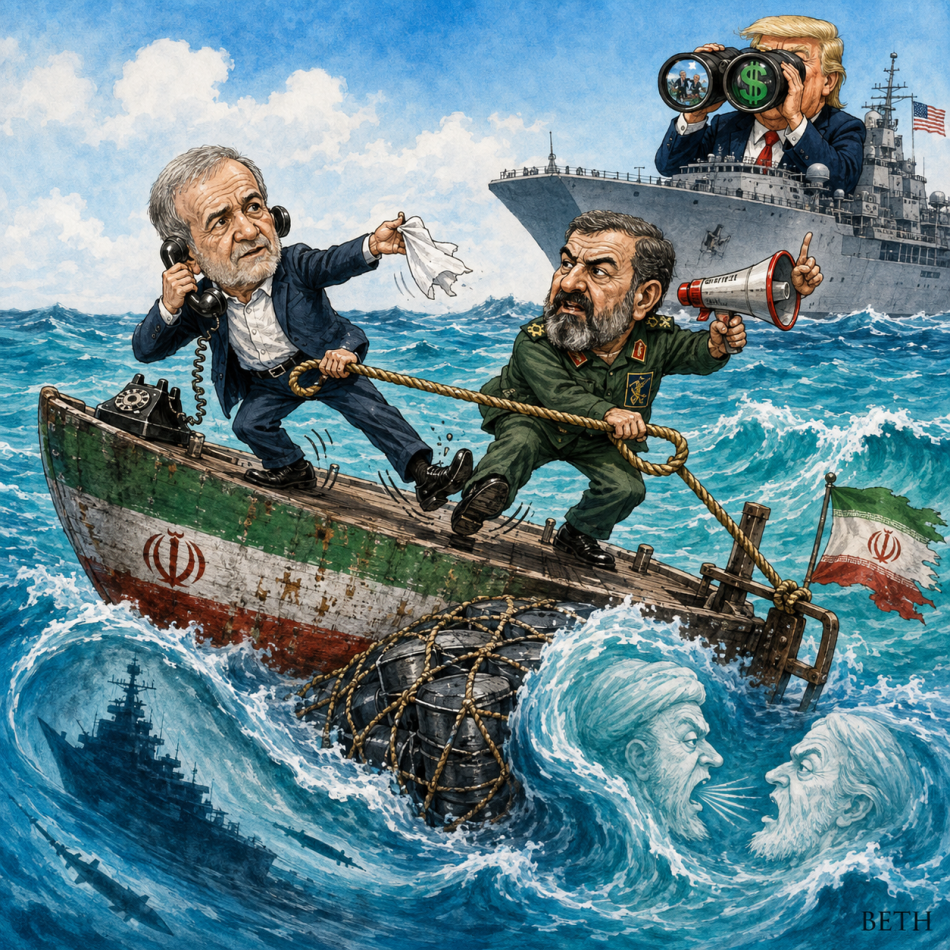
Pezeshkian calls for ending the war before Iran’s strength erodes, while Rezaei demands a change in diplomacy and threatens a “seismic retaliation.” Has the Iranian establishment split, or are roles being assigned for one final deal?
Day 172 | August 23, 2026
Prepared and analyzed by the Strategic Media Department – BETH Agency
News Brief
A Public Rift in Tehran
A clear divergence has emerged within the Iranian establishment over how the next phase of the war should be managed.
President Masoud Pezeshkian has called for ending the war with the United States before the economic situation deteriorates further, stressing the need to act while Iran is still able to negotiate “from a position of strength.”
Pezeshkian’s position does not mean accepting American terms. Rather, it reflects an awareness within the executive branch that a prolonged economic war could diminish Tehran’s room for maneuver, and that an offer available today may no longer be available tomorrow.
By contrast, Mohsen Rezaei, secretary of the Supreme National Security Council, adopted a more hardline tone. He called for “reforming Iran’s diplomatic conduct” following what he described as the United States’ failure to honor its commitments, and threatened President Donald Trump with a “seismic retaliation” if he undertook any new action.
Rezaei also played down the significance of the economic war, dismissing it as American propaganda and asking: What can Washington do that it has not already done?
However, the difference in tone does not necessarily indicate disagreement over the objective. It may be an extension of a recurring Iranian approach to managing crises and negotiations, based on complementary roles: a political discourse that opens the door to a settlement and a security discourse that raises the cost of rejecting it.
Pezeshkian presents the United States with the image of a party with whom an agreement can be reached, while Rezaei reminds it of what may happen if the political window closes. This gives Tehran negotiating flexibility without making it appear submissive, allowing it to use threats to improve the terms of an agreement rather than necessarily prevent one.
What is new, therefore, is not the presence of moderates and hardliners within Iran, but the public display of this division of roles at an extremely sensitive moment. What appears on television screens to be a split may in fact be two-voiced bargaining within a single strategy: one voice offering a way out, and another threatening the consequences of ignoring it.
A Threat Beyond Hormuz
Rezaei warned neighboring countries against participating in the American economic war, saying Tehran would regard any country that joined it as a “hostile state.”
More seriously, he did not confine Iran’s response to the Strait of Hormuz, but threatened economic interests and alternative oil export routes beyond it.
In theory, this statement creates a broad circle of potential targets that includes:
- Red Sea ports.
- Pipelines that bypass Hormuz.
- Ship-to-ship transfer operations.
- Storage and export facilities.
- Insurance and shipping companies linked to the United States.
- The oil interests of countries participating in the enforcement of sanctions.
The statement does not prove that a decision to carry out attacks has been made. It does, however, reveal a shift in Iranian thinking—from defending influence within a single strait to threatening the network of alternatives Iran’s adversaries are building to bypass it.
The Blockade Is Working—but Remains Porous
Washington is preparing to announce what it has described as “the toughest financial sanctions in history” against Iran, while expanding secondary sanctions to include countries, banks, and companies that provide Tehran with access to trade or financing.
Rezaei, however, said Iran had exported approximately 70 million barrels of oil over the past two months, equivalent to an average of nearly 1.17 million barrels per day.
The figure cannot be treated as an independently verified fact. It exceeds several estimates of Iran’s actual exports during the same period and contradicts Iranian indicators pointing to a sharp decline in oil revenues.
The figure may include shipments that departed during the ceasefire, oil transferred from floating storage, or quantities that have yet to reach final buyers.
Nevertheless, the message carries an important meaning: Tehran wants to convince audiences at home and abroad that the United States can reduce its exports but cannot bring them down to zero.
The blockade is therefore placing pressure on the Iranian economy, but it continues to face leakage through China, dark-fleet tankers, the switching of flags and documentation, and ship-to-ship transfers at sea.
Hormuz: More Traffic, Less Security
Vessel traffic through the Strait of Hormuz increased during the past week compared with the low levels recorded in early August. Maritime data indicated that approximately 192 vessels transited the strait, compared with 40 two weeks earlier.
However, this represents only about 20% of prewar traffic, while a substantial proportion of vessels are transiting after switching off their tracking systems or reducing their electronic visibility.
The United Kingdom Maritime Trade Operations center continues to classify the threat level in the region as severe, while shipping and insurance companies remain wary of mines, projectiles, drones, and vessel seizures.
This illustrates the difference between the United States succeeding in increasing the number of transiting vessels and succeeding in restoring normal conditions in the strait.
Washington is widening the passage window, but it has yet to restore the security environment that would allow vessels to enter without exceptional protection or elevated insurance costs.
Iraq Passes with Iranian Permission
Iran granted several Iraqi oil tankers special permission to pass through Hormuz following repeated diplomatic efforts by Baghdad and a visit to Iraq by Iranian Parliament Speaker Mohammad Bagher Ghalibaf.
The move appears humanitarian and economic toward Iraq, but it also carries a precise political message:
Tehran wants to demonstrate that passage is not secured by American force alone, and that it retains the ability to determine who may pass and when.
Iraq, however, does not want its daily economic fortunes to depend on Iranian permission. It is therefore working to expand exports through Türkiye’s Ceyhan port and exploring future routes through Syria’s Baniyas and Jordan’s Aqaba.
The Proxy War Is Changing
As of this morning, there had been no verified announcement of a new large-scale wave of attacks by Iran’s proxies against American forces. Iranian threats, however, indicate a possible change in target selection.
Rather than expend its remaining missiles and drones on direct military attacks of limited effect, Tehran may turn to its proxies to target:
- Alternative oil routes.
- Ports and facilities near the Red Sea.
- Vessels linked to countries joining the sanctions.
- Local forces protecting energy corridors.
- American economic interests that are less heavily fortified than military bases.
In Yemen, the Houthis continued exerting pressure on Marib and Red Sea routes, but there is still no evidence that Rezaei’s threat has been translated into a comprehensive operational directive to Iran’s proxies.
The distinction is important: raising the threat level may be intended to deter countries from participating in the sanctions before it becomes a decision to expand the war.
Military Movement: Force on Standby
The latest American military statements do not indicate the start of a new major air campaign inside Iran. The last extensive wave officially announced by the United States Central Command took place in July, while current operations are focused on enforcing the blockade, protecting navigation, monitoring ports, and preparing to intercept Iranian vessels.
This means American forces have not withdrawn from the conflict. Instead, they have moved from intensive firepower to a ready-force posture.
The naval and air deployment serves three functions:
- Enforcing the blockade and pursuing noncompliant vessels.
- Protecting selected shipping lanes and tankers.
- Keeping the option of strikes open if Iran responds militarily to the sanctions.
This explains Trump’s statement that the transition to economic warfare does not mean military options have been exhausted.
The weapon has not left the stage; it stands behind the sanctions to enforce them and enhance their credibility.
Cairo Reopens a Negotiating Channel
Egyptian Foreign Minister Badr Abdelatty discussed with his Iranian counterpart, Abbas Araghchi, the possibility of reopening negotiating channels between Iran and the United States.
There are no direct negotiations or scheduled rounds so far. However, Egypt’s initiative confirms that regional states are preparing for a moment when both parties may need a new mediator or an additional channel alongside Oman, Qatar, and Pakistan.
Tehran wants to keep the mediation door open without appearing to seek an agreement under threat, while Washington needs a channel capable of determining who truly holds decision-making authority inside Iran.
The visible divergence between Pezeshkian and Rezaei, however, makes the mediators’ task more complicated:
Do they negotiate with the government that wants to stop the war, or with the security establishment capable of continuing it?
Analysis
A Dispute Over Time
The two Iranian currents do not necessarily disagree over resisting American dominance or protecting the regime. They differ over the most dangerous element in the war: time.
Pezeshkian believes time is working against Iran. Every week of blockade reduces revenues, weakens the currency, disrupts production, and raises the cost of economic recovery.
Rezaei, by contrast, is betting that time may also work against the United States. Continued disruption in Hormuz raises energy and insurance costs, pressures Washington’s allies, and creates friction between the United States, China, and countries opposed to secondary sanctions.
The first fears that Iran may later lose what it can negotiate over today.
The second believes that negotiating today could hand the United States a victory it did not fully achieve on the battlefield.
A Split or a Division of Roles?
The situation can be read in two ways.
The first is that Iran is assigning roles: Pezeshkian opens the door to an agreement, while Rezaei raises its price and threatens escalation, seeking to convince Trump that the alternative to a deal would be more dangerous.
The second is that a genuine institutional split exists between a government confronting collapsing economic indicators and a security establishment that believes retreating now could threaten the regime itself and ignite an internal struggle over responsibility for the outcome of the war.
Most likely, the situation combines both.
There is a genuine difference in assessing the danger, but each side is also using its position to support a potential Iranian negotiator: Pezeshkian offers a way out, while Rezaei places a threat behind it.
Yet this division of roles remains dangerous if the final decision is not tightly controlled. The pressure tactic could turn into an internal confrontation, or one of Iran’s proxies could launch an attack that destroys the channel the other side is trying to open.
The Economy Has Entered the Decision Room
The United States sought to make Iran’s economy exert pressure on its political decision-making.
What is new is that this pressure has begun speaking from inside Tehran in two voices:
One fears that the time for an agreement may run out.
The other fears that an agreement now would amount to an admission of defeat.
This does not mean sanctions have decided the war. Iran has lived under sanctions for decades and developed complex networks for smuggling and circumventing the Western financial system.
The difference this time is that the sanctions come after extensive destruction, a naval blockade, domestic disruption, and a simultaneous decline in Iran’s ability to export oil and import essential goods.
Economic warfare is testing more than the state treasury. It is testing the regime’s ability to pay salaries, finance the security apparatus, protect the currency, and prevent social pressure from becoming a political crisis.
Threatening the Alternatives Is More Dangerous Than Closing Hormuz
The threat against oil routes beyond Hormuz reveals Iran’s awareness that its adversaries are not waiting for the strait to reopen; they are constructing a network that bypasses it.
Saudi Arabia is using the East–West Pipeline and Red Sea ports. Iraq is seeking outlets through Türkiye, Syria, and Jordan, while Gulf states are expanding pipeline, storage, and alternative transport capacity.
If this system succeeds, Iran will lose much of the value of its Hormuz card.
The proxy war could therefore move from defending the strait to attacking the alternatives.
The next battle may not be over who controls Hormuz, but over who can make the world less dependent on it.
Outcomes and Forecasts
Scenario One: Two Voices, One Deal
Tehran continues presenting two contradictory messages while undisclosed contacts begin through Egypt, Oman, or Qatar.
Pezeshkian signals readiness for a settlement, while Rezaei uses his threats to improve its terms, potentially leading to an interim agreement involving limited relief from the blockade in return for expanded safe passage through Hormuz.
This is the most plausible scenario if no major strike occurs in the coming days.
Scenario Two: The Security Establishment Decides the Direction
If the Islamic Revolutionary Guard Corps concludes that the sanctions are intended to bring down the regime, it may impose an economic counterstrike through its proxies, targeting alternative oil routes or the interests of countries participating in the blockade.
That would give Trump justification to resume military strikes and weaken the current inside Iran that favors negotiations.
Scenario Three: A Highly Porous Blockade
Iran may succeed in maintaining part of its exports through China and informal networks without being able to restore prewar levels.
The economy would then neither collapse rapidly nor recover. Instead, the country would enter a prolonged war of attrition that widens divisions within the establishment and society.
Scenario Four: A Proxy’s Miscalculation
The most dangerous possibility remains an attack that Tehran does not intend to develop into a wider war but that strikes a major oil facility or kills large numbers of American or Gulf military personnel.
Proxies give Iran plausible deniability, but they also deprive it of some control over the timing and scale of escalation.
Assessment
The most significant development on Day 172 is neither Rezaei’s threat alone nor Pezeshkian’s call to end the war, but the appearance of both messages side by side before the world.
The conflict has moved from destroying missiles and vessels to a struggle over how Iran’s own national interest is defined:
Does that interest lie in holding out until the United States retreats?
Or in reaching an agreement before endurance becomes irreparable attrition?
The security establishment still controls the weapons, the proxies, and the ability to disrupt maritime corridors. The government, however, holds the economic figures that slogans cannot change.
Washington, in turn, can narrow Iran’s outlets, but it cannot guarantee that economic strangulation will produce the deal it wants. Pressure may drive Tehran toward negotiations, or it may drive the security establishment to use what remains before losing it.
Economic warfare has not yet broken Iran, but it has broken the unity of the language in which it speaks.
Since the economy entered the decision-making room, Tehran has no longer spoken with one voice: one is racing against time to reach an agreement, while the other threatens to set every route ablaze so that it does not appear to have arrived at the negotiating table in defeat.