



Day 171 | A Deal Searching for a Decision
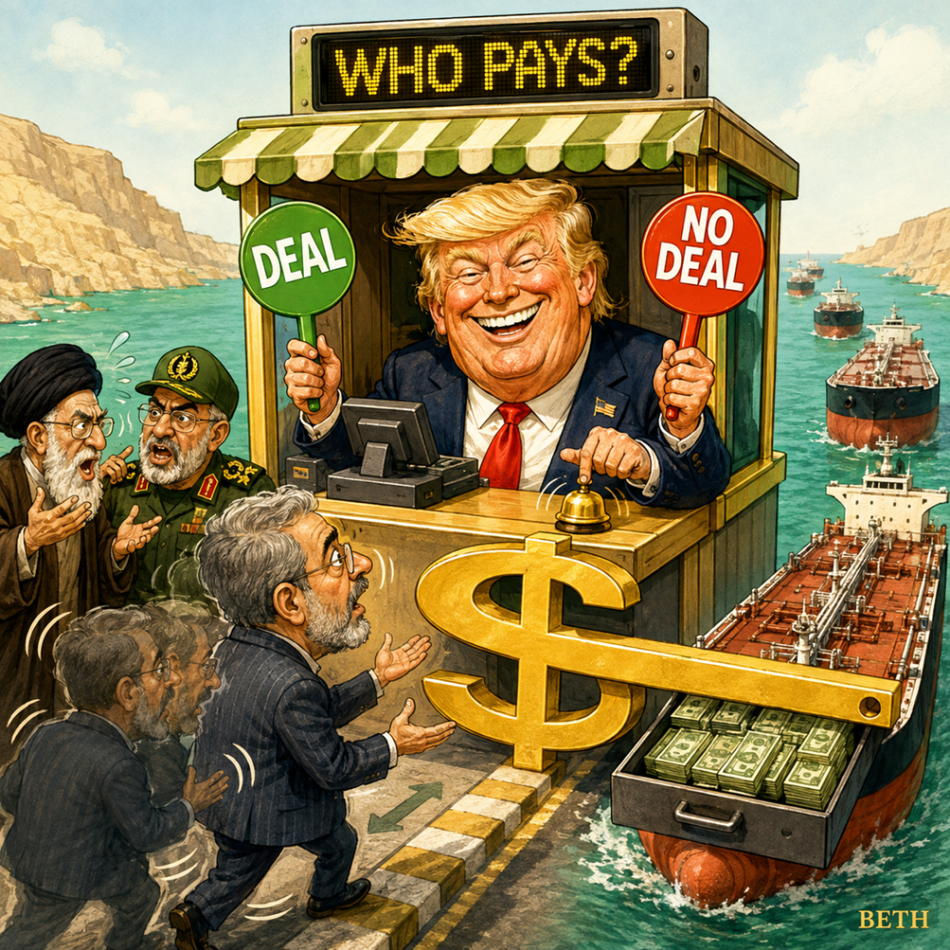
Trump says Iran wants an agreement but that he does not know whom to negotiate with, while the Iranian president calls for ending the war “from a position of strength.” The problem is not the absence of people as much as the absence of a unified decision and enforceable guarantees
Day 171 | August 22, 2026
Prepared and analyzed by the Strategic Media Department – BETH Agency
Supervised by Abdullah Al Omairah
News Brief
Trump Wants the Deal—and Does Not
U.S. President Donald Trump said Iran “desperately wants” to reach an agreement, but added that the United States does not know whether it wants a deal at all.
In the same remarks, he said he did not know whom Washington could negotiate with inside Iran because most of its leaders had been killed, adding that he did not believe anyone wanted to assume the presidency of the country.
Trump reiterated that Iran would not be allowed to possess a nuclear weapon and that U.S. military options remained available, despite the shift in the center of pressure toward economic warfare.
Tehran Offers an Exit on Its Own Terms
Iranian President Masoud Pezeshkian, meanwhile, called for ending the war now, saying Iran should do so from a “position of strength and dignity.”
Pezeshkian defended the previous memorandum of understanding with the United States, insisting that it did not represent an Iranian surrender or concession. His remarks reflect a desire among part of Iran’s leadership to return to a political track before sanctions intensify and economic conditions deteriorate further.
That position, however, does not appear to command a consensus. Iranian military leaders continue to threaten a “devastating” response and insist on retaining the Strait of Hormuz as leverage. This reveals a divide between those seeking to end the war through an agreement and those who believe that continued resistance and disruption can still improve Iran’s terms.
Toughest Sanctions Await Monday
U.S. Treasury Secretary Scott Bessent is preparing to announce on Monday the details of a new sanctions package that he described as the toughest in history.
The measures are expected to go beyond targeting Iranian institutions and include secondary sanctions against companies and countries that continue to deal with Tehran, particularly China, which purchases more than 80% of Iran’s seaborne oil exports.
Bessent said economic pressure could reduce the need for major U.S. military operations. Trump, however, stressed at the same time that shifting to economic warfare did not mean ruling out military force.
Iranian Parliament Speaker and chief negotiator Mohammad Bagher Qalibaf, during a visit to Baghdad, called for mechanisms to circumvent sanctions, expanded use of national currencies in trade between Iran and Iraq, and reduced dependence on the U.S. dollar.
No Major Fire, but No Peace
The front is not currently witnessing a major exchange of strikes, but the war is not over. It has shifted toward blockades, sanctions, disruption of oil exports, and mutual threats.
The current stage can be described as an undeclared ceasefire without a political agreement or guarantees preventing the resumption of bombardment.
U.S. forces remain positioned to resume operations if Iran carries out a major attack or targets ships, energy facilities, or American bases.
Hormuz Disproves Claims of Full Control
Trump repeated his claim that the United States has “complete control” over the Strait of Hormuz and went further by describing it as “American territory.”
That characterization is political and theatrical, however, and does not alter the strait’s legal status. Hormuz is an international waterway governed by the rules of transit passage. Its waters fall within the maritime zones of Iran and the Sultanate of Oman; it is not U.S. territory.
Shipping data also do not support claims that full operational control has been restored. Only seven commercial cargo vessels crossed the strait on Friday—half the number recorded the previous day—while major oil shipments remained largely halted.
The United States can therefore move ships and secure limited passage, but it has not yet restored normal operations in the strait or convinced shipping and insurance companies that the danger is over.
Oil Does Not Believe the End Is Near
Brent crude ended Friday’s trading near $93.30 a barrel, amid continued concern over supply disruptions and falling vessel traffic.
Trump predicted that energy prices would fall once operations involving Iran ended. That is logical in terms of market direction, but the problem is that economic warfare and secondary sanctions could prolong the crisis rather than end it quickly.
The market does not price bombardment alone. It also prices the risks of sanctions, disrupted exports, higher insurance costs, and possible Iranian retaliation against energy facilities and maritime routes.
Trump’s Figures Require Scrutiny
Trump said inflation in Iran had reached 300% and that Tehran had become unable to pay the salaries of soldiers and police officers.
There is no dispute that the Iranian economy is facing a severe crisis or that halted oil exports, frozen funds, and sanctions have weakened the state’s financing capacity. The available inflation figure for July, however, is approximately 87.9%—a catastrophic rate, but far below 300%. There has also been no independent confirmation that salaries for the military and police have stopped being paid on a comprehensive scale.
Trump’s statements should therefore be treated as part of a psychological pressure campaign rather than definitive economic figures unless they are supported by reliable data.
Analysis
Did Trump Contradict Himself?
Yes, there are clear contradictions in Trump’s remarks, although not all of them result from confusion. Some serve a deliberate negotiating style.
Trump says:
- Iran desperately wants an agreement.
- The United States does not know whether it wants an agreement.
- He does not know whom to negotiate with.
- The United States is prepared to continue applying pressure until Iran submits to its terms.
These messages combine an open door with humiliation of the party standing before it. Trump wants to say that Iran is the side in need of an agreement, that Washington is in no hurry, and that the remaining Iranian leadership lacks sufficient power or legitimacy to impose its terms.
He is therefore attempting to seize the advantage before any negotiations begin: Iran is asking to be saved, while the United States decides whether to offer it an exit.
Washington Knows the Negotiator
Trump’s claim that he does not know whom to negotiate with should not be understood literally.
Iran has a serving president, Masoud Pezeshkian; a parliament speaker and chief negotiator, Mohammad Bagher Qalibaf; and a foreign minister, Abbas Araghchi. Qalibaf and Araghchi have already participated in previous negotiations with the United States, while Qalibaf announced Iran’s conditions for reopening Hormuz this week.
The problem, therefore, is not that Washington does not know the names of the negotiators. It either does not know—or says it does not trust—who holds the final decision-making authority within the Iranian system.
The president may want to end the war and the negotiator may agree to a formula, but the Islamic Revolutionary Guard Corps controls the tools of escalation in the strait. The supreme leadership can obstruct an agreement, while Iranian institutions damaged by the assassinations have not fully regained their balance.
The real American question is not:
Who will sit at the table?
It is:
Who can guarantee that what is signed at the table will be implemented at sea, at the nuclear facilities, and across the military bases?
Pezeshkian Sends a Negotiating Signal
The Iranian president’s call to end the war “from a position of strength” represents the first clear indication that part of the leadership believes waiting could leave Iran facing worse terms.
He cannot advocate an agreement as an economic necessity because that would be presented domestically as a defeat. He therefore precedes the call with declarations of victory and dignity, attempting to construct a narrative that would permit a return to negotiations without acknowledging defeat.
This resembles Trump’s rhetoric from the opposite side.
Trump says Iran is begging for an agreement, but that he does not know whether he wants one.
Pezeshkian says Iran has won and that the time has therefore come to end the war.
Both want to preserve the image of the victor before approaching the settlement table.
Military Control Is Not Political Control
The United States says it has destroyed most of Iran’s military capability, controls Hormuz, and prevents Iran from exporting oil.
Yet the strait’s continued near-paralysis after 171 days means U.S. power has still not produced the desired political outcome.
Iran cannot drive the United States out of the region or defeat it militarily, but it remains capable of denying Washington a clean declaration that the war is over.
The battle has therefore become one over how victory is defined:
- Washington considers preventing Iran from closing the strait completely a victory.
- Iran considers preventing the restoration of normal navigation a victory.
- Washington views the collapse of Iranian exports as evidence that the blockade is working.
- Tehran sees oil remaining above $90 as evidence that the world is paying the price for strangling Iran.
Four Contradictions in the U.S. Narrative
The first contradiction:
Iran has been defeated militarily, yet the United States needs the toughest sanctions in history to force it into an agreement.
This means military defeat has not been converted into political surrender.
The second contradiction:
Washington has complete control over Hormuz, yet vessel traffic remains in the single digits.
This means naval control does not equal normal commercial operations.
The third contradiction:
Economic warfare will reduce the need for force, yet military options remain open.
This is not a complete contradiction. It is a deterrent message: sanctions are the current instrument, while bombardment remains the reserve punishment if Iran responds militarily.
The fourth contradiction:
Trump expects energy prices to fall after the war ends, but he is pursuing a policy that could prolong the conflict and expand it economically to China and Iran’s other partners.
If the sanctions develop into a U.S.-Chinese economic confrontation, energy and trade costs could rise rather than fall quickly.
Outcomes and Expectations
Monday Will Reveal the Scale of the New War
The most important event in the near term is not a military strike, but the details of the sanctions Bessent will announce.
If the measures are limited to additional Iranian institutions and networks, their effect may be modest because a large part of Iran’s economy is already under sanctions.
If they include broad secondary sanctions against Chinese and Iraqi banks, refineries, shipping companies, and entities in other countries, however, the confrontation will become a global test of Washington’s ability to impose its blockade beyond Iran’s borders.
An Undeclared Negotiating Window
Pezeshkian’s statements do not mean negotiations have begun, but they reveal that the door has not been closed inside Tehran.
A return could begin through a backchannel or a limited understanding involving Hormuz and permission to export a specific volume of oil before moving to the larger files.
Any agreement, however, will require an Iranian party holding a clear mandate from the supreme leadership and the Revolutionary Guard. It will also require U.S. guarantees that Washington will not use a period of calm to reorganize its strikes.
A Calculated Iranian Response
Iran may respond to the sanctions without returning to full-scale war by:
- Tightening its disruption of navigation.
- Carrying out a limited attack on a vessel.
- Mobilizing the Houthis in the Red Sea.
- Launching cyberattacks against ports or financial institutions.
- Expanding informal trade with Iraq and China.
- Using national currencies, gold, and smuggling networks.
The purpose of such a response would be to demonstrate that economic warfare does not operate in only one direction and that preventing Iran from selling its oil will be met by increasing the cost of getting other countries’ oil to market.
The Risk of Division Inside Iran
If the disagreement deepens between the faction calling for an end to the war and military leaders refusing concessions, Tehran may struggle to produce a unified negotiating position.
That temporarily serves Trump because it supports his claim that there is no reliable partner. It also presents a danger to the United States, however. The absence of a disciplined decision-making center could allow a military or naval actor to carry out an attack that destroys any political channel.
Concluding Assessment
The war entered its 171st day without major bombardment, but it is no closer to peace.
Trump says Iran wants a deal, then questions whether anyone is capable of signing it. Pezeshkian calls for ending the war, but presents it as the decision of a victor rather than the request of a state whose economy is being strangled.
Between these two narratives are parties that know each other and individuals who have already negotiated. What is missing is a unified political decision and confidence that an agreement will be implemented after it is signed.
Trump’s statement—“We do not know whom to negotiate with”—is therefore not an accurate description of the absence of an Iranian negotiator. It expresses the deeper problem:
Washington knows who speaks for Iran, but it does not know who can bind Iran.
Tehran, meanwhile, knows what it wants from an agreement, but has not yet decided what it can concede to obtain it.
The negotiator exists, and the desire for an exit is emerging on both sides—but the deal is still searching for a decision.