



Saudi Arabia Reorders Its Priorities
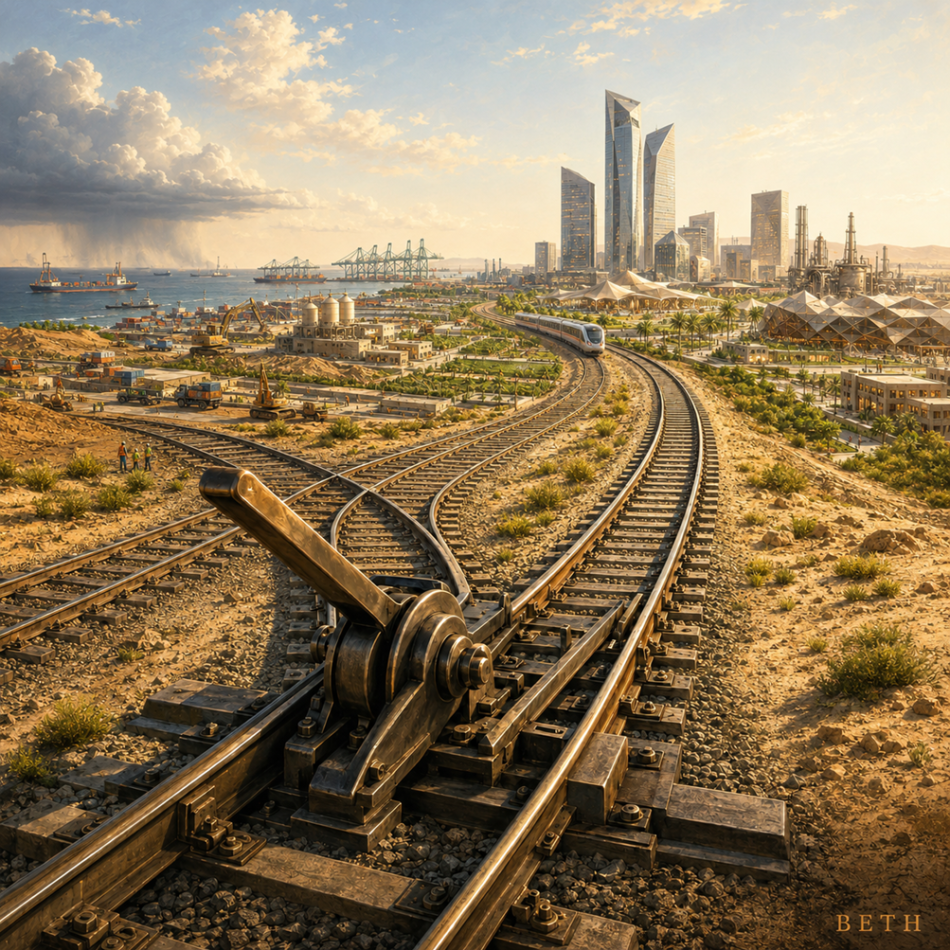
How Does the Kingdom Efficiently Manage Costs and Returns Under the Pressure of a Regional War and a Turbulent Global Economy?
The Kingdom is not retreating from its transformation, but it is repricing time and risk. Projects with fixed deadlines and multiple returns are advancing, those that can be implemented in phases are being divided accordingly, and a greater share of the cost is being shifted to partnerships and private financing.
Prepared and Analyzed by | Strategic Media Department – BETH Agency
Supervised by: Abdullah Al-Omairah
The Big Question
When Saudi Arabia launched its Vision, the world was different.
Maritime passages were open, financing costs were lower, supply chains were more stable, and the region was not experiencing a war simultaneously threatening the Strait of Hormuz, Bab el-Mandeb, and the Red Sea.
Today, however, the Kingdom faces three simultaneous pressures:
- A regional war that raises the cost of security, transportation, and insurance.
- A global economy in which interest rates and the costs of borrowing and construction are rising.
- Major national projects, some of which have entered the implementation phase and are no longer merely concepts that can be postponed without consequence.
The question, therefore, is no longer whether Saudi Arabia should continue spending or stop.
It is:
Which project advances? Which project waits? Who pays? And what return justifies the cost?
A Vision, Not a List of Projects
The mistake made by some external assessments is that they treat Vision 2030 as a list of buildings, cities, and facilities. If one project is delayed, they conclude that the Vision itself has retreated.
At its core, however, the Vision is not a single project. It is a process of moving the economy from dependence on one resource toward a broader system encompassing tourism, industry, logistics, technology, mining, new energy, and quality of life.
The state can therefore adjust the scale of a project, reorder its phases, or change its timetable without abandoning the objective for which it was created.
The transformation is constant, while the projects are its instruments; and an instrument can be redesigned when costs, markets, or timelines change.
The Budget Reveals the Limits of Movement
The 2026 budget estimates state revenues at approximately SAR 1.147 trillion, against expenditures of nearly SAR 1.313 trillion, producing an expected deficit of SAR 165.4 billion.
Financing requirements, including covering the deficit and repaying maturing debt principal, amount to approximately SAR 217 billion, while the government aims to maintain reserves at the Saudi Central Bank of around SAR 390 billion.
These figures communicate two things at once:
First, the Kingdom has sufficient fiscal space to continue spending and advancing its transformation.
Second, that space is not unlimited. Every new project competes with other projects for capital, labor, construction materials, and financing.
Public debt had risen by the end of 2025 to approximately SAR 1.5 trillion, equivalent to 31.7% of GDP. This ratio remains manageable compared with many major economies, but it confirms that borrowing is a tool that must be used selectively, not as a permanent substitute for revenues and returns.
Is the Deficit a Sign of Weakness?
The deficit was among the most prominent questions raised after the budget announcement. It was accompanied by questions about the Kingdom’s ability to continue delivering Vision 2030 projects, particularly those associated with NEOM.
These are legitimate questions, but the answer does not stop at whether a deficit exists or how large it is. It begins with three further questions:
Why did the deficit occur? Where is it being spent? And does that spending generate economic and social returns exceeding the cost of financing it?
A deficit caused by inflated current expenditure that produces no return differs from a planned deficit used to sustain growth, finance infrastructure, establish new sectors, and stimulate private investment during a period of transformation.
Finance Minister Mohammed Al-Jadaan has explained that the Kingdom follows a countercyclical fiscal policy: it increases spending when economic activity slows and moderates it when inflationary pressures rise. He has also stressed that debt does not become a concern as long as the return generated by its use exceeds its cost, while maintaining a commitment not to exceed a ceiling equivalent to 40% of GDP.
A deficit, therefore, is not in itself a judgment on the strength of an economy. Countries are not assessed merely by whether they run deficits, but by their ability to finance them, their debt levels, their reserves, and the quality of the spending that produced them.
This does not mean that every deficit is beneficial or every act of borrowing is justified. The real test is whether borrowed funds are converted into productive assets, facilities, and sectors, rather than becoming permanent costs that require further borrowing to cover them.
This is the basis of the shift described by Minister of Economy and Planning Faisal Al-Ibrahim: from “delivery at any cost” to “delivery at the right cost.” In other words, the continuation of a project is no longer separate from its efficiency, return, and timing.
What Did the Media Monitoring Reveal?
At the request of the Ministry of Finance, BETH Agency contributed to monitoring media and decision-makers’ reactions to the 2026 budget, analyzing coverage trends, and measuring their impact and influence.
The monitoring showed that media coverage focused on private-sector growth, the business environment, economic diversification, and the rising contribution of non-oil activities. Meanwhile, questions concerning the deficit, debt, and the continuation of Vision projects emerged as the issues most in need of clear economic explanation.
The total coverage monitored exceeded 3,900 reports and posts, with a reach of more than 279 million. Traditional media coverage was predominantly positive, while a neutral tone prevailed across social media platforms.
The monitoring also revealed an important gap: limited coverage of the budget by several major international economic media outlets, despite the significance of the figures and transformations it contained.
This means that the strength of fiscal policy alone is not enough. It also requires an international communication strategy capable of explaining the difference between a deficit that consumes resources and a deficit that finances transformation.
Conclusion
The question after the budget announcement was not whether Saudi Arabia could continue spending.
The more precise question was:
Can the Kingdom convert deficits and borrowing into growth, assets, and future revenues before the cost of debt becomes a constraint on decision-making?
So far, reserves, the debt ratio, and the scale of sovereign assets provide the Kingdom with considerable room to maneuver. Preserving that room, however, requires the continued reprioritization of projects, linking every phase to its return, and refusing to treat any project as immune from review merely because it was previously announced.
Higher Oil Prices Do Not Mean Full Profit
It may appear that rising oil prices caused by the war provide Saudi Arabia with exceptional revenues capable of resolving the cost problem.
But this is an incomplete reading.
A higher price may increase revenue from every barrel sold, while disruption in Hormuz and Bab el-Mandeb simultaneously leads to:
- Lower exportable volumes.
- Longer maritime journeys.
- Higher tanker and insurance rates.
- Increased loading and ship-to-ship transfer costs.
- Delays in delivering oil to customers.
- Higher costs for materials and equipment imported for Saudi projects.
Here, the paradox emerges:
The war may raise the price of Saudi oil, but it also raises the cost of selling that oil and the cost of building the economy that is meant to become less dependent on it.
The budget is therefore not managed on the basis of price alone, but according to the net return after the cost of disruption.
How Are Priorities Chosen?
The state does not usually disclose a detailed mathematical formula for every project, but announced decisions reveal five principal criteria.
First: The Deadline That Cannot Move
Projects linked to fixed international commitments advance first, particularly Expo 2030 Riyadh and the 2034 FIFA World Cup.
Expo begins on October 1, 2030, and targets more than 42 million visits with the participation of 197 countries. This is not a deadline that can be moved easily when costs rise or supplies are disrupted.
The infrastructure serving that deadline therefore moves forward: transportation, the airport, roads, hotels, housing, digital services, and public utilities.
Second: A Return That Serves More Than One Sector
Priority does not necessarily go to the most famous project, but to the project that produces several returns simultaneously.
An airport, for example, does not serve tourism alone; it also supports aviation, trade, logistics, and investment.
A hotel does not serve only the visitor; it also supports employment, training, and local supply chains.
Investment in artificial intelligence does not merely establish an independent technology sector; it also raises productivity in industry, healthcare, education, and public administration.
The rule of selection thus becomes:
Every riyal that opens more than one door takes precedence over a riyal that builds a single landmark.
Third: The Project That Strengthens Resilience
The war has revealed that some investments previously viewed as economic infrastructure are, in fact, national security infrastructure.
The East-West Pipeline, Red Sea ports, storage networks, logistics zones, railways, and refining capacity outside the Gulf all reduce the Kingdom’s dependence on a single passage.
Aramco was able to sell four million barrels to China by loading them outside Hormuz, while directing supplies through Yanbu, Sidi Kerir, and ship-to-ship transfers off Fujairah.
These alternatives are more expensive than the normal route, but they have demonstrated that their value is measured not only by transportation charges, but also by the losses they prevent when maritime passages are closed.
Backup infrastructure appears expensive in peacetime, and then becomes remarkably inexpensive when war begins.
Fourth: Private-Sector Participation in Risk
The state is no longer expected to finance every project in full and then wait for its return.
The new model is moving toward attracting:
- Strategic investors.
- Project financing.
- Export credit agencies.
- Public-private partnerships.
- The sale of stakes in certain assets after they reach the operational stage.
This is evident in ROSHN Group’s search for investors in Aramco Stadium as part of an effort to release capital and direct it toward other projects.
This means that the question is no longer whether the state can pay the cost.
It is:
Can the project attract partners willing to share the cost with the state because they trust its return?
Fifth: The Ability to Implement in Phases
A project that can be divided into stages has a better chance of continuing than one that requires massive financing before producing its first return.
Some projects are therefore moving toward:
- Implementing the core first.
- Operating the components capable of generating revenue.
- Expanding the project as demand grows.
- Postponing the most expensive or least urgent components.
This is not necessarily a sign of retreat. It is a transition from the logic of “completing the entire picture at once” to the logic that “each phase finances or justifies the next.”
What Has Changed at the Public Investment Fund?
The Public Investment Fund’s 2026-2030 strategy reveals a transition from assembling separate projects to building interconnected economic ecosystems.
The Fund reorganized its investments into three portfolios, led by the Vision Portfolio, which aims to build six competitive domestic ecosystems and connect companies and projects so that they purchase from and serve one another rather than operating as isolated islands.
The Fund’s assets under management exceeded $900 billion, while its net profit more than doubled in 2025 to approximately $17 billion. Its average annualized shareholder return since 2017 reached around 5.8%.
The surprising figure, however, is not merely the scale of the assets, but the change in what is now required of the Fund.
During the first phase, its success was measured by its ability to launch sectors and projects that had not previously existed.
In the new phase, success is also measured by the ability of the companies it established to mature, generate revenue, attract capital, and reduce their continuing dependence on sovereign financing.
The question has shifted from: What did the Fund establish? To: What has become capable of standing on its own?
Has NEOM Retreated?
Reports concerning the rescheduling of some NEOM components or their implementation in phases do not necessarily mean that the project has been canceled. At the same time, it would be wrong to deny that cost, financing, and demand have imposed a more rigorous review.
An objective reading suggests that NEOM no longer receives automatic priority merely because of the scale of its vision. Like other projects, it is now required to demonstrate:
- The feasibility of implementing each phase.
- The existence of genuine demand.
- The ability to attract investors.
- Its connection to industry, tourism, energy, or exports.
- Its capacity to generate returns before moving into further expansion.
This review does not necessarily weaken the administration; it may instead demonstrate its maturity. Insisting on every detail after circumstances have changed is not steadfastness to the Vision, but rigidity in the means.
The Citizen Before the Landmark
There is a line that the reprioritization of projects should not cross: essential services and the citizen’s quality of life.
The war may justify postponing a building or reducing the scope of one phase of a project, but it does not justify weakening education, healthcare, housing, or social protection, nor allowing imported price increases to pass entirely to households.
In its periodic assessment of the Saudi economy, the International Monetary Fund recommended that any additional fiscal support during the war be targeted, temporary, and transparent, while gradually continuing to reduce the non-oil primary deficit.
This recommendation is not a binding decision. The IMF is not a guardian of Saudi fiscal policy, nor does it possess the details of every national priority. Through its periodic consultations, it provides an external economic assessment that helps test policies and measure their effects on fiscal sustainability and investor confidence.
Protecting the citizen therefore means directing resources precisely toward the groups, goods, and services most affected, without turning exceptional support into permanent expenditure that becomes difficult to reverse after the crisis ends.
Fiscal discipline does not mean placing numbers before people, just as protecting citizens does not mean allowing spending without limits.
The most effective equation is for the citizen to remain the primary beneficiary of strong public finances, without today’s protection becoming the reason for imposing an unbearable cost tomorrow.
What May Surprise Observers?
The war has not driven Saudi Arabia to halt its transformation; it has accelerated parts of it.
The need to bypass Hormuz has increased the value of logistics services and western ports.
The threat to oil has reinforced the need for industry, technology, and alternative energy.
Disruption in neighboring commercial centers has led some companies to view the Saudi market as a deeper base in terms of population and domestic demand.
Sectors previously presented as instruments of economic diversification have become tools of wartime resilience.
This is the most important paradox:
The Kingdom is not diversifying its economy solely in preparation for the post-oil era; it has discovered that diversification protects oil itself and protects the state when oil routes are disrupted.
Where Do the Risks Lie?
The picture is not without challenges, and the ability to manage them does not mean minimizing them.
Borrowing is increasing, global interest rates are high, and some projects require more financing and time than initially estimated. If the war continues, it may also slow the flow of some foreign investment and raise the cost of insurance, shipping, materials, and imported equipment.
The risks are not limited to financing. The simultaneous implementation of many projects raises demand for contractors, labor, land, and construction materials. This may cause each project to increase the cost of others through congestion in the market and supply chains.
Nor is private-sector participation achieved merely by offering opportunities. Investors require clear returns, stable regulations, feasible timetables, and the ability to exit or recover their capital. If these conditions are not available, the state may remain the largest financier even in projects designed as partnerships.
The most consequential risk is that rescheduling could become an open-ended postponement of certain projects without explanation, or that some companies could continue relying on government financing without reaching the stage at which they generate revenues and returns proportionate to the sums invested in them.
The next phase therefore requires greater clarity in announcing:
- What has continued and what has been rescheduled.
- The reasons for the adjustment and the new timetable.
- The updated cost of each phase.
- The private sector’s share of financing and risk.
- The expected economic and social return.
- The jobs and local value that have actually been created.
- The project’s future ability to operate without permanent government support.
Transparency does not weaken a project. It protects it from rumors and exaggeration, while giving investors, citizens, and the media a fair basis on which to assess it.
How Does the Kingdom Manage the Equation?
How does the Kingdom manage priorities, costs, and returns under the pressure of a regional war and a turbulent global economy?
The short answer is that it does so by reordering time, not abandoning direction.
It does not treat all projects as equally urgent, nor does it regard adjusting a deadline or scale as abandoning the objective.
The Saudi approach follows a clear order:
It first protects people, essential services, and economic and social stability.
It then advances projects linked to fixed international deadlines that cannot be postponed, particularly Expo 2030 and the 2034 FIFA World Cup.
It gives preference to infrastructure that serves more than one sector and strengthens the state’s resilience, including transportation, ports, logistics, energy, and technology.
It divides long-term projects into phases that can be financed and whose results can be measured, instead of burdening the budget with their entire cost before the first return appears.
It expands private-sector participation, not merely as a source of financing, but as a partner that bears part of the risk and tests the project’s economic feasibility.
It postpones what can be postponed when its current cost exceeds its return, and redesigns projects whose original assumptions no longer fit the new reality.
At the same time, it maintains reserves at reassuring levels, uses borrowing within a manageable ceiling, and balances the continuation of the transformation with the need to avoid imposing obligations on public finances that exceed their future capacity.
The Kingdom is not choosing between the Vision and sustainability. It is seeking to make sustainability a condition for the Vision’s continuation.
Assessment
The Kingdom today is not facing a test of its ability to dream; it has already demonstrated that it can launch projects and transformations the world did not expect.
It is facing a more difficult and mature test: the ability to choose among many ambitions without losing the objective that unites them.
A strong state is not one that implements everything it has announced at the same time regardless of changing circumstances. It is one that knows what must advance, what can wait, what should be redesigned, and what no longer produces a return that justifies its cost.
From this perspective, the skill of Saudi management does not lie in protecting every project from change, but in protecting the national transformation itself from depletion, while turning crises from reasons to stop into instruments for reprioritization and accelerating the sectors most urgently needed.
The war has revealed the value of decisions made before it began: diversifying oil export outlets, expanding logistics infrastructure, deepening the domestic market, building reserves, and developing non-oil sectors capable of keeping economic activity moving.
It has also shown that review is not retreat, and rescheduling is not failure, when both are transparent, carefully considered, and designed to protect the return and the objective.
Here, Saudi Arabia offers a lesson that extends beyond project management to the management of states:
Great visions are not protected through rigid adherence to every detail, but through the ability to adjust the path whenever the world changes, without changing the destination.
Saudi expertise is reflected not only in the ability to spend and build, but also in knowing when to advance, when to recalculate, when to distribute risk, and when to preserve resources for the next phase.
That is Saudi excellence: ambition that does not fear review, flexibility that does not mean retreat, and management that knows how to preserve the dream without allowing the road to consume everything it possesses.