



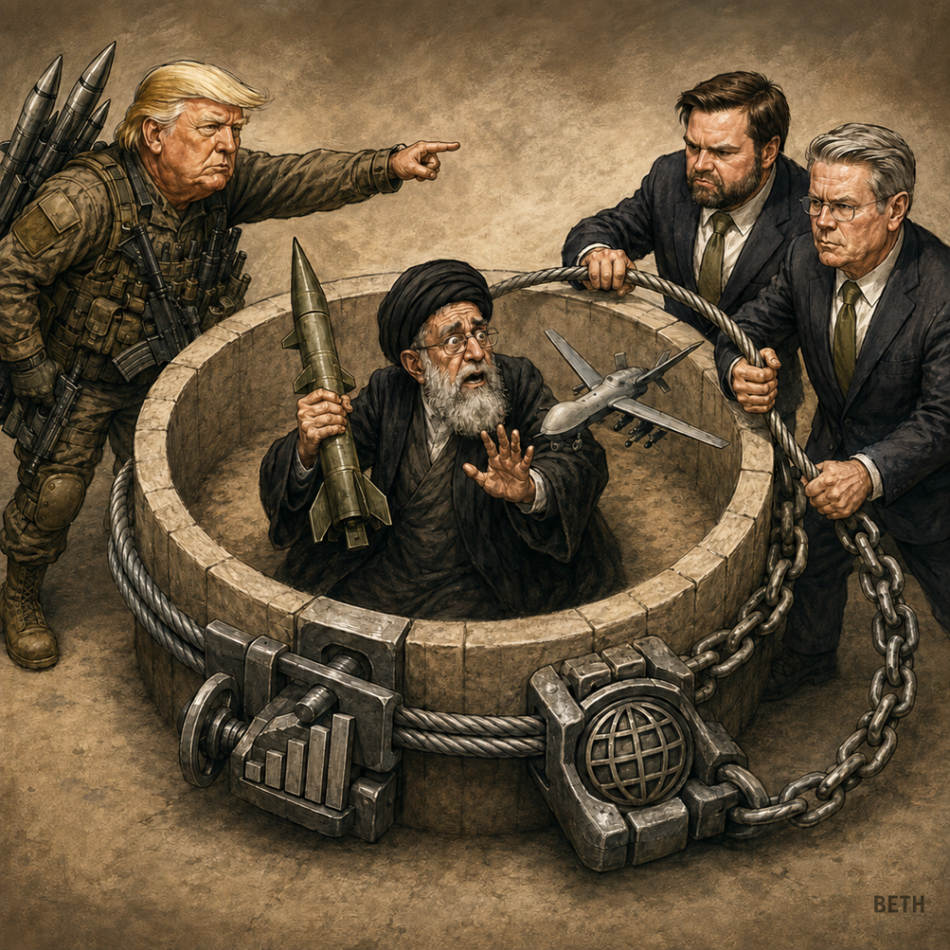
Washington shifts from targeting Iran’s military power to strangling its economy, but declining traffic through Hormuz reveals that control of the strait has not yet been settled
Day 170 | August 21, 2026
Prepared and Analyzed by | Strategic Media Department – BETH Agency
Quick News Roundup
Washington Announces the Economic Pressure Phase
An Economic, Not Military, D-Day
Trump described his forthcoming campaign as an “Economic D-Day.” What is meant is not a ground operation, but a coordinated financial and commercial offensive targeting oil exports, banking transfers, smuggling networks, and any country, company, or institution that provides Iran with an economic outlet. If successful, it could accelerate Iran’s domestic economic strangulation and push Tehran toward an agreement. However, it could also raise energy prices and open an economic confrontation with China and other countries that refuse to comply with U.S. sanctions.
U.S. Vice President JD Vance said that the war had entered a “new phase,” in which economic pressure has become the most effective tool for achieving the objectives of the United States, following what he described as the elimination of Iran’s military capability.
He explained that Washington wants to place Tehran before two choices: economic strangulation, or a return to normal relations with the international community through the conclusion of an agreement.
Vance’s remarks coincide with U.S. Treasury Secretary Scott Bessent’s announcement that Washington is preparing to impose what he described as “the toughest sanctions in history” on Iran, with details to be disclosed next Monday. The plan includes tightening secondary sanctions on countries and companies that continue to trade with Tehran, with a clear focus on China, the largest buyer of Iranian oil.
No Negotiations in Sight
President Donald Trump confirmed that there are no ongoing or scheduled negotiations with Iran, following the failure of attempts to reach an understanding over the Strait of Hormuz and the lifting of the blockade on Iranian ports.
The confrontation has therefore moved from a phase that awaited an Iranian offer or a return to negotiations to one in which Washington seeks to change Tehran’s calculations before allowing a new political track to open.
Hormuz Is No Longer Normal
Vance said that the United States had broken Iran’s control over the strait and had succeeded in securing the passage of large quantities of oil and gas, adding that it would continue increasing the number of shipments passing through to prevent Tehran from using Hormuz as a weapon.
Shipping data, however, paints a more cautious picture. Only seven commodity vessels crossed the strait on Thursday—four entering and three leaving—compared with 14 vessels the previous day. None of them was a very large crude carrier or a liquefied natural gas tanker.
One large gas carrier loaded with propane and butane crossed through the Iranian route, indicating that the limited movement remains subject to precise arrangements and has not returned to its normal prewar level.
Bab el-Mandeb Traffic Also Declines
The number of vessels passing through Bab el-Mandeb fell to 23, after reaching 34 on each of the previous two days. No very large crude carriers or liquefied natural gas tankers crossed, confirming that the shipping crisis is no longer confined to Hormuz, but extends to both ends of the maritime energy route.
In a development that warrants caution, the Houthis claimed to have targeted an Aramco facility and a sensitive site at Najran Airport with two drones. As of the preparation of this analysis, no Saudi confirmation had been issued proving that the attack occurred or that any damage was caused. The claim therefore remains part of the media war unless confirmed by an official authority.
Oil Votes Against De-escalation
Oil headed toward a second consecutive week of gains, with Brent crude reaching approximately $93.44 per barrel, while West Texas Intermediate stood at around $86.76.
The two benchmarks rose by more than 7% and 8%, respectively, over the course of a week, indicating that the market still sees no guaranteed path toward reopening Hormuz or resolving the war.
The American Cost Emerges
The Pentagon announced that the number of U.S. military personnel wounded since the war began had exceeded 750, and that a large number of the injuries involved brain injuries and disorders caused by explosions.
The figure reveals that the war has not been without a human cost for the United States, despite its air and naval superiority and the absence of its involvement in a large-scale ground confrontation.
Analysis
A Military Victory That Did Not Open the Strait
Washington says that it has eliminated Iran’s military capability, while simultaneously saying that it needs a broad economic war to force Iran into an agreement.
Here, the most important question emerges:
If Iran has been defeated militarily, why has it not surrendered politically, and why has Hormuz not returned to normal operations?
The answer is that the United States succeeded in destroying a large part of Iran’s military infrastructure, but it did not deprive Tehran of its ability to disrupt. What remains for Iran is not necessarily a force capable of enabling it to win, but it is sufficient to prolong the crisis, threaten vessels, mobilize its proxies, and raise energy and insurance costs for its adversaries.
Vance’s remarks therefore appear less a description of the end of the military phase than an acknowledgment that military force alone did not produce the desired political decision.
From Eliminating Weapons to Breaking the Will
The previous phase targeted missiles, drones, and military and nuclear facilities.
The new phase, however, targets:
- Iran’s ability to sell oil.
- The banking system and financial transfers.
- Smuggling networks and intermediary companies.
- Countries that provide Iran with a commercial or financial outlet.
- The regime’s ability to pay salaries and finance the Islamic Revolutionary Guard Corps and its foreign proxies.
The objective is therefore no longer merely to prevent Iran from launching missiles, but to make it incapable of enduring the passage of time.
Washington is betting that the Iranian economy is more fragile than Iran’s military capability, and that sanctions and the blockade will generate domestic pressure that drives the leadership to accept an agreement it refused to accept under bombardment.
China Becomes the Decisive Front
The new sanctions will not be tested in Tehran alone, but also in Beijing.
China buys more than 80% of Iran’s seaborne oil. If it continues purchasing it, it may provide Iran with the minimum resources necessary to withstand the pressure. If it yields to U.S. pressure or significantly reduces its imports, Tehran will face strangulation more quickly.
However, threatening China with sanctions carries a corresponding risk: it could turn the war with Iran into an economic confrontation between the United States and China, and make Beijing more determined to protect its trade and the independence of its decisions.
The success of the American plan therefore depends not only on Iran’s weakness, but also on Washington’s ability to prevent major powers from rescuing it.
Hormuz Between Two Narratives
Washington believes that the successful passage of some vessels means that Iran’s monopoly over the strait has been broken.
Iran, meanwhile, believes that traffic remaining in single digits, combined with the absence of very large crude and gas carriers, proves that it is still capable of preventing the full restoration of navigation.
The truth lies between the two narratives:
The United States has prevented Iran from closing the strait completely, but it has not succeeded in reopening it normally and safely.
Military control of the water is not sufficient if shipping and insurance companies remain afraid of mines, projectiles, drones, and the possibility of vessels being seized.
The true measure of control is therefore not the number of U.S. destroyers present in the region, but the number of very large carriers willing to pass through without exceptional arrangements or high insurance premiums.
Outcomes and Expectations
Scenario One: A Long Blockade Without Widespread Strikes
This is the most likely scenario in the near term.
Washington will continue tightening sanctions and the naval blockade, while allowing limited shipments to pass. Iran, meanwhile, will attempt to endure and preserve a minimum level of exports through China and indirect transportation networks.
Under this scenario, the war remains suspended: no peace, no widespread bombardment, and no full reopening of Hormuz.
Scenario Two: An Indirect Iranian Response
Tehran may avoid a direct confrontation with the United States and push the conflict toward:
- Limited targeting of vessels.
- Attacks carried out by its proxies in the Red Sea.
- Threatening energy facilities in the region.
- Cyber operations against ports or shipping companies.
- Using different munitions or warheads to prove that its capability has not been completely eliminated.
The objective would not be to achieve a military victory, but to demonstrate that economically strangling Iran will be met by raising the cost of energy for the world.
Scenario Three: A Return to Negotiations Through the Economic Door
If the sanctions succeed in reducing Iran’s exports and closing its financial outlets, Tehran may return to negotiations, but not in the form of a complete surrender.
In return for reopening Hormuz, it may demand:
- A gradual easing of the blockade.
- Permission to export a specified quantity of oil.
- The release of a portion of its frozen funds.
- Guarantees that the strikes will not resume.
- Postponement of the nuclear file to a later stage.
This scenario could produce an agreement to manage the war, rather than a final peace.
Scenario Four: A Strike That Returns the War to Fire
The risk of escalation remains if an attack results in the deaths of a large number of U.S. military personnel, the damaging of a very large carrier, or the targeting of a Gulf energy facility with extensive damage.
Washington may then conclude that economic warfare is no longer sufficient and return to strikes targeting the Islamic Revolutionary Guard Corps, missile facilities, and Iranian ports.
Assessment
On its 170th day, the war has shifted from an attempt to destroy Iran’s power to an attempt to break its capacity to endure.
Economic pressure, however, is not a guaranteed path to surrender. It may drive Iran toward an agreement, but it may also drive it to use what remains at its disposal before losing it.
Washington appears convinced that Iran has become too weak to wage a new war, while Tehran appears convinced that the world cannot endure the closure of energy routes for much longer.
Between these two convictions, Hormuz remains the test:
Washington can force vessels into the strait, but Iran is still capable of preventing them from feeling safe.
For this reason, the war has not yet been settled.