



Day 169: The Blockade Crosses Borders
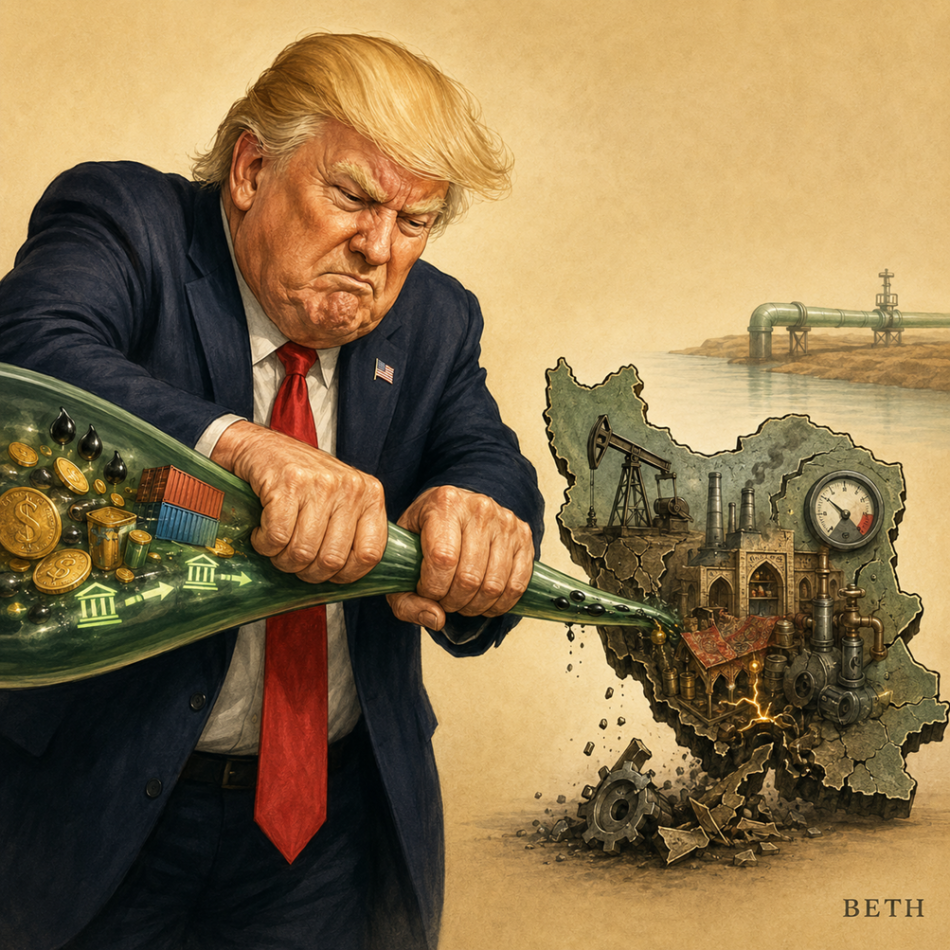
Trump threatens countries that provide Iran with a “lifeline,” as Russia begins replenishing its arsenal through the Caspian Sea; Israel withdraws from most of the fighting, leaving the United States with a war it launched successfully but has yet to find a way to end
Prepared and analyzed by the Strategic Media Department – BETH News Agency
On the 169th day of the war, the pressure campaign expanded beyond Iran to threaten every country or institution helping it survive.
U.S. President Donald Trump announced the launch of what he described as the most severe economic operation ever imposed on a country, warning of “enormous economic consequences” for any party providing Iran with a lifeline—whether by purchasing its oil, transferring funds, registering ships, or supplying the components and materials needed to rebuild its capabilities.
As Washington attempts to close Iran’s economic outlets, new intelligence has revealed that Russia has begun transporting drone components, munitions and TNT explosives to Tehran across the Caspian Sea.
Two opposing movements thus emerged on the same day: the United States is attempting to cut off the lifeline, while Russia is opening a route beyond the reach of the U.S. Navy.
The war is no longer confined to Washington and Tehran; it is now between those seeking to strangle Iran and those preventing it from suffocating.
Trump Pursues the Lifeline
Trump has not yet identified the countries and institutions to be targeted or specified the nature of the penalties they could face. Nevertheless, he has expanded the scope of the economic war from Iran itself to its network of external relationships.
The term “lifeline” does not refer solely to direct government assistance. It may also include:
- Purchasing or marketing Iranian oil.
- Processing payments and financial transfers.
- Supplying spare parts and industrial or military components.
- Registering or insuring ships and concealing their ownership.
- Using intermediary companies, ports and airports to transport goods.
- Helping Iran circumvent the naval blockade and sanctions.
This is the difference between sanctions on Iran and secondary sanctions: the former prohibit American institutions from dealing with Tehran, while the latter force the rest of the world to choose between the Iranian market and access to the U.S. economy.
Yet the breadth of the threat also reveals the difficulty of enforcing it. The parties capable of providing Iran with a genuine lifeline are not merely small companies, but major powers such as Russia and China.
If Washington enforces its threat fully, the economic war against Iran could develop into a commercial and financial confrontation with countries capable of retaliating. If it exempts the major powers and limits punishment to weaker companies, the operation could lose part of its credibility.
Trump can threaten everyone who assists Iran, but the effectiveness of that threat depends on his ability to punish those who are not easily intimidated by sanctions.
Russia Opens Caspian Route
According to a European government document corroborated by a Western official, Russia is transporting drone components, munitions and TNT to Iran across the Caspian Sea, helping Tehran replenish part of the arsenal damaged in American and Israeli strikes.
Neither Moscow nor Tehran has disclosed details of the shipments, and insufficient public information is available regarding their quantities or delivery schedules. They should therefore be treated as intelligence with strong implications, rather than a complete record of what Iran has already received.
The choice of the Caspian Sea is significant. It is an enclosed body of water in which neither the United States nor its allies maintains a permanent naval presence. Russia and Iran both have direct coastlines there, allowing cargo to move between them away from Western inspection points and the waterways monitored by the U.S. Navy.
Russian components do not mean that Iran has restored its arsenal or regained its former capabilities. Replacing launch platforms, factories, command networks and air defenses requires time and resources extending far beyond shipments of munitions and explosives.
However, the supplies could provide Tehran with what it needs for a war of attrition: less sophisticated munitions, components that can be assembled locally, and materials that allow some drone production lines to resume operation.
Moscow is not rebuilding Iran’s military power in full, but it may prevent it from reaching the level of incapacity Washington seeks.
What Does Russia Want?
Russia does not need Iran to achieve a complete victory in order to benefit.
It is enough for Iran to remain capable of distracting the United States, depleting its munitions and resources, increasing the cost of its military presence, and preventing Washington from redirecting its full attention toward Europe or other regions.
Moscow also benefits economically from higher energy prices and increased Chinese demand for Russian oil following the decline in Iranian supplies and the disruption of Gulf shipping routes.
Russian assistance may therefore be carefully calibrated: sufficient to prolong Iran’s ability to resist, but not enough to bring Moscow formally into the war or provide Tehran with weapons capable of altering the balance so dramatically that they provoke a direct U.S.–Russian confrontation.
These shipments place Trump’s declaration before its first practical test. If every lifeline to Iran is to face economic consequences, the route across the Caspian leads directly to Russia.
Israel Leaves the Burden
Israel has largely withdrawn from direct combat, although the war has not achieved all its declared objectives. The Strait of Hormuz has not reopened, the nuclear issue remains unresolved, and Iran retains the ability to launch and rebuild drones and missiles.
Does this mean Israel has achieved its objectives?
The more accurate answer is: Israel achieved an important part of its military objectives, but not a political end to the war.
American and Israeli strikes succeeded in weakening Iranian air defenses, killing political and military commanders, destroying facilities and bases, reducing parts of Iran’s missile and drone capabilities, and striking naval forces and command centers.
Israel also transformed the Iranian threat from a danger it confronted largely alone into a war fought directly by the United States. Protecting Israel and weakening Iran have consequently become part of a continuing American military burden.
From this perspective, Israel can reduce its involvement after achieving an acceptable level of damage to its adversary, while retaining the option of resuming strikes if it believes Iran is rebuilding a direct threat against it.
Why Did Israel Withdraw?
Israel’s withdrawal cannot be attributed to a single factor, but several considerations help explain it.
First, the outcome Israel seeks differs from the one the United States requires. Israel may be satisfied with an Iran that remains weak, preoccupied and unable to build an immediate threat. Washington, however, needs an agreement that reopens Hormuz, ends the blockade, restrains the nuclear program, protects its bases and allies, and justifies the war’s cost to American voters.
Second, reducing Israel’s participation limits the exposure of its cities to missile attacks, preserves munitions and interceptor stocks, and allows the military to redeploy capabilities toward Gaza, Lebanon and Syria.
Third, Israel may believe that the continuing American blockade and economic pressure are serving its objectives without requiring Tel Aviv to bear the same military and political costs.
Fourth, continued airstrikes may no longer guarantee significant new strategic gains. Major targets have already been struck, while completely eliminating Iran’s remaining capabilities would require a longer war, more precise intelligence and repeated attacks on facilities that are being rebuilt or relocated.
Israel has not ended its war with Iran; it has ended the part whose returns it believed justified the cost, leaving the United States to transform military strikes into a political settlement.
A Successful Beginning, a Failed Ending
The United States entered the war with the air, naval and technological superiority required to strike a wide range of targets inside Iran.
Military superiority alone, however, cannot answer the question: What happens the next day?
Washington and Tehran announced two ceasefire agreements, in April and June, intended to restore the free flow of shipping through Hormuz to prewar levels and move toward ending the conflict. Both agreements quickly collapsed because the parties failed to agree on the sequence of implementation or the concessions to be exchanged.
Iran wants the blockade and sanctions lifted and its frozen funds released before restoring normal navigation. The United States wants the strait reopened and Iranian compliance verified before offering concessions.
This is where the weakness in the American strategy becomes apparent: Washington succeeded in weakening Iran militarily, but failed to convert that weakness into surrender, an agreement or an open waterway.
Trump’s shift toward a “crushing economic war” confirms that military force did not produce the desired outcome, prompting Washington to replace bombs with an attempt to exhaust Iran’s capacity to endure.
The United States succeeded in entering the war, but it is still searching within sanctions and the blockade for a way out.
Hormuz Delivers the Verdict
Only nine commercial vessels crossed the Strait of Hormuz on Wednesday—the same number recorded the previous day—compared with more than 130 ships daily before the war.
Traffic through Bab al-Mandab declined to 27 vessels from 32 the previous day, although additional ships may have been operating with their tracking systems switched off.
These figures demonstrate that claims of an open Hormuz remain more political than commercial. The waterway does not return to normal when a limited number of vessels cross it, but when shipping companies, insurers and supertankers regain confidence that it can operate without exceptional protection.
The strait does not vote through statements; it votes through the number of ships willing to cross.
Energy Pays the Price
Brent crude rose to approximately $92 a barrel, while refined fuel markets remained under even greater pressure than crude prices themselves.
The war has removed part of the Middle East’s refining capacity from operation and disrupted shipments of diesel, gasoline and aviation fuel. Its consequences may therefore persist even if crude prices begin to ease.
China has also increased its reliance on Russian oil to compensate for declining Iranian supplies. This has narrowed India’s options and intensified Asian competition for alternative barrels.
The war is consequently reshaping global energy trade: Iran loses buyers, Russia gains demand, China changes suppliers, India pays the cost of competition, and consumers worldwide bear higher fuel prices and inflation.
Between the Lines
Day 169 reveals that the war has entered a different phase.
The United States is no longer merely attempting to destroy Iran’s capabilities; it is seeking to prevent the world from helping Tehran rebuild them. Russia, meanwhile, is no longer limiting itself to political objections but has—according to the new intelligence—begun supplying materials that could restore part of Iran’s capacity for attrition.
Israel has stepped back after obtaining much of what it needed: a weakened adversary, direct American involvement in the confrontation, and relief from the largest share of the immediate burden.
Yet what constitutes a temporary Israeli success does not necessarily amount to an American one. The United States has inherited the issues that airstrikes cannot resolve: Hormuz, the nuclear program, the blockade, the future of the Iranian regime, the protection of allies and the method of ending the war.
This explains Trump’s shift from targeting Iran to targeting those who deal with it. When a strike fails to produce an agreement, preventing the adversary from recovering becomes the available alternative.
Israel sought to make Iran weaker; the United States needs that weakness to produce an agreement. This is the difference between achieving a military objective and constructing a political endgame.
Assessment
Russian shipments alone will not restore Iran’s former capabilities, but they may prolong its ability to resist and provide it with sufficient means to conduct limited attacks or continue threatening maritime traffic.
The most important indicator will be whether Washington sanctions Russian entities connected to the Caspian route, or avoids expanding the confrontation with Moscow and limits its pursuit to weaker intermediaries.
China will be the greatest test of the economic campaign. It is a major market for Iranian oil, and any attempt to force it to halt purchases could transfer the crisis into relations between the world’s two largest economies.
Militarily, Israel is likely to remain outside most of the fighting unless Iran rebuilds a capability that directly threatens it, or American pressure fails so completely that Tel Aviv decides to resume its strikes.
The war does not appear close to a genuine conclusion. Iran is acquiring tools for survival, Russia is preventing its complete isolation, Washington is expanding the blockade, and Israel is watching from a less costly distance—while Hormuz remains largely closed.
On Day 169, the United States is no longer blockading Iran alone; it has begun blockading every route leading to it. But the Caspian Sea has revealed that closing every route may prove more difficult than starting the war itself.