



25% Stakes in Four Clubs Transferred to PIF
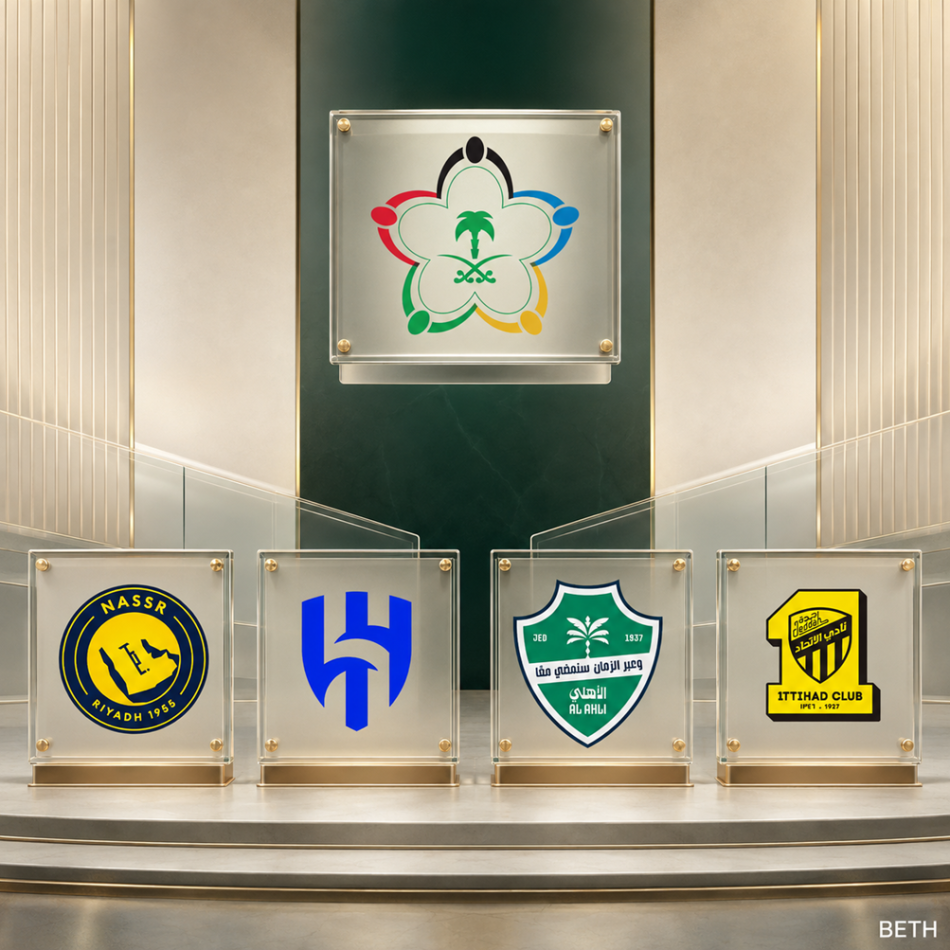
Saudi Ministry of Sport transfers 25% stakes in the companies of Al-Ittihad, Al-Ahli, Al-Hilal and Al-Nassr to the Public Investment Fund and dissolves the boards of their nonprofit foundations; the move consolidates ownership ahead of a new investment phase
Riyadh | BETH
The Saudi Ministry of Sport announced on Wednesday, August 19, 2026, that it had begun transferring the shares held by the nonprofit foundations—representing 25% of the companies of Al-Nassr, Al-Hilal, Al-Ittihad and Al-Ahli—to the Public Investment Fund, following the completion of the required statutory procedures.
The ministry also decided to dissolve the boards of the four clubs’ nonprofit foundations. The move represents the second phase of the clubs’ ownership transfer and reshapes the relationship between their corporate owners and the entities that represented club members within their shareholder structures.
According to the announcement, the decision does not dissolve the boards of the club companies or their executive management teams. It applies only to the boards of the nonprofit foundations that held the 25% stakes.
What Has Changed?
When the Sports Clubs Investment and Privatization Project was launched in 2023, the four clubs were converted into independent companies. The Public Investment Fund owned 75% of each company, while the respective nonprofit foundations were allocated 25% stakes to represent club members within the ownership structure.
That model combined the institutional capital provided by PIF with the social and supporter-based dimension represented by the nonprofit foundations.
The new decision ends the dual ownership structure at Al-Ittihad, Al-Ahli and Al-Nassr and transfers all shares in their companies to PIF, unless other transactions alter their ownership structures.
Al-Hilal’s position is different. In April, PIF signed a binding agreement to sell 70% of the club company to Kingdom Holding Company for SAR840 million, based on an enterprise value of SAR1.4 billion. The nonprofit foundation’s stake will now form part of Al-Hilal’s new ownership structure after its transfer to PIF; the decision does not necessarily mean that PIF will own the entire company.
Why Consolidate Ownership?
Transferring the stake to a sovereign wealth fund may appear contrary to the privatization process, but it could be an organizational step preceding it.
Having a single owner or a simpler ownership structure makes it easier to value a company, reorganize its assets and liabilities, make decisions, and negotiate a clearly defined stake with a prospective investor, rather than conduct a transaction involving shareholders with different structures and objectives.
It also gives PIF greater authority to standardize governance, control spending, review contracts and obligations, and build a financial model that investors can assess before making an acquisition.
Consolidated ownership may not mark the end of privatization; it may be the room in which a club is prepared before being presented to an investor.
End of the Nonprofit Model
The deeper effect of the decision extends beyond the percentage of shares transferred. It ends the institutional role of the nonprofit foundations within the ownership of the club companies.
Dissolving their boards and transferring their shares raises questions about the role club members and supporters will retain in governance and decision-making, after the foundations had—at least in principle—served as the link between the companies and the clubs’ social identities.
The announcement does not yet explain whether an alternative body will be created to represent members, or how memberships and general assemblies will be organized after the foundations’ ownership role is abolished.
This is not a procedural detail. A sports club is a company that needs capital and professional competence, but it is also a history, a supporter base, and an identity that cannot be fully reflected in financial statements.
A successful transformation requires a clearly defined owner, but it also requires a clear channel through which the club’s voice can be heard beyond the shareholders’ boardroom.
Governance Before Spending
The transfer gives PIF greater authority to impose financial and operational discipline on the three clubs that remain under its control, while reducing the number of decision-making centers between each company and its nonprofit foundation.
It may also lead to budgets being tied more closely to actual commercial resources, increased revenue from sponsorships, ticketing and merchandise, and further development of assets, stadiums and academies, rather than continued reliance on direct funding.
A club’s attractiveness to investors is not built solely on trophies and star players. It also depends on transparent ownership, stable management, accurate accounts, and the ability to generate revenue from its brand and supporter base.
BETH Comment
The decision does not return the clubs to PIF as much as it concludes a transitional phase that began in 2023.
During the first phase, sporting activities were separated from the clubs’ traditional structures, and companies were established to own assets and contracts and manage professional operations, while nonprofit foundations retained 25% stakes.
In the new phase, those stakes are being transferred and the foundations’ boards dissolved, giving the companies greater clarity in control and decision-making and making them better prepared for restructuring or the entry of new investors.
The ministry’s description of the move as one that enhances investment appeal and sustainability indicates that PIF’s increased stakes do not necessarily represent a permanent expansion of ownership. Instead, the move may constitute a consolidation of shares before their redistribution under investment models tailored to each club.
The decision gives the Public Investment Fund greater authority to restructure the clubs’ ownership, but it also transfers to the fund full responsibility for their financial and administrative performance during the next phase.
Once decision-making is consolidated, multiple ownership can no longer be cited as a reason for delayed governance, weak revenues, excessive spending or unclear accountability.
The true measure of the move’s success will be what follows: Are the clubs being prepared for sale to strategic investors? Will privatization models differ according to each club’s value, supporter base and assets? And how will members retain a meaningful role after the dissolution of their nonprofit foundations?
The 25% stakes have been transferred to PIF, but the larger story awaits the next owner. The transformation will not be complete when the shares are consolidated in one pair of hands, but when the clubs become companies capable of growing through their own resources without losing the voice and identity of their supporters.