



Day 167: The Deadline Becomes an Ultimatum
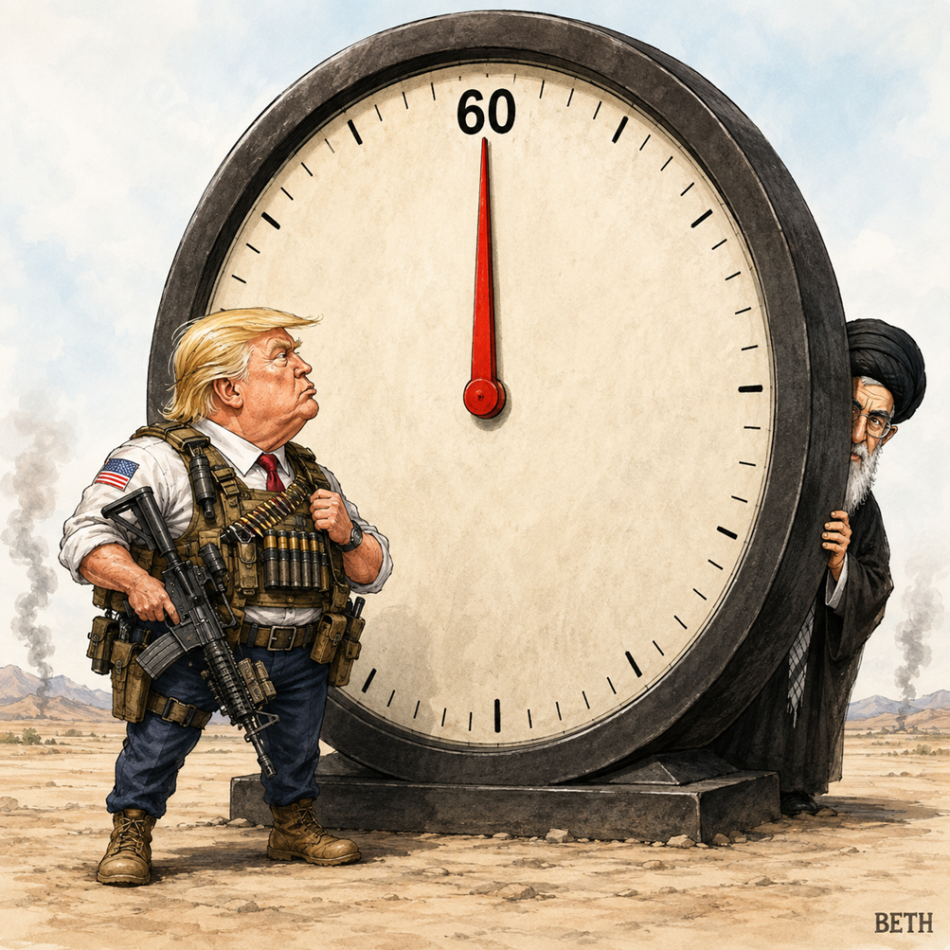
Washington refuses to extend the 60-day understanding, while Tehran gives it “a few weeks” before shifting to an offensive posture; a projectile strikes a vessel in Hormuz as Saudi Arabia cautiously resumes oil loadings
Prepared and analyzed by | Strategic Media Department – BETH Agency
The 60-day deadline did not end with a peace agreement, but neither did it trigger an immediate return to full-scale war.
What happened is more dangerous than the mere failure of a diplomatic deadline. The two sides have replaced their shared timetable with two separate clocks: the United States is maintaining its blockade without a fixed end date, while Iran has given Washington “a few weeks” to implement the June understanding before Tehran moves to what it described as a “timely and precise” military operation.
The question is therefore no longer when negotiations will begin, but: Which clock will reach the moment of explosion first?
From Defense to Offense
A senior Iranian official said Tehran was preparing to shift from a defensive position to a “fully offensive posture” if mediation efforts failed and Washington did not implement the provisions of the interim understanding.
According to the Iranian message, any potential action would not be confined to the Strait of Hormuz, but could extend across a broader regional area with the aim of breaking the United States naval blockade imposed on Iranian ports and vessels.
This does not necessarily mean that a decision to attack has already been taken. Iran’s reference to “a few weeks” leaves one final window for mediators. It does, however, transform the waiting period from an open opportunity for diplomacy into an actionable military ultimatum.
Notably, Tehran has not publicly specified when its ultimatum will expire. This gives it the freedom to choose the time and target, while keeping United States forces and regional countries in a prolonged state of alert.
After the shared deadline was abandoned, Iran introduced a vague new period of “a few weeks” without specifying when it would end. This allows Tehran to retain control over the timing of escalation, use the interval to rebuild its capabilities and test its adversaries, and perhaps wait for an event that could provide justification for an attack. Iran is not extending time because it owns it, but because it is searching within it for a moment when an attack would be less costly and easier to justify.
Trump Stops the Clock
In response, United States President Donald Trump said his country was not seeking to extend the June understanding and dismissed the expiration of the 60-day deadline, saying that Washington was not bound by a timetable.
Here lies the contradiction: the United States is formally refusing to extend the agreement, but it is not closing its channels of communication.
A back channel reportedly delivered a United States message to Islamic Revolutionary Guard Corps Commander Ahmad Vahidi, in an attempt to determine whether Iran’s negotiators were capable of binding the military establishment to any potential agreement.
Washington is not negotiating with Iran through a single door: it is pressuring the state through the blockade while communicating with the center of military power through a back channel.
This suggests that the United States concern is no longer limited to the wording of an agreement, but extends to identifying the Iranian authority capable of guaranteeing its implementation.
A Strike After the Deadline
In the first significant field development following the deadline’s expiration, an unidentified projectile struck a vessel as it was leaving the Strait of Hormuz, damaging its engine room and causing a casualty among the crew.
The Omani Coast Guard assisted the remaining crew members. The party responsible for the attack has not been identified, and no environmental damage has been reported.
The available information does not justify directly accusing Iran. Nevertheless, the timing gives the incident significance beyond the identity of the attacker: it tells shipping companies that the deadline’s expiration has not reopened the waterway and that passage remains a high-risk decision.
Perhaps the most dangerous aspect of the attack is that it targeted a vessel leaving the Gulf. This indicates that the proposed arrangements to separate inbound and outbound shipping routes have not yet produced an effective security guarantee.
Only Six Vessels
Six commercial vessels crossed the strait on Monday: three entered the Gulf and three departed. This compares with a ten-day average of 11 vessels and more than 130 vessels a day before the war.
None of the vessels was a very large crude carrier or a liquefied natural gas tanker, confirming that the limited increase in crossings does not constitute a genuine restoration of commercial navigation.
Some ships used the route closer to Iran, but major vessels and insurance companies are still waiting for a written agreement and enforceable guarantees, rather than political understandings that can be reversed.
The strait is open on the map, but remains nearly closed in the calculations of global trade.
Oman’s Suspended Corridor
Iran and Oman say they have reached an understanding on a shipping route map that would assign an inbound lane close to the Iranian side and an outbound lane along Oman, with no fees during an interim period.
The final statement has not been issued, however, because the disagreement is no longer merely technical or concerned only with shipping lanes. It has become a political dispute over who possesses the right to manage the passage, who authorizes ships to cross, and whether reopening the strait should precede or follow the lifting of the United States blockade.
Trump increased the pressure on Muscat with an exceptionally severe statement, reported without the release of an audio recording, in which he threatened to strike Oman if it obstructed the reopening of the strait.
This does not appear to indicate an actual United States intention to attack an allied country. Rather, it is an attempt to prevent an Iranian-Omani agreement from granting Tehran practical recognition of a right to control shipping movements.
The real dispute is therefore not merely about the passage of vessels, but about who holds the key.
Saudi Arabia Tests the Passage
In an important economic development, Saudi Aramco resumed loading crude from the Ras Tanura and Ju’aymah terminals inside the strait after a suspension of approximately three weeks following attacks on tankers during the previous escalation.
Three very large crude carriers loaded two million barrels each between August 12 and 16, while preliminary data indicate that six additional tankers may load during the month.
Aramco also offered prompt cargoes of Arab Medium and Arab Heavy crude, with the possibility of ship-to-ship transfers off Fujairah.
This resumption does not mean that the route has returned to normal. It is a carefully calculated operation involving a limited number of vessels and more flexible loading arrangements.
The Saudi message is twofold: the Kingdom does not accept the closure of Hormuz, but neither does it treat the waterway as fully secure.
China Leaves the Chokepoints
In contrast to the Saudi test, two major Chinese state-owned shipping companies have stopped sending their tankers through the Strait of Hormuz and Bab el-Mandeb, instead loading oil from ports outside the Gulf or near Oman and Fujairah.
The two companies operate more than 100 very large crude carriers and transported nearly half of China’s oil imports from the Middle East before the war.
This shift is significant because China is not a military party to the conflict, yet it has begun restructuring its energy supply routes as though disruption to the region’s maritime passages will persist for a long time.
When the world’s largest oil-importing country redirects its fleet, the danger has moved beyond a temporary incident and become a new commercial reality.
Oil Votes Against Peace
Brent crude rose to approximately $91.76 per barrel, recording a third consecutive session of gains, while United States crude climbed to $85.55.
The increase reflects more than constrained supplies. It represents the market’s verdict on the political trajectory: no imminent agreement, no complete reopening of Hormuz and no guarantee that Iran’s ultimatum will pass without being carried out.
Between the Lines
The significant development on Day 167 is not the expiration of the deadline. Its failure had become predictable amid the continuing blockade and disruption to maritime traffic.
What is new is that both sides have freed themselves from a single shared clock:
- Trump has effectively removed the United States deadline.
- Iran has created a new unilateral deadline.
- Oman is trying to establish a maritime corridor before the two clocks trigger an explosion.
- Saudi Arabia is testing whether the strait can operate.
- China is acting on the assumption that the disruption will be prolonged.
The conflict has consequently shifted from negotiations under a deadline to deterrence under an ultimatum.
The United States channel to the Revolutionary Guard is the most important diplomatic thread between the lines. Despite its threats, Washington is searching for the authority capable of preventing Iran’s next attack.
Assessment
Tehran is unlikely to begin a full-scale confrontation within the next few hours. It has given itself “weeks,” not days, and wants to use its ultimatum to improve its position before carrying it out.
The attack on the vessel nevertheless demonstrates that events on the ground could overtake political decisions, whether through a limited Iranian strike, an operation conducted by an affiliated actor, or an incident that is misinterpreted.
The Makkah Agreement makes any direct attack—by Iran or any other party—on Saudi Arabia, Türkiye or Pakistan a test of the credibility of their collective defense. This raises the cost of miscalculation and narrows the space for operations that might otherwise be described as limited.
One of three developments will provide the decisive indicator in the coming days:
The issuance of the joint Iranian-Omani statement, an end to attacks on vessels, or the beginning of reciprocal implementation linking the reopening of Hormuz to an easing of the blockade.
If negotiations remain secret, vessels continue to be attacked and Iran begins naming the expiration date of its ultimatum, Day 167 will mark the beginning of a new countdown rather than an extension of the expired deadline.
Sixty days ended without peace. What followed were weeks whose remaining distance from the next strike is known to no one.