


Iraq Escapes Hormuz
A new oil project worth at least $15 billion would transport two million barrels per day to the Mediterranean through Syria, after the war made dependence on a single outlet an economic and sovereign risk
Baghdad | BETH
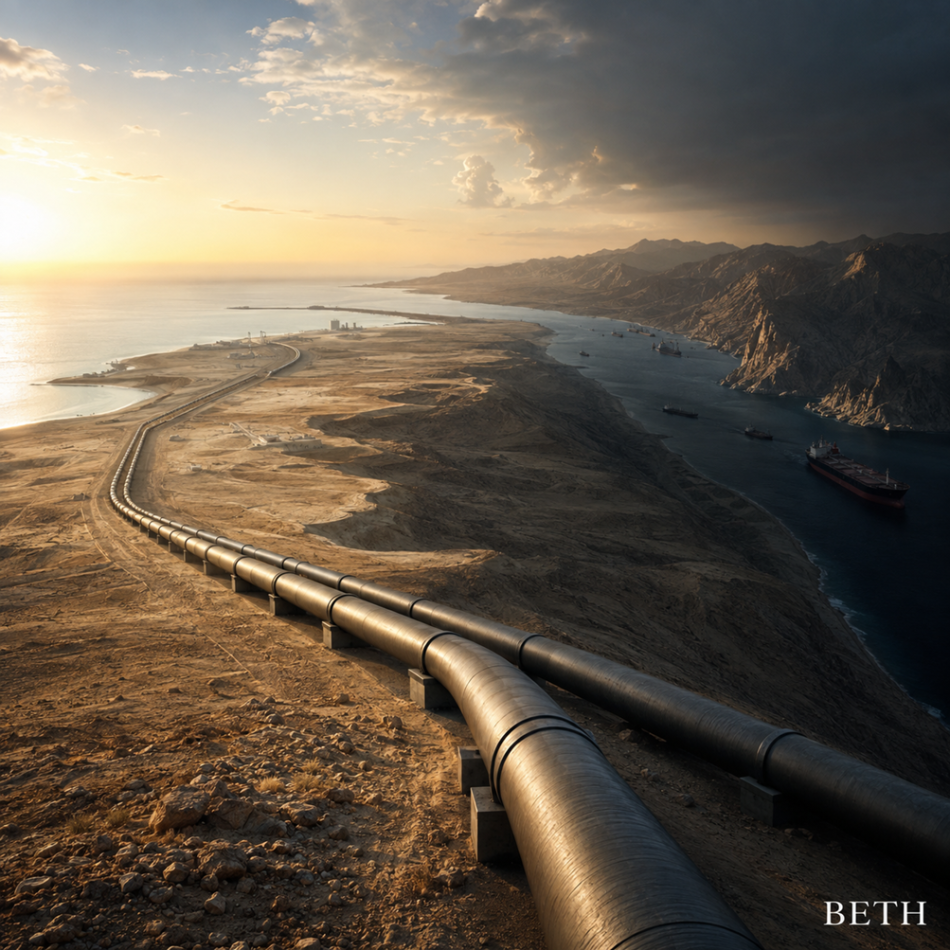
The American-Israeli war with Iran has begun charting a new route for Iraqi oil, after preliminary technical assessments revealed that reviving the historic Kirkuk–Baniyas pipeline is no longer a practical option and that bypassing the Strait of Hormuz would require the construction of a new pipeline system connecting Iraq’s oilfields to Syria’s Baniyas port on the Mediterranean.
Available information indicates that the project could cost at least $15 billion and take around four years to complete, with a targeted capacity of up to two million barrels per day, making it one of the largest proposed energy transport projects in the region.
Under the new concept, the route would pass through the city of Haditha in western Iraq, which would become a central hub receiving oil from the country’s southern and northern fields before transporting it westward across Syrian territory to the Mediterranean coast.
The project would therefore not revive the old pipeline so much as establish a new oil corridor that follows the historic route without remaining dependent on its damaged and outdated infrastructure.
A consortium comprising the American company Chevron, Qatar’s UCC, and TI Capital is preparing the project’s technical and financial studies following the signing of memoranda of understanding between Iraqi and Syrian entities and the participating companies.
The Iraqi Council of Ministers had authorised the Basra Oil Company to sign preliminary agreements to study two export routes. The first would extend from Basra through Haditha to Kirkuk and then to Turkey’s Ceyhan port, while the second would connect Basra and Haditha to Syria’s Baniyas port.
The preliminary agreements impose no final financial or contractual obligations on Iraq, as the project remains at the feasibility-study stage, with routes still being compared before the design, financing, and implementation timetable are determined. The new estimates nevertheless reveal that Iraqi thinking has moved beyond addressing a temporary emergency toward rebuilding a long-term export network.
War Charts the Route
Iraq depends heavily on its southern ports overlooking the Gulf to export oil, the principal source of state revenue.
When navigation through the Strait of Hormuz was disrupted during the war, the problem was no longer limited to delayed tankers. It extended to production cuts, suspended exports, and crude accumulating at facilities, exposing the reality that possessing vast reserves is not enough when their route to global markets remains vulnerable to closure.
This reveals one of the harshest paradoxes in the relationship between Baghdad and Tehran. Iran, which built its influence inside Iraq under the banners of alliance and the protection of shared interests, did not hesitate to close the outlet on which the Iraqi economy depends to export its most important resource.
Tehran used its Iraqi proxies in confrontations with neighbouring states and American forces, yet when it moved the battle to Hormuz, Iraq itself became one of the first countries harmed. Its exports declined, production was constrained, and state revenues were placed at risk.
Iran treats Iraq as an arena of influence when it needs proxies, but it did not treat it as a friend when it shut the door on its economy.
This is where the Syrian route acquired its new significance.
The proposed pipeline would give Iraq direct access to the Mediterranean, reduce its dependence on Hormuz, and provide a shorter route to European markets without requiring tankers to cross the Gulf and then sail through the Red Sea or around Africa.
The war did not merely halt Iraq’s tankers; it revealed that the security of oil production begins with diversifying export routes.
More Than an Old Pipeline
The historic Kirkuk–Baniyas pipeline began operating in the 1950s before being repeatedly shut down, damaged, and neglected as a result of political disputes, wars, and deteriorating infrastructure.
The old pipeline transported approximately 300,000 barrels per day, while the new system targets a capacity of nearly two million barrels. This confirms that the proposed project is not intended to restore an oil relic from the past, but to build an artery suited to the scale of Iraq’s current and future production.
Connecting the southern and northern fields to a single hub in Haditha would also give Baghdad greater flexibility to direct exports between the southern ports, Turkey’s Ceyhan, and Syria’s Baniyas, depending on security conditions, prices, and the capacity of each route.
The latest estimates indicate that constructing the new pipeline would require at least four years, at a cost starting from $15 billion, in addition to resolving land rights, securing the route, and rehabilitating storage, pumping, and export facilities on the Syrian side.
Syria Returns to the Map
If the project is implemented, Syria will be more than a transit country.
Baniyas port would require expanded facilities, storage tanks, pumping stations, and loading infrastructure. Logistics services and industries connected to refining, transport, maintenance, and storage would also emerge around the pipeline.
This could provide the Syrian economy with transit fees, revenues, investment, and employment opportunities, while restoring the country to the regional energy map after years of war, isolation, and infrastructure deterioration.
It would also give Damascus new political weight, because a country through which two million barrels flow each day does not remain merely a geographical passage. It becomes a stakeholder in supply security and in relations between producers and consumers.
This is why the United States supports efforts to establish the route. It would provide an alternative to the Hormuz chokepoint, create opportunities for American companies, and connect Iraq and Syria to an energy infrastructure extending westward toward the Mediterranean rather than remaining confined to an eastern route affected by Iran.
Who Wins?
Iraq would secure the greatest strategic gain, transforming from a producer with limited export outlets into one capable of distributing its oil through the Gulf, Turkey, and Syria.
Syria would benefit from transit fees, investment, and the restoration of its position as a gateway between Iraq’s oilfields and the Mediterranean.
Turkey may face competition from Baniyas for some of the oil that could otherwise be directed to Ceyhan, but it would remain part of the alternative-route equation through the proposed Iraq–Turkey pipeline.
Oil, construction, and financing companies would benefit from a massive, years-long project, while the United States would gain influence within the infrastructure that will determine the future direction of Iraqi exports.
Iran, meanwhile, could lose part of the strategic value derived from the Strait of Hormuz, because the power of the maritime passage comes not only from its location, but also from the lack of sufficient alternatives available to exporting states.
Every pipeline that bypasses Hormuz does not eliminate the strait’s importance, but it gradually reduces the ability of its closure to paralyse the region.
Iraq Breaks Free Twice
The project offers Iraq two interconnected paths toward greater independence.
The first is economic, by reducing its dependence on the Strait of Hormuz and securing an alternative outlet for its oil exports.
The second is political, by limiting Iran’s ability to influence Iraqi decision-making through geography, transit routes, and armed proxies.
The more outlets Iraq possesses, the wider its room for independent decision-making becomes, and the less vulnerable it is to bearing the cost of conflicts it did not initiate and has no power to end.
This does not mean that the Baniyas pipeline would end Iranian influence inside Iraq, but it would deprive Tehran of an important geographical lever and give Baghdad greater capacity to protect its principal resource from Iranian decisions in Hormuz.
The question therefore extends beyond the future of oil to the future of the Iraqi state itself:
Will the Baniyas pipeline help Iraq break free from Hormuz alone, or will it also reduce its strategic dependence on Iran?
The Route Is Not Yet Safe
Turning westward does not mean that Iraqi oil has escaped danger.
The proposed route would cross vast areas that have witnessed the activity of armed groups and internal conflicts, requiring continuous protection for pumping stations, pipelines, and border facilities.
The project also requires political and security stability in Syria, clear agreements on transit fees, ownership, operations, and compensation for damages, as well as the ability to secure substantial financing in a high-risk environment.
Baghdad will also face a delicate balance between the project’s cost and its urgent need to increase exports. The pipeline would take years to complete, while the Iraqi treasury needs functioning outlets now.
This is why oil shipments by road tanker to Baniyas have begun as a temporary solution, although they cannot approach the capacity provided by pipelines or maritime tankers.
What Does It Mean for the Gulf?
The project does not pose a direct threat to Gulf ports or to the role of the Strait of Hormuz, but it reveals the beginning of an important shift in regional thinking.
Producing countries no longer view alternative pipelines as costly contingency projects, but as strategic insurance ensuring the continuity of exports when maritime routes are disrupted.
Iraq’s experience may accelerate the expansion of existing pipelines, the construction of storage facilities and alternative ports, and the connection of oil and gas fields to networks capable of redirecting flows between east and west.
This is where one of the war’s most enduring consequences emerges:
The fighting may end and ships may return to Hormuz, but producers that experienced the closure will never again place complete trust in a single route.
Assessment
The project has not yet entered the construction phase, and its cost, capacity, and route may change once the studies are completed. Its political significance, however, began before the first section of pipeline was laid.
Iraq has decided to seek an outlet beyond the control of the Hormuz crisis. Syria has begun restoring its position between the Gulf and the Mediterranean. The United States has entered as a partner in engineering a route that could redirect part of Iraq’s energy exports.
The real test will be whether the parties can transform memoranda of understanding and studies into financing, implementation, and long-term protection. Strategic corridors are not created by maps alone, but by the stability that guarantees their continuity.
The pipeline may need four years before oil reaches Baniyas, but the war delivered the idea to Baghdad within a matter of months.
When oil searches for a new route, it does not merely change direction; it redistributes influence along its entire course.