



A Multi-Route Economy
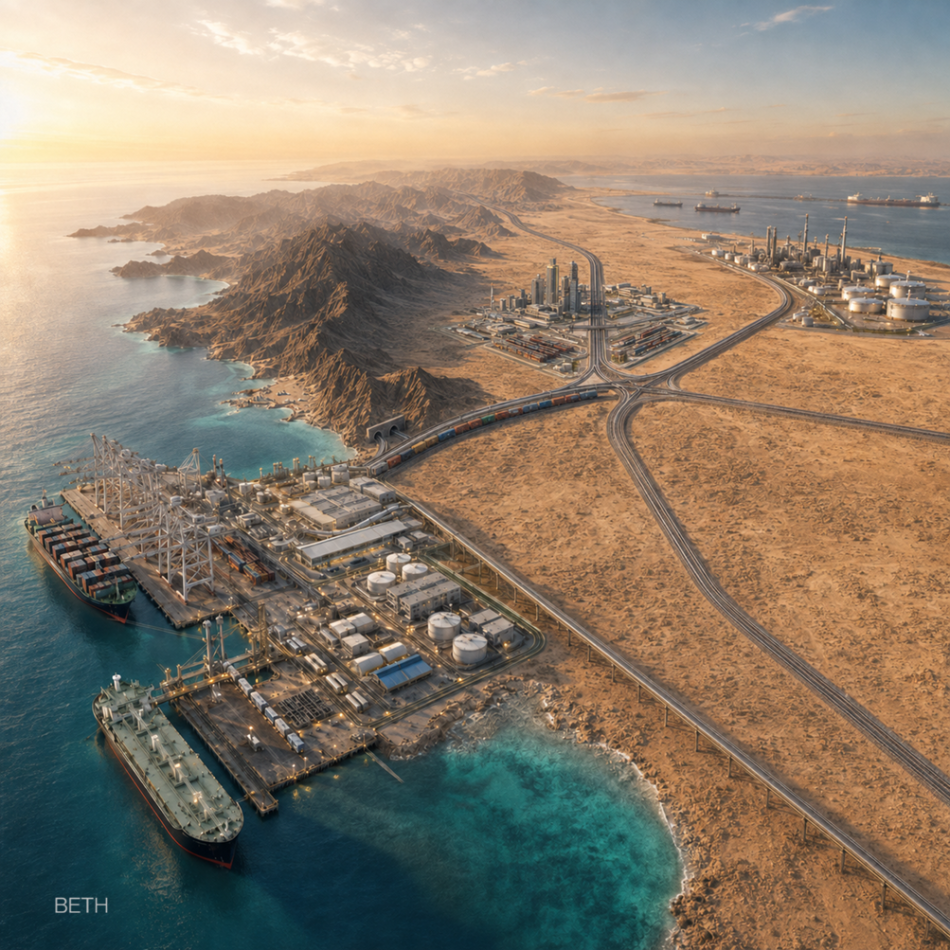
Saudi Arabia is expanding its energy and trade routes—from the Red Sea to overland corridors—to reduce dependence on Hormuz and connect its economy to new regional and global destinations
Prepared and analyzed by the Strategic Media Department – BETH Agency
Supervised by Abdullah Al-Omira
Saudi Arabia has not announced a single project titled the “Western Economic Gateway.” Yet a reading of the decisions and projects unveiled separately over recent months reveals that such a gateway is already taking shape.
An oil pipeline runs from the east to Yanbu in western Saudi Arabia. Operational corridors redirect cargo from Gulf ports to the Red Sea. A new container service has begun calling at a port previously associated mainly with oil and petrochemicals. Logistics centers are expanding in Jeddah, while downstream industries are moving toward Yanbu.
Each development appears independent when viewed separately. Taken together, however, they reveal a larger transformation:
Saudi Arabia’s western coast is not merely being used as a temporary escape route from the Hormuz crisis; it is being developed into a permanent economic frontage operating alongside the eastern coast.
From Emergency to Strategy
When navigation through the Strait of Hormuz was disrupted, attention turned to the East–West Pipeline, which transports oil from fields in the Eastern Province to the port of Yanbu on the Red Sea.
International coverage portrayed the route as an emergency corridor built by the Kingdom to bypass the strait when necessary.
Oil, however, is not the only commodity moving westward.
In March 2026, Saudi Arabia launched the Logistics Corridors Initiative to establish operational routes for containers and cargo redirected from Eastern Province ports and ports across the Gulf Cooperation Council states to Jeddah Islamic Port and other Saudi ports on the Red Sea.
This means the trans-Saudi corridor is no longer dedicated solely to energy. It can also move trade between the two coasts and connect the Gulf to the Red Sea through Saudi territory.
The crisis revealed the function of the infrastructure; it did not create it.
Yanbu Moves Beyond Oil
In June, the Red Sea Express container service began operating at King Fahd Industrial Port in Yanbu with the arrival of its first shipment aboard a Saudi vessel operated by Folk Maritime, in cooperation with SABIC and Red Sea Gateway Terminal.
The service connects Yanbu and Jeddah with the ports of Aqaba in Jordan and Ain Sokhna in Egypt. It offers capacity of up to 1,100 twenty-foot equivalent units and opens direct routes for national exports and imports arriving from global ports.
The significance of the initiative lies not only in its initial capacity, but in its location.
King Fahd Industrial Port is Saudi Arabia’s largest Red Sea port for handling crude oil, refined products, and petrochemicals, with an annual handling capacity of up to 210 million tonnes.
The arrival of container traffic signals the beginning of a functional transformation:
The industrial port that traditionally exported energy and petrochemicals is beginning to accommodate a broader commercial system encompassing containers, national products, and direct imports.
This does not mean that Yanbu will immediately become a container port competing with Jeddah. Rather, it points to the integration of functions that were previously separate: oil, industry, maritime transport, and non-oil trade.
Jeddah Builds the Logistics Backbone
In July, the Saudi Ports Authority signed seven contracts worth nearly SAR1 billion to build and expand logistics centers at Jeddah Islamic Port and the Al-Khumrah area.
The projects cover more than 384,000 square meters for storage, cargo consolidation, and re-export activities. They are expected to create more than 5,000 direct and indirect jobs.
With these additions, the number of port-based logistics centers in Saudi Arabia rose to 34, half of which are located at Jeddah Islamic Port, supported by investments exceeding SAR14 billion.
Another part of the picture emerges here:
Yanbu is moving from oil toward containers and industry, while Jeddah is expanding its storage, re-export, and digital services and strengthening links between the port, airport, and major road networks.
Yanbu provides industrial and energy weight, while Jeddah provides commercial and logistics density.
Together, they form a western economic frontage that depends neither on a single port nor on a single activity.
The Red Sea Is a Network, Not a Port
In recent months, new maritime services have connected Jeddah and King Abdullah Port with ports in China, South Korea, India, Malaysia, Oman, Europe, and Africa.
These include three Maersk services with a combined capacity of up to 14,400 TEUs, a service connecting Jeddah with East Asia with a capacity of 17,000 TEUs, and another linking Jeddah with India and Djibouti.
A Mediterranean Shipping Company service has also connected Jeddah Islamic Port and King Abdullah Port with European ports, supported by an overland extension to King Abdulaziz Port in Dammam and onward distribution to Gulf markets.
This final detail is significant because it reflects movement in both directions.
Goods do not move only from east to west. They can also arrive from Europe at Red Sea ports and then cross Saudi Arabia overland to the Eastern Province and Gulf states.
Saudi Arabia is therefore evolving from a country bypassing a troubled strait into a bridge that redistributes trade between two seas.
Industry Follows the Corridor
An economic gateway cannot be completed through ports and roads alone. It requires nearby industry, storage capacity, and companies capable of re-exporting products.
In January, initial terms were announced for the development of an advanced, integrated aluminum industrial complex in Yanbu. The project includes advanced smelting technologies, a major continuous-casting facility, and the production of high-value downstream aluminum goods.
An integrated logistics center is also being developed at Yanbu Commercial Port over an area exceeding 120,000 square meters to enhance storage and handling capacity and attract private-sector participation.
Together, these elements reveal a clear economic sequence:
Raw materials arrive or are produced, then processed industrially, stored, transported in containers, and exported from the same port or a nearby one.
This is not merely a transit corridor; it is a value chain taking shape along the coast.
Is the War Creating an Economic City?
The war did not create Yanbu, nor did the development of Red Sea projects begin solely because Hormuz was closed.
The East–West Pipeline has existed for decades, while port development forms part of Saudi Vision 2030 and the National Transport and Logistics Strategy.
The war, however, has done three things:
- Tested the infrastructure’s ability to operate under pressure.
- Accelerated the redirection of oil and cargo from east to west.
- Revealed the strategic value of projects previously viewed largely as separate economic initiatives.
More precisely:
The war did not alter the direction of Saudi Arabia’s plans, but it accelerated their implementation and revealed their security significance.
Will the Red Sea Replace the Gulf?
The objective is not to weaken the eastern coast or relocate the center of the Saudi economy entirely to the west.
The Eastern Province will remain the heart of energy and heavy industry, while Gulf ports will remain essential to trade with Asia and regional markets.
Nor is the Red Sea immune to danger. Houthi attacks have demonstrated that Bab al-Mandab can also become a chokepoint, potentially forcing tankers to sail northward through the Suez Canal or take the longer, more expensive route around Africa.
Saudi strategy is therefore not based on replacing one strait with another, but on reducing the ability of any single strait to disrupt the entire economy.
The true transformation is this:
An east that produces and a west that exports—followed by an east and west both capable of producing, receiving, exporting, and redistributing.
The Unannounced Story
Official statements have not said that Saudi Arabia is building a “western economic frontage” under a single project with a specified completion date.
The announced facts nevertheless show that:
- Oil is crossing the Kingdom toward Yanbu.
- Cargo is being redirected from Gulf ports to Red Sea ports.
- Containers have begun entering King Fahd Industrial Port.
- Jeddah is expanding its logistics and re-export centers.
- Yanbu is attracting downstream industry and storage facilities.
- Maritime services are connecting the western coast with Europe, Asia, and Africa.
When these facts are brought together, the inference becomes clearer:
Saudi Arabia is moving its western coast from the margins of its economic plans to one of their principal frontages—and from an emergency route during crises to a permanent platform for energy, industry, and trade.
What Does This Mean for the Kingdom?
First, greater flexibility for energy exports and less dependence on a single maritime direction.
Second, an overland-maritime route enabling Gulf states to reach the Red Sea through Saudi territory and ports.
Third, the attraction of industries to locations close to ports, energy sources, and African and European markets.
Fourth, an expanded role for the national carrier and Saudi maritime services in regional trade.
Fifth, transforming the Kingdom’s geography from a space between two seas into an economic power connecting them.
BETH Assessment
The transformation underway appears to be more than an expansion in port capacity or the addition of a new shipping service.
It represents a redistribution of economic functions within Saudi Arabia.
The east retains its weight in energy and industry, while the west gains increasing importance in exports, manufacturing, storage, logistics services, and intercontinental connectivity.
If these projects continue in the same direction, the East–West Pipeline will no longer be merely a conduit carrying oil whenever Hormuz is closed. It will become the backbone around which a broader network transports energy, cargo, and industrial value between the two coasts.
When Hormuz closed, Saudi Arabia did not merely search for an exit; it began transforming the alternative route into a new economic frontage.
Another Perspective
The image does not depict a specific industrial location. Instead, it visualizes the transformation itself: a route crosses Saudi Arabia from the east but does not end at an oil tanker on the Red Sea. It branches into a container port, industry, rail transport, and logistics services. The route created to provide protection from risk has begun building an economy around it.