



BETH Eyes on the Capitals of Decision
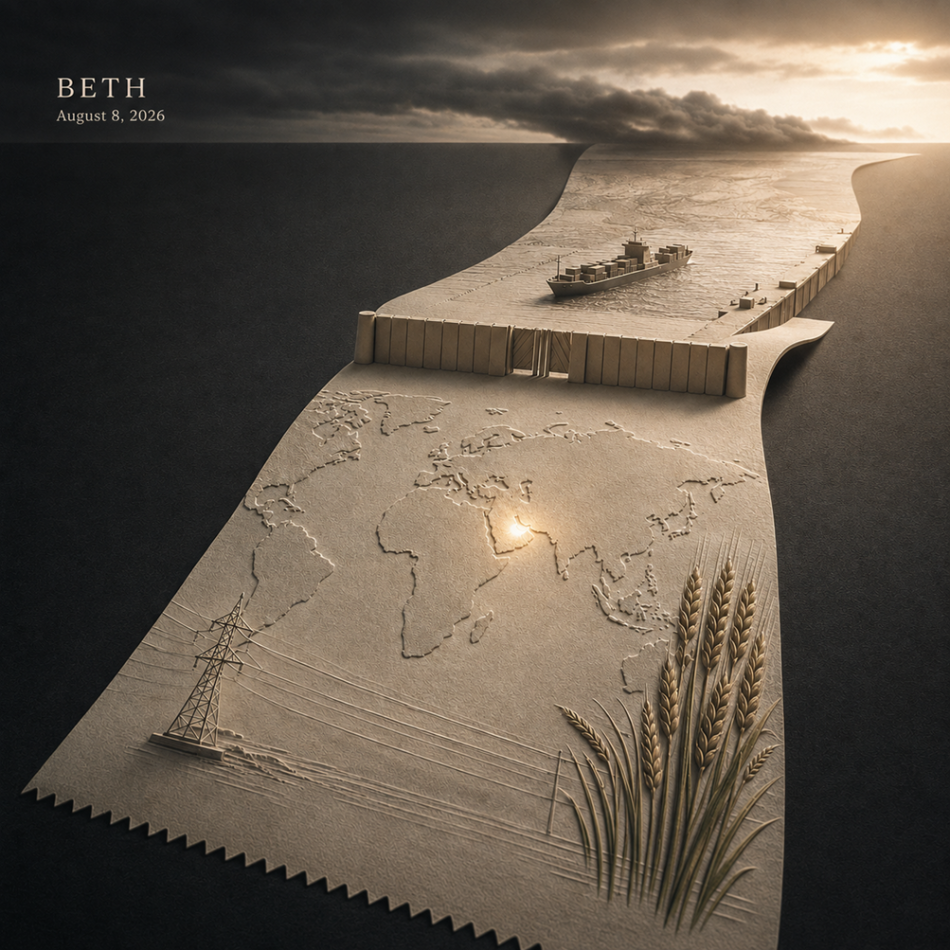
The World Pays the Bill
U.S. employment declines, Europe’s borders return, a typhoon shuts East Asian ports, and food prices rise, while Houthi attacks move from regional warnings to condemnation by the UN Security Council
World Capitals | BETH
Monitoring and Analysis | Strategic Media Department
A review of the global press today, Saturday, August 8, 2026, reveals that instability is no longer merely a military story followed from the battlefields.
Wars and climatic and political tensions have begun to seep into the details of economic life: a job lost in the United States, borders reinstated within Europe, a port closed in China, an aircraft grounded in Japan, and food prices rising as wheat, vegetable oils, and sugar are increasingly affected by both heat and war.
In the Arab media, coverage has shifted from the shock of announcing the Makkah Defence Agreement to questions about its ability to operate, while the UN Security Council has given attacks by the Houthis against Saudi Arabia and maritime navigation a clearer international dimension.
The world, in short, is no longer merely watching the crises. It has begun paying their bill.
Washington | Employment Declines
The U.S. employment report surprised the markets, as the economy lost 23,000 jobs in July, contrary to expectations of continued growth, while the unemployment rate remained at 4.1%.
The negative signal was not confined to July. Estimates for May and June were revised downward by a combined 103,000 jobs, indicating that the labour market had been weaker than the initial readings suggested.
The losses were concentrated in local government education and retail trade, while employment continued to grow in healthcare. Annual wage growth stood at 3.2%. Official U.S. employment report
The American and British press presented the figures as a new test for the Federal Reserve. Declining employment creates pressure to ease monetary policy, but rising energy prices caused by the war are fuelling inflation again and making interest-rate cuts more difficult.
Paradoxically, financial markets received the weak employment figures with some relief because they reduced the likelihood of further interest-rate increases, even though the news fundamentally reveals the economy’s declining ability to create new jobs. Analysis of the report’s market implications
For Saudi Arabia, the figures carry two opposing effects: easing pressure on interest rates may benefit markets and investment, but a slowdown in the U.S. and global economies could later weigh on energy demand.
New York | International Condemnation
The UN Security Council condemned the missile attacks launched by the Houthis against Saudi Arabia since July 13, along with attacks targeting commercial vessels since July 22.
It also expressed concern over aircraft landing at Sanaa and Hodeidah airports without authorisation from the Yemeni government, stressing the need to respect Yemen’s sovereignty and the safety of civil aviation.
The significance of the statement is not limited to its condemnation. It moves the attacks from the framework of Yemen’s domestic conflict into one connecting them to maritime security, civil aviation, and regional stability.
It also gives the Saudi position a clearer international foundation: the Kingdom supports de-escalation and a political solution, but attacks against it are not a legitimate part of any regional bargaining process.
This takes on even greater significance following the Makkah Defence Agreement, as Saudi Arabia is now surrounded by two circles of deterrence: a new defence partnership and an international condemnation that identifies more clearly the party threatening regional security.
Madrid and Rome | Borders Return
The European press followed the escalating dispute between Spain and Italy after Rome refused Madrid’s demand to lift the border inspections it had imposed following the arrival of large numbers of migrants in the city of Ceuta.
Madrid responded by reinstating controls on arrivals from Italy, beginning August 8 for one month, in a move demonstrating how disagreements over Europe’s external borders can bring borders back within Europe itself.
The Financial Times reported that approximately 72,000 migrants had entered Ceuta, placing the Spanish authorities under immense humanitarian, political, and security pressure. Coverage of the Schengen crisis
The crisis exposes the fragility of one of the European Union’s most important achievements. Freedom of movement remains easy to uphold in times of stability, but during crises it becomes the first principle liable to suspension.
It also demonstrates that migration is no longer merely a dispute between Europe and transit countries. It has become a source of tension among European governments themselves, particularly when each state believes another is attempting to shift the burden onto it.
London | America’s Vulnerability
The Financial Times drew attention to a less visible aspect of American power: Washington’s dependence on sustained foreign demand for U.S. Treasury bonds to finance its debt and fiscal deficit.
The analysis came in the context of U.S.-Japanese intervention to support the yen. The United States wants stronger Asian currencies to protect its competitiveness, but it does not want higher Japanese interest rates or changes in Asian monetary policy to reduce purchases of U.S. bonds.
Here lies the paradox of the American financial empire: the United States issues the currency the world needs, yet it simultaneously needs the world to continue financing its debt.
For economies linked to the dollar and invested in U.S. assets, including Saudi Arabia, movements in the yen and bond markets are not a remote Japanese-American matter. They affect interest rates, capital flows, the value of reserves, and financing costs worldwide.
Tokyo and Beijing | The Typhoon Closes Routes
Typhoon Dolphin led coverage across East Asia after striking Okinawa, injuring six people, cutting power to more than 50,000 buildings, and forcing Japanese airlines to cancel flights.
In China, authorities closed ports in Zhejiang province, suspended ferry services and construction work, and cleared vessels from Yangshan Port near Shanghai in preparation for the typhoon’s arrival on the eastern coast.
Seventy-eight flights were also cancelled in Taiwan amid broader disruption to maritime and air transport.
The story is climatic on the surface but economic in its consequences. China’s eastern coast is a central part of the global network of factories, ports, and supply chains. Any disruption there transmits its effects to shipping, insurance, production, and deliveries in distant countries.
The lesson repeated by the Asian press is that missiles are not the only threat to trade security. Within hours, a typhoon can close ports that took countries years to build.
Rome | Food Prices Rise
The Food and Agriculture Organization announced that its global Food Price Index rose by 0.6% in July, driven by higher prices for cereals, sugar, and vegetable oils.
Global wheat prices jumped by 5.8% in a single month because of disruptions to Black Sea exports, damage to infrastructure, and heatwaves that affected crops in several producing countries.
The Vegetable Oil Price Index also reached its highest level since June 2022, while sugar prices increased by 5.6% because of heat, drought, and concerns over production in Europe and Asia. Food and Agriculture Organization data
The figures show that war and climate are no longer separate crises. Port disruptions increase the cost of wheat, heat reduces crop yields, and energy prices raise transportation and production costs. The combined result ultimately reaches the consumer.
For Saudi Arabia, these developments reaffirm the importance of investing in food security, strategic reserves, and diversified supply chains. Financial capacity alone cannot guarantee the availability of food when transport routes are disrupted or global production declines.
Khartoum | A Generation Is Being Lost
The United Nations warned that Sudan is losing another generation to war, after more than 1,000 days of fighting that have deprived millions of children of education, stability, and essential care.
It noted that the UN and its partners had managed to return more than one million children to some form of education during the current year, but this remains far below the scale of need.
Some Arab media outlets presented the story as a humanitarian crisis, but its significance extends beyond relief. A child who loses years of education does not automatically recover them when the gunfire stops.
The true cost of the war in Sudan will therefore not be reflected solely in the numbers of those killed or displaced, but in a generation entering the future with fewer opportunities and in a country that will need to rebuild its people before rebuilding its structures.
Arab Media | Testing the Alliance
The Arab press quickly moved from celebrating the signing of the Makkah Agreement to raising questions about its effectiveness and the limits of the commitments it imposes on Saudi Arabia, Türkiye, and Pakistan.
Three trends emerged in the coverage:
- One views the agreement as the nucleus of a new regional security order.
- Another directly links it to the U.S.-Iranian war and Houthi attacks.
- A third asks about the institutions, leadership, and response mechanisms that would transform the principle of collective defence into an operational capability.
Al Jazeera directly asked whether the alliance could produce a new regional order, while simultaneously following indications that Yemen may be approaching a broader confrontation. Regional coverage
This shift is healthy. The importance of the agreement no longer needs to be demonstrated. The next stage is now more important: how can it move from the power of its wording to the power of an institution?
The View from Riyadh
When these readings are brought together, a global map emerges, united not by a single crisis but by countries’ attempts to protect themselves from multiple, simultaneous crises.
Washington faces a weak labour market and inflation threatened by energy prices.
Europe is restoring borders after failing to distribute the burdens of migration.
East Asia is closing ports and airports in the face of a typhoon testing global supply chains.
The world is confronting rising food prices caused by war and extreme heat together.
The UN Security Council has placed attacks by the Houthis against Saudi Arabia and maritime navigation under clear international condemnation.
Meanwhile, the Arab media has begun asking about the instruments required to make the Makkah Agreement operational.
Within this picture, Saudi Arabia’s roles overlap: it is an energy state affected by the balance between price and demand; a food-importing country that must protect its supplies; a political power defending the stability of maritime navigation; and a country facing attacks while working to prevent the war from expanding.
Riyadh therefore cannot regard employment figures, typhoons, or border disputes as distant matters. To varying degrees, they are all transformed into prices, interest rates, shipping costs, insurance premiums, food supplies, and security concerns.
Beyond the Capitals
The most important message in today’s press is that a state’s strength is no longer measured solely by the weapons or wealth it possesses, but by its ability to keep jobs, ports, borders, electricity, and food supplies functioning while parts of the world around it are disrupted.
A modern crisis does not always enter a country in the form of an army.
It may arrive as an insurance premium, the price of bread, a delayed vessel, a higher interest rate, or a job that no longer exists.
The world is not living through separate crises.
It is living with a single bill, delivered to every capital in a different form.