



Who Closes the Sea?
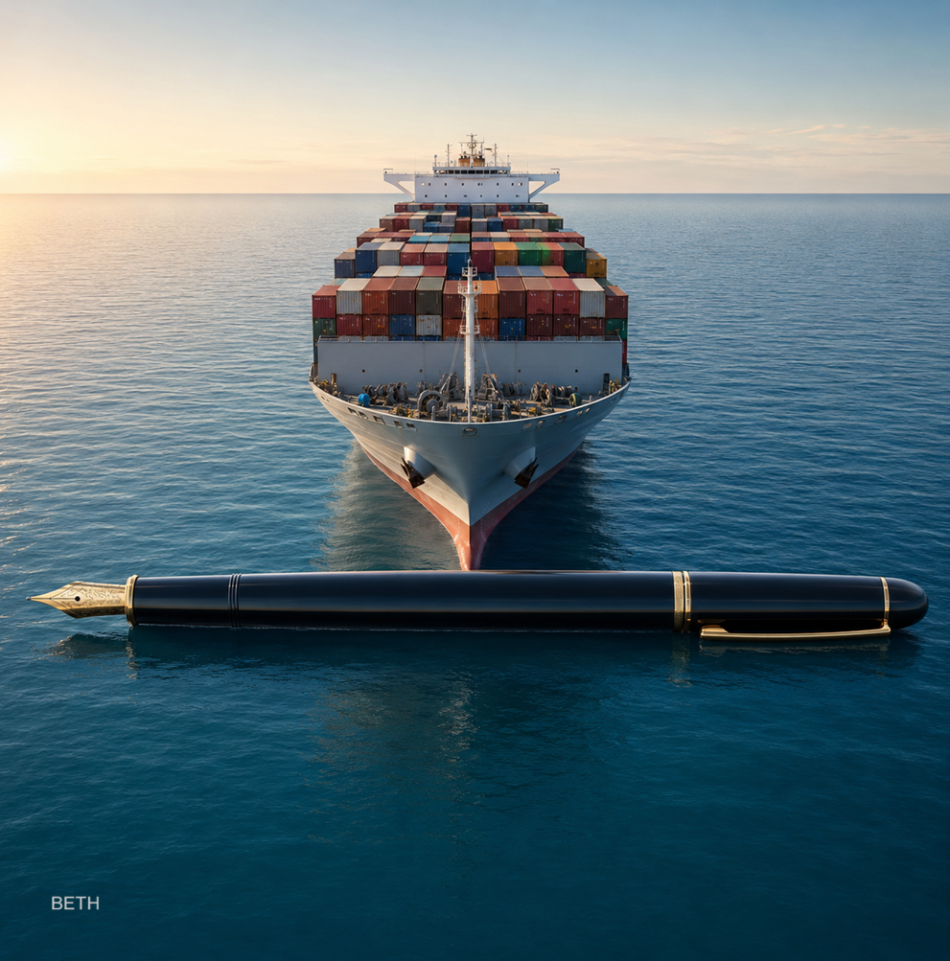
A ship may be commercially defeated without being struck by a missile, while military protection paves the way for the return of confidence
Prepared and analyzed by | Strategic Media Department – BETH Agency
Supervised by: Abdullah Al-Omira
Introduction
When a ship comes under attack, attention turns to the missile that struck it, the party that launched it, and the military force that will respond.
But the greater danger may begin after the attack has ended.
A call from an insurance company, a warning from a risk center, or a decision by a bank may stop dozens of ships that have not been attacked and transform a maritime corridor that is militarily open into a commercially closed route.
This reveals another dimension of warfare at sea:
Military forces may control the waters while commercial operators remain afraid to enter them.
This is where the scope of protection expands. The military coalition secures maritime corridors and limits threats, while an integrated economic and information system conveys this security to shipping companies, insurers, and banks, and restores confidence to the markets.
The Open Sea
Closing a maritime corridor does not require sinking every ship that passes through it.
It is enough for the probability of danger to rise to a level that prompts shipping companies to change their routes, insurance companies to increase premiums or exclude coverage, and cargo owners to refuse to place their goods aboard vessels crossing the region.
The sea then remains open on the map but becomes closed in commercial calculations.
UN Trade and Development has confirmed that disruptions to maritime corridors lead to route changes, shipment delays, and higher transport and insurance costs. The World Bank has also indicated that the Red Sea crisis increased shipping and insurance costs, with repercussions extending to regional and international economies.
A single strike then becomes larger than the vessel it targets because it does not merely destroy a metal structure; it strikes confidence in the entire route.
The Hidden Rulers
Behind every vessel is a network of institutions that do not appear in images of military operations but possess the power to allow it to sail or force it to stop.
The Insurance Company
An insurance company does not examine political statements alone. It considers the probability of loss and the cost of compensation.
When a region is designated a war-risk zone, the cost of the voyage increases, and the ship may require additional coverage for each passage. If the cost of insurance exceeds the voyage’s ability to generate a profit, the route becomes commercially unusable even if it remains militarily open.
The Classification Society
A vessel is not merely a floating structure; it is also a technical, legal, and financial file.
Classification societies monitor its condition, seaworthiness, and compliance with safety standards. Any deficiency in the vessel’s classification or certificates may affect its insurance, financing, and acceptance at ports.
The Bank
The vessel may be capable of sailing and the shipping company prepared to take the risk, but the bank financing the cargo or the voyage can stop the operation if it considers the danger too high or believes that sanctions could affect one of the parties involved.
A financial decision issued from an office far from the sea can therefore prevent a ship from entering it.
The Port
A voyage does not end when a vessel safely passes through a maritime corridor, but when subsequent ports agree to receive it.
Ships arriving from high-risk areas may be subjected to additional procedures, delays, or inspections, increasing the cost of the voyage and reducing the attractiveness of the route.
Information Companies
Satellites, tracking systems, and maritime security centers monitor ships’ routes and conduct, as well as the threats surrounding them.
The data they produce are converted into risk assessments used by shipping companies, insurers, ports, and governments. Maritime information has therefore become part of security, rather than merely a monitoring service.
The International Maritime Organization treats ship and port security as a risk-management activity based on collecting, assessing, and exchanging threat information, rather than on military protection alone.
The Hidden Strike
The impact of an attack does not end with the vessel that it strikes.
The first blow is carried out by an armed party, but its effects multiply when it becomes an international warning, followed by an increase in insurance premiums, the rerouting of vessels, and higher prices for goods and energy.
This is where the hidden strike appears: a risk report capable of stopping ships that no missile has approached.
The effects of the attack thus travel from the sea to factories, shops, and homes.
The attacking party does not need to destroy all trade. It is enough to make shipping companies question the safety of the route.
It is not targeting vessels alone; it is targeting the decision to sail.
Who Controls the Route?
On the surface, freedom of navigation depends on international law, naval fleets, and ports.
In practice, however, it also depends on the decision of an insurance company in London, a bank in New York, a data center in Singapore, and a shipping company in Copenhagen or Shanghai.
This is the paradox:
Military forces may prevail at sea while fear persists in commercial decision-making rooms.
Governments may announce that a maritime corridor is safe, but ships may not return unless the institutions that bear the losses are convinced that the level of risk has become acceptable.
The next battle is therefore not only over the waters, but over defining and pricing risk and convincing the world that it has declined.
What Comes Next?
The outcome of the crisis depends on the distance between three levels: the cessation of attacks, the restoration of passage, and the return of confidence.
Military operations may cease, but shipping companies do not immediately return. Some vessels may resume passage while insurance premiums remain high. Maritime corridors may be officially reopened, while banks and cargo owners continue to treat them as high-risk zones.
The crisis may therefore move in one of three directions:
A Rapid Settlement
The United States and Iran reach an agreement, and attacks associated with the war stop. Ships begin to return gradually, and insurance and transport costs decline.
A Fragile De-escalation
Attacks decline without a final agreement. Some voyages resume, but maritime corridors remain vulnerable to disruption with every confrontational statement or security incident.
Open-Ended Pressure
Negotiations fail and military operations and the blockade expand. Shipping companies turn to alternative routes, and a temporary cost develops into a long-term change in trade routes.
The most dangerous outcome is not the closure of the sea for several days, but global trade becoming accustomed to an alternative route. Ships that change their routes may not return quickly, even after the danger has disappeared.
How Is the Sea Reopened?
No single solution can restore maritime navigation to normal. What is required is an interconnected sequence that begins with security and ends with confidence.
The first level is to halt attacks and reduce the ability to repeat them because political statements alone do not lower risk assessments.
The second is to establish an international mechanism to verify the cessation of attacks, exchange information immediately, and determine responsibility for any violation, so that every incident does not become a reason for the de-escalation to collapse.
The third requires protected and monitored maritime corridors, rapid responses to vessels exposed to danger, and clearly declared security levels that change according to measurable data.
The economic solution is based on involving insurers, reinsurers, shipping companies, and ports in return arrangements, while providing temporary guarantees that reduce passage costs during the transitional phase.
The media solution plays a complementary role through a credible center that publishes verified information quickly and prevents rumors and exaggeration from turning a limited incident into a comprehensive commercial closure.
The return to normality does not begin with a statement declaring that the sea is safe, but with a system that enables shipping companies to prove this to their boards of directors, banks, and insurers.
What Does the Coalition Protect?
The importance of the Saudi-led multinational maritime defense coalition stems from its ability to reduce military risk, monitor maritime corridors, exchange information, and respond to attacks.
The coalition’s success is measured by its ability to reduce military risk, protect vessels, and restore navigation to maritime corridors. That success becomes complete when security on the ground produces lower insurance costs, shorter voyage times, and renewed confidence among companies and markets.
A destroyer intercepts a missile and protects a vessel, while the economic and information system translates this military achievement into commercial confidence and a sustainable return of maritime navigation.
The coalition therefore needs a parallel economic and information arm that includes shipping companies, insurers, classification societies, ports, information centers, and major banks.
The coalition can achieve considerable success in reducing attacks and securing passage. Its complete success depends on military security producing a tangible decline in risk assessments and insurance costs, and vessels returning to their normal routes.
Military force prevents the attack, while the economic and information system reopens the sea.
Politics and Force
The latest U.S. position enhances the prospects of the coalition’s success. President Donald Trump has presented Iran with what he described as its “last chance” and limited its options to signing an agreement or surrendering, in an attempt to close the political file that fuels maritime risk and restore maritime corridors to normal.
Trump is combining the threat of blocking supplies from reaching Iran with keeping the door to an agreement open. This is an exercise in what is known as “coercive diplomacy”: force ready in the background and a political settlement offered in the foreground.
Force can push an adversary toward negotiations, but it cannot, on its own, produce a stable settlement.
If Trump wants to close the file and restore normal conditions, the threats must be transformed into an enforceable agreement that determines the future of Iran’s nuclear program, the security of the Strait of Hormuz, the cessation of attacks against vessels, the role of Iran-linked groups, oversight mechanisms, and the penalties resulting from violations of the agreement.
The settlement also requires an exit that the Iranian leadership can present to its public without using the word “surrender.” The more the language of humiliation intensifies, the narrower the political space available for Tehran to make concessions.
This is where the role of mediating countries, including Saudi Arabia, Oman, and Qatar, becomes important: transforming the U.S. ultimatum into clear commitments and drafting an agreement that prevents Iranian maneuvering without making rejection the only option available to Tehran.
The coalition’s establishment alongside U.S. pressure does not mean that it is an arm of the U.S. war against Iran. Washington is applying pressure to the source of the threat, while the Saudi-led coalition protects maritime corridors and Saudi diplomacy works to contain escalation and prepare the ground for a settlement.
The tracks therefore complement one another in outcome without performing identical roles: U.S. pressure, collective protection, and Saudi mediation.
Force opens the window for an agreement, while politics determines whether it leads to the end of the war or to a more intense round.
A Saudi Opportunity
Saudi Arabia has coastlines on both the Red Sea and the Arabian Gulf, as well as ports located along corridors connecting three continents. Vision 2030 also seeks to strengthen the Kingdom’s position as a global logistics gateway.
The Saudi role should therefore not be limited to leading military protection. It could extend to establishing an International Center for Maritime Confidence.
The center would not be another military operations room, but an institution that collects security and commercial information and converts it into accurate and rapid assessments on which insurers, shipping companies, and ports can rely.
The center could:
- Issue a Saudi-led international risk assessment for the Red Sea and the Gulf of Aden.
- Establish an immediate information-sharing platform connecting military forces, vessels, insurers, and ports.
- Develop indicators measuring maritime-corridor security, passage costs, and the degree to which confidence has returned.
- Establish advanced national and regional capabilities in maritime war-risk insurance and reinsurance.
- Provide guarantees or joint arrangements that encourage vessels to return when risks have genuinely declined.
- Document and verify attacks to prevent rumors and exaggeration from closing the sea psychologically and through the media.
If this is achieved, Saudi Arabia will not merely be a country that protects the sea. It will become a country that helps determine the global price of maritime risk.
The Return to Normality
A return to normal conditions will not mean merely that missiles have stopped. It will require the appearance of four clear signs:
Ships returning to their original routes, war-risk premiums declining, energy and shipping prices stabilizing, and armed groups ceasing to use maritime corridors as instruments of pressure.
When these signs appear, it will be possible to say that the file has genuinely begun to close.
If attacks stop while insurance costs remain high, vessels stay away, and markets remain anxious, the war will have subsided militarily but will not have ended economically.
Force may stop the attack, and politics may end the war, but confidence alone restores the sea to normal.
Conclusion
A missile can strike a ship.
But fear can stop an entire commercial fleet.
The Saudi mission therefore extends beyond protecting maritime corridors. The more consequential power lies in building a system that enables the world to trust that passage is possible, risk is measurable, information is reliable, and losses are insurable.
The Kingdom would then move from protecting ships to protecting trade, and from leading a military coalition to shaping maritime security in its fullest sense.
The sea does not reopen merely when the missiles stop, but when confidence returns.