



Refinery Outside Hormuz.. Through a Saudi–US Consortium
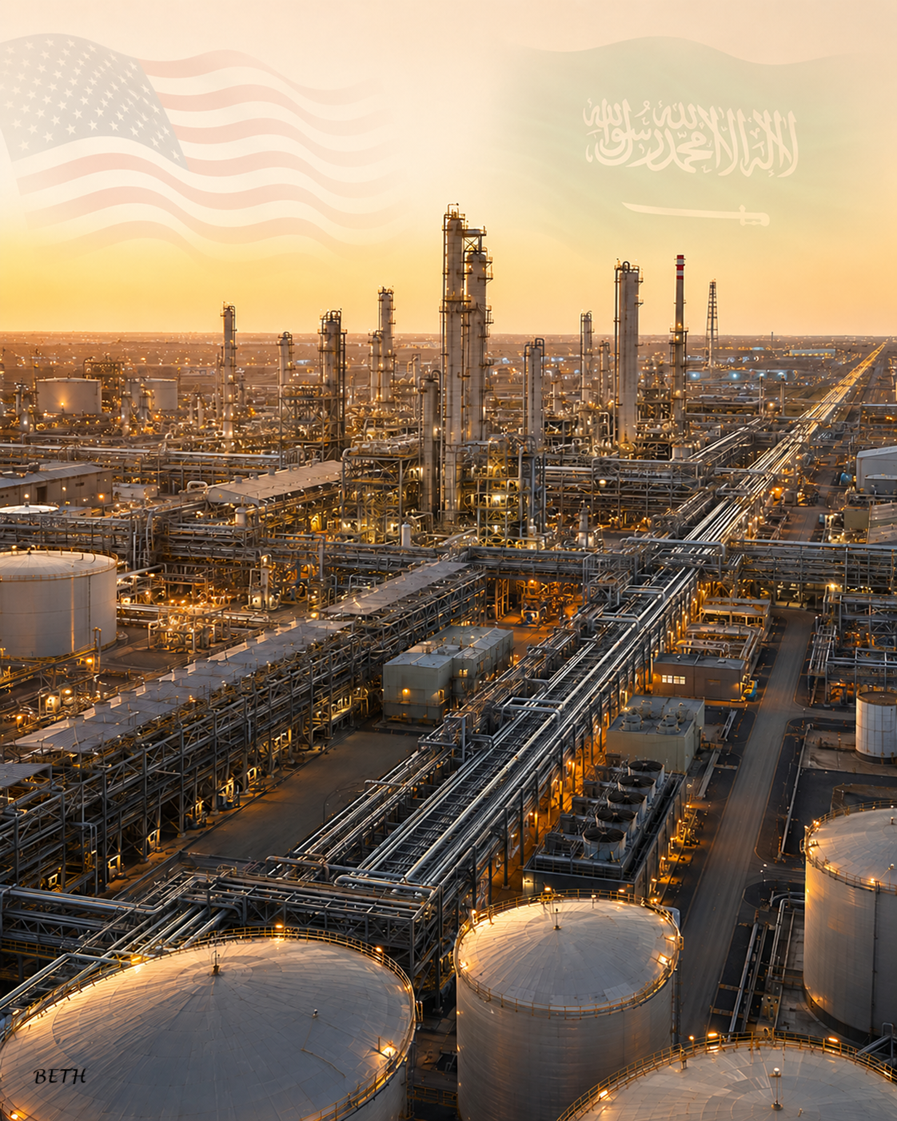
A $5 billion project to establish an integrated refining, storage and export platform.. Host country to be announced before the end of 2026
BETH | B
The Saudi–US MERA Oil consortium has entered the final stage of selecting the Gulf country that will host an integrated project worth up to $5 billion, combining oil refining, storage and the export of refined products through a deepwater port outside the Strait of Hormuz.
The project is not limited to building a new refinery. Rather, it seeks to establish an export platform independent of the Strait, giving energy producers direct access to international shipping routes and reducing the exposure of Gulf supplies to closure, disruption, or increased insurance and shipping costs.
Three Candidate Countries
The consortium spent three years evaluating sites across the Gulf Cooperation Council countries and two years holding detailed consultations with the governments of the candidate countries, before narrowing its options to three sites, all located outside the Strait of Hormuz.
The consortium has not disclosed the names of the three countries, confirming that the preferred location will be announced before the end of 2026.
It is important not to present any potential names as confirmed information. What has been officially announced so far is merely that three Gulf countries are under consideration, without identifying them.
Who Is Behind the Project?
The MERA Oil consortium includes:
- MWG Enterprises, a US energy-project developer based in Fort Worth, Texas.
- Patel Family Office, an investment firm.
- PWS, which is affiliated with Saudi Arabia’s Abdulhadi Abdullah Al-Qahtani & Sons Industrial Group, AHQ Group.
This means that the project is being led by private Saudi and US companies and investments. It is not an announced project of Saudi Aramco or the Saudi government. This distinction is necessary to avoid confusing the identity of the investors with the project’s official status.
What Does the Project Include?
The refinery’s planned design capacity is 200,000 barrels per day, giving it a commercially significant scale, although it would not place it among the world’s giant refineries.
The project will include:
- An integrated crude-oil refinery.
- A deepwater port capable of receiving oil tankers and large vessels.
- Large storage facilities for crude oil and refined products.
- Marine export facilities.
- An industrial and logistics base supporting manufacturing, technical services and energy security.
- Advanced emissions-control systems and technologies to improve energy efficiency.
- The potential future addition of co-processing capacity for sustainable aviation fuel and carbon management.
The complex will be built on port-connected industrial land covering between 1,200 and 1,500 acres, equivalent to approximately 485 to 607 hectares.
What Will the Refinery Produce?
The refinery will focus on high-specification middle distillates, primarily:
- Ultra-low-sulphur diesel.
- Jet fuel.
The products will target import-dependent markets in the United States, the Atlantic Basin, the Gulf and other international markets. Final engineering studies and purchase agreements will determine the shares allocated to each market.
This choice is important because the project is not relying solely on crude-oil exports. Rather, it seeks to convert crude into higher-value refined products that offer greater flexibility in reaching markets.
Financing and Implementation
The pre-feasibility study has reached an advanced stage and covers the refinery’s design, product mix, capital requirements, logistics and implementation phases.
The first phase is expected to be financed through:
- Contributions from the partners.
- Participation by sovereign and institutional investors.
- International project financing.
- Export-credit support.
- Shariah-compliant financing instruments.
Following the selection of the host country, final site due diligence and engineering design will begin, with mechanical completion of the first phase targeted for the end of 2029, followed by testing and commercial operations.
At the peak of construction, preparation and operations, the project could support as many as 3,000 direct jobs, in addition to approximately 15,000 indirect employment opportunities.
However, these figures remain preliminary estimates, and the project has not yet reached a final investment decision. It remains conditional upon site selection, completion of engineering designs and environmental reviews, government approvals, financing arrangements, securing crude-oil supplies and product-purchase agreements.
Why Outside Hormuz?
A highly significant share of Gulf oil and gas exports passes through the Strait of Hormuz, making any military tension, threat to navigation, or rise in insurance costs capable of affecting global supplies and prices.
Establishing the refinery and port outside the Strait does not mean dispensing with Hormuz, nor can the project alone replace the volumes of energy that pass through it. It does, however, add a backup route that reduces the concentration of risk at a single transit point.
There is a fundamental difference between “bypassing Hormuz” and “dispensing with Hormuz.”
The project can bypass the Strait when exporting its products, but it must first ensure that crude oil can reach the refinery. If the crude comes from fields located inside the Gulf, the pipeline network or overland supply source will become a decisive element in the corridor’s actual feasibility.
This raises the biggest question that has yet to be resolved:
How will crude oil reach the refinery without transferring the Hormuz risk from the export stage to the supply stage?
What Will Determine the Location?
The country that wins the project will not simply be the one offering the least expensive land. It will be the country capable of providing an integrated system that includes:
- A genuine maritime location outside the Strait.
- An expandable deepwater port.
- Secure and sustainable connectivity to crude-oil sources.
- Extensive industrial land and ready infrastructure.
- Speed in issuing licences and environmental approvals.
- Long-term legal and investment protection.
- Financial and tax incentives and financing facilities.
- Proximity to shipping routes and target markets.
- The ability to protect the facilities and maritime corridor.
The competition among the three sites is therefore not merely about hosting a refinery, but about accommodating a new hub on the Gulf energy map.
Why Is the Project Important to Saudi Arabia?
Saudi participation gives the Kingdom a presence in a project that combines energy, industry, ports and international trade. It also creates opportunities for Saudi companies to invest in energy infrastructure beyond their traditional boundaries.
The project is also consistent with the Kingdom’s transition from selling crude oil alone to maximising value through refining, specialised products, logistics services, financing, engineering and supply chains.
The greater value does not lie solely in owning a refinery with a capacity of 200,000 barrels per day, but in gaining a position within the route through which energy moves from the producer to global markets.
Whoever owns the refinery profits from refining.
Whoever owns the storage capacity benefits from market flexibility.
Whoever owns the port and the corridor participates in controlling the timing, destination and cost of the flow.
BETH Analysis
The war has redefined energy security.
Previously, energy security meant possessing reserves and production capacity. Today, the availability of oil is no longer sufficient if the routes through which it reaches the world are vulnerable to closure or attack.
Investment is therefore moving beyond protecting oilfields alone towards diversifying corridors, ports, storage facilities and refineries.
The MERA Oil project reflects this transformation because it is not merely building a refinery in a commercially suitable location. It is selecting its location according to the geopolitics of risk.
Nevertheless, the project’s strategic value will remain dependent on three conditions:
First, the source of crude oil must be diversified and must not itself depend on passage through Hormuz.
Second, long-term offtake agreements must be concluded to ensure the marketing of products before major investments are committed.
Third, the project must secure sustainable financing, rather than financing driven solely by the circumstances of war.
If these conditions are fulfilled, the refinery could become the nucleus of an energy, industrial and storage corridor that may later expand to receive multiple types of crude and serve different markets.
But if the project merely relocates the refinery geographically outside Hormuz while its supplies remain dependent on the Strait, it will have addressed the end of the route without addressing its beginning.
Beyond the News
The project does not declare the end of the Strait of Hormuz’s importance.
Rather, it declares the end of confidence in complete dependence upon it.
The country that wins the project will not merely host an oil facility. It will enter the new energy-security map as an alternative outlet, a refining and storage base, and a point of direct connection to international markets.
It is a $5 billion investment, but its true value may lie in the route it opens, rather than the refinery it builds.