



Saudi Economy Attracts Investment
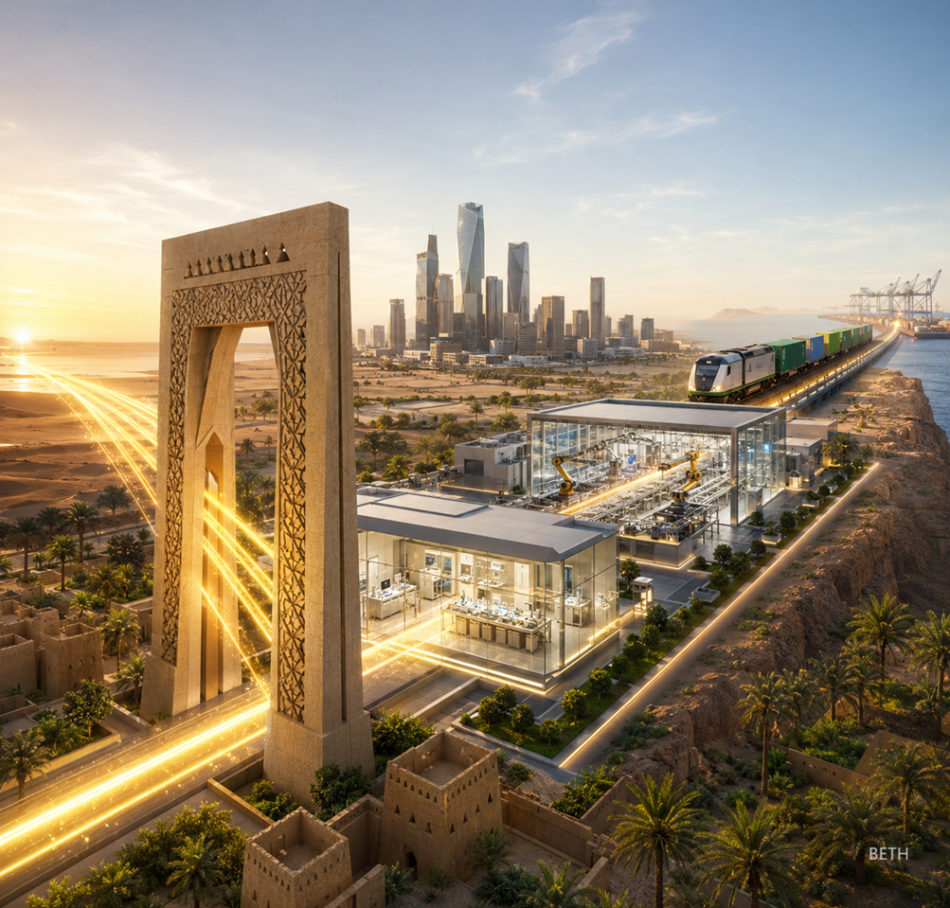
HSBC observes economic improvement and growing confidence among global companies, while foreign direct investment reached $32.6 billion in 2025
Riyadh | BETH
HSBC believes that the Saudi economy is witnessing significant improvement, supported by the expansion of non-oil activities, the development of the investment environment, and the growing inflow of foreign companies and capital into the Kingdom.
The bank’s study indicates that eight out of every ten international companies intend to increase their trade and investment with Saudi Arabia over the next five years, while more than 60% plan to take action within six months.
Fifty-three percent of the participating companies attributed their interest in the Kingdom to economic growth, alongside stability and business-supportive policies, while technology and infrastructure topped the sectors expected to attract the most investment. HSBC Study
These findings do not merely reflect interest in the Saudi market as a large consumer market, but its transformation into a potential base for business management, manufacturing, technology, and access to markets across the Middle East, Africa, and Asia.
The Figures Support the Transformation
Saudi Arabia advanced to 13th place globally in foreign direct investment inflows during 2025, after inflows reached $32.6 billion, an increase of approximately 53% compared with 2024, according to data cited in the World Investment Report 2026. Ministry of Investment
The Saudi economy recorded real growth of 3% during the first quarter of 2026, while the non-oil private sector continued to expand, supported by increased production, new orders, and the resumption of several projects.
Foreign investment is not the result of a single factor, but of several converging transformations:
The expansion of the domestic market and increased spending on projects.
The growth of technology, tourism, entertainment, industry, and logistics.
The Regional Headquarters Program, which transferred part of companies’ executive decision-making to Riyadh.
The development of legislation, licensing platforms, and digital services.
And the expansion of partnerships led by the Public Investment Fund and major national companies.
The Kingdom has thus moved from presenting opportunities to foreign investors to involving them in existing projects, supply chains, and markets.
What Does Corporate Confidence Mean?
When a global company says it intends to increase its investments, this does not necessarily mean that the money has already arrived.
But the announcement reveals the direction of decision-making within companies and usually precedes the opening of a headquarters, the allocation of capital, the recruitment of expertise, and the signing of contracts.
HSBC’s assessment carries additional significance because it is an international bank operating within trade and finance networks linking Asia, Europe, and the Middle East, and is able to observe corporate movements before they appear fully in official statistics.
The fact that more than 60% of companies are prepared to act within six months also means that interest in the Kingdom is not limited to distant plans, but is moving toward imminent decisions concerning expansion, partnerships, and trade.
A Quarterly Decline Does Not Reverse the Direction
Accuracy requires distinguishing between the strong annual trajectory and the latest quarterly result.
Net foreign direct investment reached SAR 23.1 billion during the first quarter of 2026, a decline of 2.4% compared with the same period in 2025, and a larger decrease compared with the final quarter of last year, which witnessed the completion of high-value deals. General Authority for Statistics
A single quarter is not sufficient to determine a change in direction, because investment flows are affected by the timing and registration of completed transactions, and may rise in one quarter and decline in another.
But the figure represents an important warning:
Declared confidence must be converted into continuous inflows, and annual performance should not remain dependent on a limited number of major deals.
The stronger measure is not the value of money entering at a particular moment, but the number of companies that begin production, the factories that open, the jobs that are created, and the exports that leave the Kingdom.
Why Are Companies Coming?
Foreign companies are heading to Saudi Arabia for three main reasons:
The Market
The Kingdom has a large economy, strong purchasing power, and extensive projects in housing, transportation, energy, tourism, sports, and technology.
This provides investors with existing demand, not a theoretical opportunity waiting for a market to emerge.
The Location
Saudi Arabia lies between Asia, Europe, and Africa. Through its ports, airports, economic zones, and logistics services, it can become a base for manufacturing and re-exporting.
The Transformation
Saudi Vision 2030 is opening sectors that were previously limited or nonexistent, from entertainment and tourism to renewable energy, artificial intelligence, and advanced industries.
The investor is therefore not entering a static economy, but an economy rebuilding its size and structure at the same time.
What Could Slow the Inflows?
Despite the positive outlook, the companies included in HSBC’s study pointed to challenges, including intense competition and certain restrictions related to ownership and market entry.
Investment also faces external factors, most notably the war in the region, disruption to maritime routes, high global financing costs, and the effect of oil prices on spending and liquidity.
The Organisation for Economic Co-operation and Development expects the Saudi economy to grow by 3.2% in 2026 and then by 4.3% in 2027, with consumption and the labor market remaining strong. However, it also points to the effect of the regional conflict and shipping constraints on performance. OECD Outlook
Maintaining investor confidence is therefore linked to the Kingdom’s ability to combine three elements:
Continuing economic projects.
Protecting energy facilities and transport routes.
And improving the ease and cost of doing business.
BETH Analysis | From Inflow to Impact
HSBC’s assessment confirms that the image of Saudi Arabia inside the boardrooms of global companies has changed.
The Kingdom is no longer viewed solely as a source of capital or a market in which to sell products, but as a place to which companies can bring capital, management, and technology.
The next phase, however, requires moving from attracting investment to selecting its type.
The most valuable investment is not necessarily the largest in numerical terms, but the one most capable of:
Transferring knowledge.
Localizing supply chains.
Creating high-quality jobs.
Increasing exports.
And connecting local companies to global markets.
A distinction should also be made between capital entering to purchase an existing asset and capital establishing a factory, research center, or new service. Both are investments, but their effects on the economy, jobs, and national capabilities are not equal.
True success is not achieved merely when money enters the Kingdom, but when it remains, produces, expands, and transforms the Saudi market into a base from which it can reach the world.
International companies have begun to see Saudi growth.
The more important step is for this growth to become the reason they come, and then for knowledge, industry, and exports to become the reasons they stay.