

Wars Reveal What Was Hidden

Prepared and Analyzed by | BETH
Supervised by: Abdullah Al-Umairah
Wars do not merely redraw the maps of geography; they also reveal the maps of politics and the true balances of power. In the midst of crises, slogans and masks fall away, and truths that were once concealed behind diplomatic rhetoric and apparent alliances come to light.
With the escalation of tensions in the region, the contours of a new regional and international order have emerged. The war has exposed the nature of the positions adopted by major powers, the limits of alliances, and the depth of divergences within the Arab region.
Some adherents of conspiracy theories may interpret these transformations as the result of a “diabolical American–Israeli plan.” However, such an interpretation, in essence, does not reflect a strategic reading as much as it represents an implicit acknowledgment of weakness and an inability to act. Planning is an inherent characteristic of state policy and is not exclusive to any single party.
In contrast, the Gulf states, led by the Kingdom of Saudi Arabia, have demonstrated an advanced ability to read the strategic landscape and plan with awareness and responsibility. They work to repel threats to their security and stability while simultaneously cooperating with the international community in ways that serve development and stability. While these states rely on a clear future vision, others remain trapped in slogans and emotional reactions, far removed from the logic of interests and political realism.
In this analytical report, we shed light on aspects of the outcomes of the war, with the aim of deconstructing their implications and anticipating their future trajectories.
Russia: Mediation in Search of Influence
The war has shown that Russia’s role in the region is governed more by calculations of influence than by a genuine effort to resolve conflicts. Moscow’s offer to mediate between the conflicting parties comes at a time when it remains unable to settle its own conflict with Ukraine, reflecting its desire to maintain its international presence and assert its status as an influential power in the global order.
Moreover, the Russian media’s alignment with Iran reflects a convergence of geopolitical interests between the two sides, particularly in confronting Western influence, confirming that Moscow’s positions are shaped by strategic considerations rather than a commitment to neutrality or balanced mediation.
China: Pragmatic Neutrality to Protect Interests
China’s stance has been characterized by caution and pragmatism. Beijing has preferred to avoid direct political alignments while focusing on protecting its economic interests and energy security. This approach reflects China’s recognition of the importance of regional stability in supporting the Belt and Road Initiative, leading it to favor de-escalation without becoming directly involved in open conflicts.
Europe and NATO: Energy Security and Stability
The war has revealed a clear European focus on safeguarding energy security and preventing the expansion of the conflict. European countries, still grappling with the repercussions of the war in Ukraine, seek to avoid further disruptions to energy markets. Meanwhile, the North Atlantic Treaty Organization (NATO) has approached the crisis from a strategic perspective aimed at deterring escalation and preserving the stability of vital maritime corridors.
The United States: Managing the Conflict Without Expanding It
The United States has demonstrated its ability to manage regional balances through a combination of military pressure and diplomacy, in an effort to reshape power dynamics without sliding into a comprehensive confrontation. This approach reflects Washington’s recognition of the importance of partnership with the Gulf states as a cornerstone of regional stability and global energy security.
The Arab Rift: From Slogans to Interests
The war has highlighted clear divergences in Arab positions, similar to previous conflicts that affected the security of the Gulf states. In this war, traditional slogans receded— to some extent— in favor of more explicit national interests. These divergences revealed differences in strategic visions among Arab states, underscoring the need to rebuild the framework of joint Arab action on realistic foundations based on integration and cooperation, rather than sterile ideological rhetoric and superficial conclusions.
In this context, the war revealed that what was described as policies of neutrality or balance often reflected shortcomings in strategic vision and weaknesses in managing national interests. The positions of some states also demonstrated submission to immediate considerations and narrow calculations, limiting their ability to achieve stability and development. This underscores the necessity of rebuilding joint Arab action on the principles of efficiency, governance, and strategic vision.
Media and Narrative Discourse: Between Awareness and Influence
The war was not only military but also a battle of narratives. Events exposed disparities in media discourse between those relying on objective analysis and future foresight, and those still captive to slogans and emotional reactions. Herein lies the pivotal role of professional media in shaping public awareness and providing a balanced reading of events.
The Arabian Peninsula: A Renewed Civilizational Continuum
Amid these transformations, the Gulf states, led by the Kingdom of Saudi Arabia, have emerged as a model of stability and development. The Arabian Peninsula, which has hosted ancient civilizations throughout history, is now witnessing a new civilizational renaissance based on an ambitious strategic vision, reflecting these states’ ability to combine authenticity with modernization.
Ancient civilizations succeeded one another across the Arabian Peninsula in a continuous historical sequence, beginning with Al-Ahqaf and Midian, followed by Dilmun and Magan, then Tasm and Jadis, and later Dadan, Lihyan, the Nabataeans, and Kindah, culminating in the kingdoms of Saba, Ma’in, Qataban, Hadramawt, and Himyar. Many of these civilizations are associated with the history of prophets and messengers, such as the people of ‘Ad with Prophet Hud (peace be upon him), the people of Midian with Prophet Shu‘ayb (peace be upon him), and the story of Saba with Prophet Solomon (peace be upon him). This reflects the profound civilizational and spiritual depth of this land and confirms that the contemporary renaissance in the Kingdom of Saudi Arabia and the Gulf states is a natural extension of this ancient historical legacy. Those wishing to delve deeper need only read history carefully.
In contrast to some countries that continue to evoke the glories of the past without building a strong present, the Kingdom and the Gulf states present a contemporary civilizational model based on investment in human capital, sustainable development, and innovation.
Future Outlook: Where Is the Region Heading?
Current indicators suggest that the region is entering a phase of reshaping political and economic balances, with increasing reliance on alliances based on shared interests and regional integration. The Gulf states are expected to play a pivotal role in this transformation, benefiting from their political stability, economic strength, and forward-looking vision.
These ongoing transformations may pave the way for new models of regional cooperation that enhance opportunities for development and stability, redefining the concept of regional leadership beyond traditional slogans.
Conclusion
Recent wars have revealed truths long concealed behind the veil of politics, confirming that balances of power are not measured by slogans but by the ability to achieve stability, development, and a clear future vision.
The war has revealed:
- The strength of the Kingdom of Saudi Arabia and the resilience of the Gulf states in confronting regional challenges.
- The strategic importance of the Gulf states to global stability and international trade, beyond their role as energy suppliers.
- The advanced civilizational level achieved by the Kingdom and the efficiency of its governance, making it a global model of stability, development, and forward-looking vision.
Ultimately, despite their harshness, wars contribute to unveiling realities and rearranging priorities, paving the way for a new phase led by states capable of combining power, stability, and civilization.
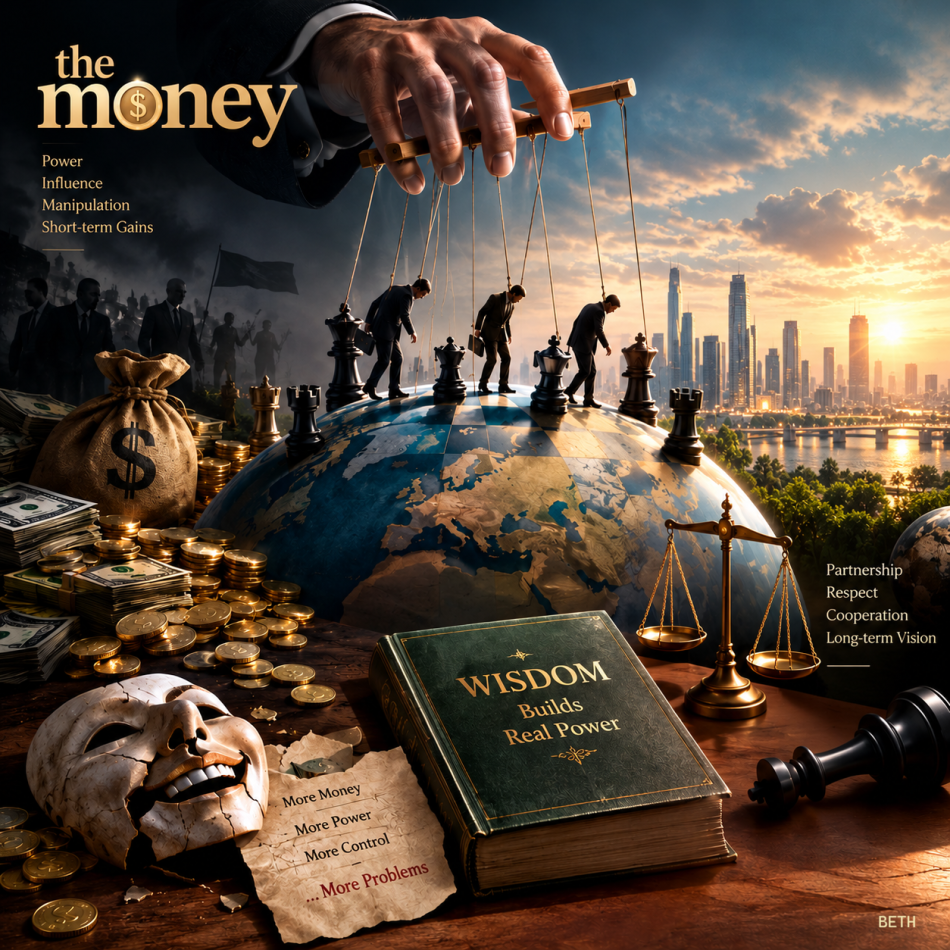
Image Caption
“The white mind addresses the black mind: Organize your thoughts, adjust your thinking… and welcome to the future.”