



Day 191: Trump Links the End to the Elections
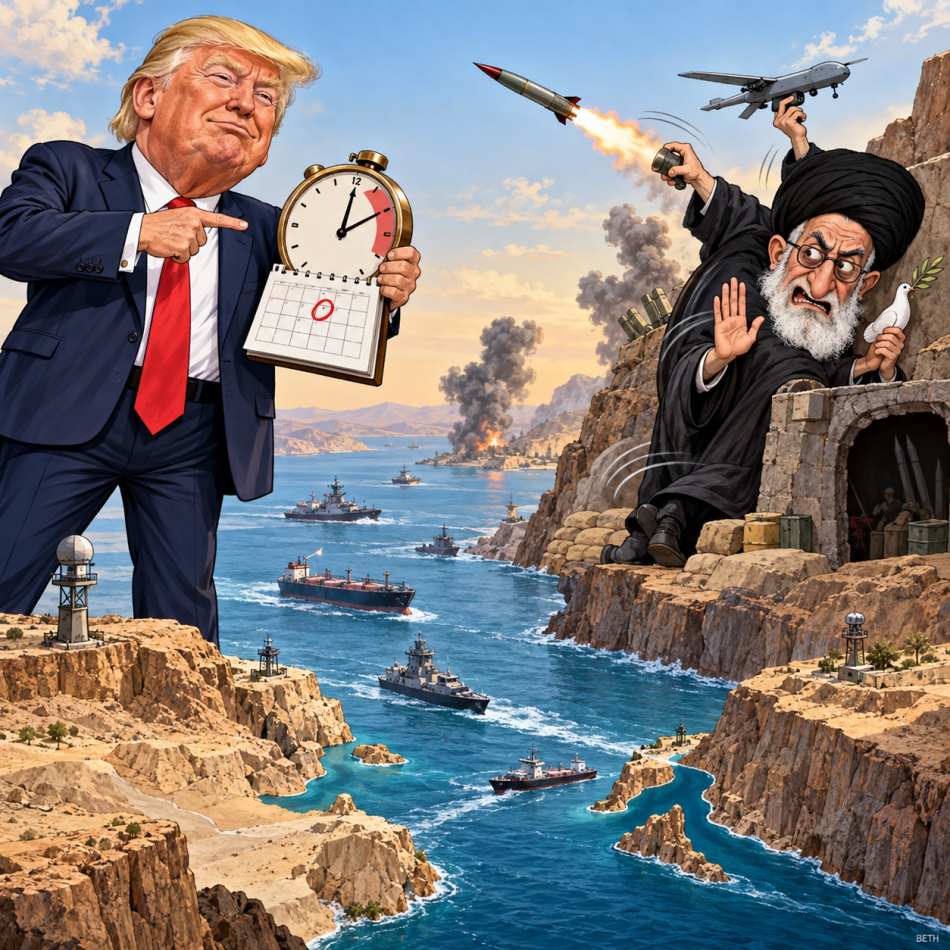
The U.S. president says he does not regret the war and expects it to end after the November elections; negotiations remain a possibility, not a current option, while traffic through Hormuz shrinks to seven ships, the Houthis advance toward Bab el-Mandeb, and oil remains above $100
September 11, 2026
Monitoring and Analysis | Strategic Media Department – BETH Agency
The U.S.-Iran war entered its 191st day, but the most important development this time did not come from a missile or an oil tanker.
It came from the U.S. president himself.
Donald Trump said he does not regret the decision to go to war with Iran, and that if he returned to the same moment, he would make the same decision, once again saying that the war would end “right after the elections,” referring to the U.S. midterm elections on November 3.
This link between the war and the ballot box is no longer incidental.
Trump has put a political clock on the war, but the battlefield has not set a similar deadline.
Trump: No Retreat
Against the backdrop of domestic pressure caused by higher fuel prices and the prolonged war, Trump held firmly to his position.
He said his supporters were not discouraged by the war, and that his goal was to prevent Iran from obtaining a nuclear weapon, while continuing to insist that Tehran is trying to prolong the crisis in order to influence the U.S. elections.
A day earlier, he said clearly that negotiations with Iran could happen, but added that they were not the option Washington was currently seeking.
Here lies the paradox:
Washington is not closing the door to negotiations.
But it is not moving toward them either.
The door exists, but no one is walking through it.
Where Are the Negotiations?
As of this morning, there are no newly announced U.S.-Iranian negotiations that could be described as a political track toward ending the war.
Iran, for its part, continues to maintain diplomatic channels with other countries; it requested a call with South Korea today that addressed Hormuz and freedom of navigation, with both sides agreeing to keep communication open.
Tehran is also publicly calling for dialogue on Yemen, while at the same time warning against expanding international military involvement in the Gulf.
In other words, diplomacy has not disappeared.
But it is moving around the war more than within it.
And that is an important difference.
Hormuz Nears Paralysis
At sea, the numbers have become clearer than the statements.
Only seven ships passed through the Strait of Hormuz yesterday, compared with 11 the day before, with an average of 15 ships over the past ten days.
Before the war, the average was around 125 ships per day.
This is not a complete closure of the strait.
But it is movement closer to breathing with difficulty.
More importantly, the latest decline came after a period in which Washington had begun speaking of relative success in returning some tankers to the passage.
In other words, the latest escalation has reopened a problem that had been thought to be beginning to recede.
Bab el-Mandeb Enters the War
On the other side of the Arabian Peninsula, a second danger has emerged.
The Houthis seized the port of Mokha and advanced toward the Hanish Islands, bringing them closer to Bab el-Mandeb; the passage linking the Red Sea to the Gulf of Aden, through which trade and energy flows move toward the Suez Canal.
So far, traffic through Bab el-Mandeb has remained far better than through Hormuz; 26 ships passed yesterday, a figure close to the current average.
But the danger is not in the current number.
The danger is in the geography.
If Hormuz becomes a high-risk passage, the Red Sea automatically becomes the alternative.
And if the alternative itself comes under pressure, the global problem becomes much larger than a single strait.
The world can work around one bottleneck; but when both the main route and the alternative are constricted, that is a different equation.
Who Protects Bab el-Mandeb?
Bab el-Mandeb is not protected by a single party; there are the coastal states, U.S. and European forces, and maritime coalitions that monitor the passage and protect ships.
But protecting ships is one thing, and protecting the strait itself from missiles, drones, and threats coming from the coast is another.
That is why the Houthis’ advance toward Bab el-Mandeb does not test maritime security alone; it tests the ability of this entire protection system to keep the route open.
And perhaps what does not enter into the calculations of analysis.
Saudi Arabia Between Two Maritime Fronts
This development directly concerns Saudi Arabia.
The Kingdom can move large quantities of oil to the western coast and export them through Yanbu in order to reduce dependence on Hormuz.
But the Houthis’ approach toward Bab el-Mandeb raises the risks to the alternative route itself.
Here, the strategic importance of the Red Sea becomes clear:
It is no longer merely a supporting route to Hormuz.
It has become part of Saudi and global energy security at the same time.
Oil Remains Above $100
The markets absorbed this picture quickly.
Brent crude is trading this morning near $106 per barrel, while U.S. crude is near $101, with both benchmarks heading to end the week above $100 for the first time in nearly four months, with weekly gains exceeding 10%.
The reason is no longer a shortage of production alone.
It is the fear of being unable to transport that production.
This is a fundamental point.
The world may possess the oil.
But what use is it if the route that takes it out of the region is disrupted?
The War Reaches Interest Rates
The rise in oil prices has also begun moving beyond energy markets into financial markets.
The yield on the U.S. 10-year Treasury approached 5%, while expectations increased that the Federal Reserve may raise interest rates next week, after inflationary pressures linked to energy returned.
And so the effects of the war widen:
From a missile.
To a tanker.
To a barrel of oil.
To the price of fuel.
Then to a home loan, a company loan, and a government bond.
The war is no longer measured only by what it destroys, but also by how much it raises the cost of life outside its battlefield.
What Comes Next?
Three paths are expected over the coming days:
First: Limited negotiations, not peace.
Temporary arrangements may emerge concerning navigation or an exchange of guarantees; because oil remaining above $100 places pressure on Washington just as it pressures its opponents. But turning that into negotiations to end the war remains more distant.
Second: More maritime escalation than ground escalation.
Hormuz and Bab el-Mandeb will remain the most sensitive arena; because pressure on shipping gives Iran and its allies a broader global economic impact than many direct military strikes.
Third: U.S. politics moves closer to the battlefield.
The closer November gets, the more important gasoline prices, inflation, and Trump’s popularity will become in White House calculations. Trump himself linking the end of the war to the elections means that this factor has become public, not merely an outside analysis.
BETH Analysis
Day 191 does not say that the war is nearing its end.
But it does say that the cost of continuing it has begun to change the way it is being managed.
Iran has not been forced to surrender.
Washington has not retreated.
Negotiations have not actually begun.
But Hormuz is nearly suffocating, Bab el-Mandeb is entering the danger zone, oil is above $100, and global interest rates are rising.
Here, the question changes.
It is no longer only:
Who wins militarily?
But:
Who can endure time longer?
Trump is betting that Iran will not hold out beyond November.
Iran is betting that the cost of the war will make waiting itself a weapon against Washington.
Between the two bets, the world pays the bill.
And this may be the most dangerous thing to enter the war on its 191st day: time itself has become a front.
As for the latest development tonight..
The Houthis Reach Mayyun
The Houthis advanced today to Mayyun Island, also known as Perim, and Dhubab after seizing Mokha, in a development that brings their presence directly to Bab el-Mandeb and increases pressure on one of the world’s most important trade and energy routes.
But this advance does not necessarily mean that the battle has been decided in their favor.
The rapid seizure gives the Houthis an important card, but at the same time pushes their forces into coastal and island positions that are more exposed.
For that reason, the talk circulating about a “trap” remains, so far, a possible interpretation.
The Houthis have advanced; but the more important question is: have they occupied a position of strength, or advanced into an area that will make them easier to target?