



Mercenaries | Shadow Soldiers
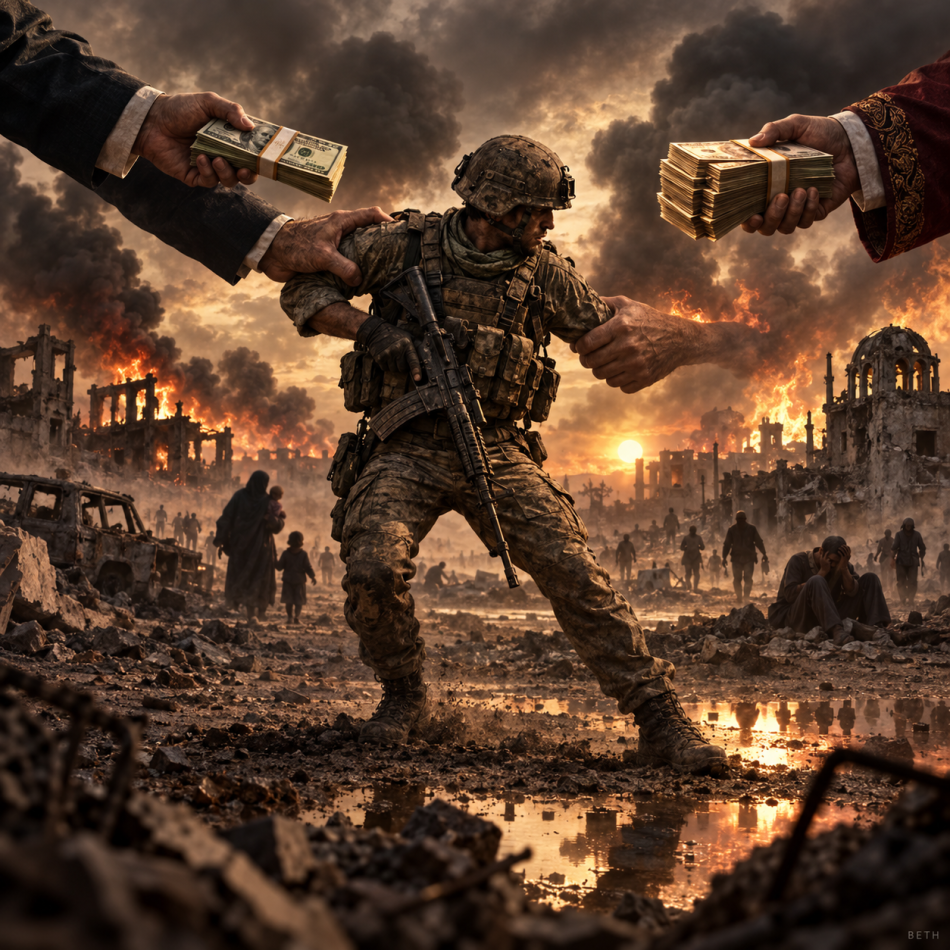
From the Mamluks, the condottieri, and licensed privateers to private security companies and modern militias: how states throughout history have relied on forces that do not bear their name, and how some of those tools turned into rulers, states within states, and arms that cross borders
Special Report | BETH
Prepared and Analyzed by | Strategic Media Department – BETH Agency
Supervision: Abdullah Al-Omairah
Before modern politics knew the term “proxy war,” states were already practicing it.
Sometimes in the name of mercenaries.
Sometimes in the name of private guards.
Sometimes through a commercial company that owned an army.
And sometimes through an ideological group receiving money, weapons, and training from another state.
The names changed, but the idea remained the same:
How does a state fight an adversary, expand its influence, or protect its interests without always pushing its regular army to the front?
Sometimes, the question is even more basic:
What does a state do if it does not have a sufficient army in the first place, or a population large enough to translate its ambitions into direct power?
That is where the need for others begins.
For the mercenary.
For the proxy.
For the man who fights on its behalf.
And sometimes the motive is neither defense nor necessity, but an ambition greater than the capability, a chronic sense of inadequacy, or an abundance of money searching for influence.
Here, a popular saying comes to mind:
“Whoever has a coin troubling him buys pigeons and lets them fly.”
But the pigeons here are not symbols of peace.
They are iron that flies wherever its financier wants it to go, or men moving on the ground with no genuine belonging to the battle; they fight because someone paid, ordered, or promised them something.
When a state is unable to generate its power from within, it begins buying it from abroad.
This is where the shadow soldier appears.
He is not necessarily an agent, not always a mercenary, and not every militia is a proxy for a state. These distinctions matter, because history becomes distorted when every armed man outside a regular army is placed in the same category.
Yet they all meet at one point: an armed force operating outside the traditional structure of the state, then entering the making of politics and war.
What is striking is that history keeps repeating itself, as though no one ever reads how these stories end.
A mercenary or proxy may give a state temporary superiority, rapid influence, or the ability to open a front at lower cost; but rarely do they give it a stable victory whose consequences can be fully controlled.
Over time, the armed tool develops interests and calculations of its own, and may turn from an instrument into a burden, or from a subordinate into a partner that imposes its conditions.
Regular armies, meanwhile, however amorphous and concealed a shadow army may appear, know how to expose its structure, strike its funding, supply lines, and leadership, and drag it out of the shadows into an open battlefield and exposed space.
A mercenary may therefore win a round; but history never guarantees that his financier will win the war, control the territory, or turn armed influence into an administration capable of building a state and a people.
When the Tool Became the Sultan
The Mamluks may be among the clearest historical examples of a tool turning into authority.
They entered the military system as Mamluk fighters serving rulers, then seized power in Egypt in 1250 and established a state that lasted for centuries. They were no longer guards protecting the sultan; they became the sultans themselves.
And this was not an isolated Egyptian case.
In Italy during the fourteenth and fifteenth centuries, the phenomenon of the condottieri flourished. They were commanders of professional military bands hired by cities and principalities to wage war for money.
Their relationship was governed by contracts specifying the number of fighters, length of service, payment, and nature of the mission. The commander could therefore move from one ruler to another once his contract expired or his interests changed.
Then came what every state employing a force whose loyalty it does not fully own fears:
Francesco Sforza, the son of one of the most famous mercenary commanders, did not remain a hired commander; he seized Milan and became its duke in 1450.
The tool had transformed from a force hired to fight into an authority ruling the state itself.
The significance does not lie in the strangeness of the story.
It lies in the rule behind it:
When a group monopolizes weapons and military expertise, the holder of the contract may become weaker than the man carrying it out; indeed, that man may turn against him because he knows his weaknesses better than anyone else.
This is where the danger lies in relying on a force governed less by loyalty than by money and interest. A man who fights today for money may change sides tomorrow if the price changes or his ambitions expand.
The mercenary does not always seek only the battle; he may begin with money, then seek influence, and then seek a place of his own.
The Sea Knew Them Before the Land
Even the seas knew an early version of “shadow soldiers.”
States granted private ships letters of marque, authorizing them to attack enemy vessels and seize them. The ship was not part of the regular navy, but it fought in the state’s interest and shared in the spoils.
During the American Revolution, the emerging United States relied on these privateers to compensate for its weakness against the British Navy. In other words, it legally purchased a military capability it did not yet possess.
The difference between a pirate and a licensed privateer was simple:
The first steals for himself; the second steals from the state’s enemy with its permission.
Here appears one of the earliest forms of gray-zone warfare: almost the same act, but political legitimacy changes its definition.
America Tried It... Then Paid the Price
The United States benefited tactically from “shadow soldiers,” but paid strategic, political, and legal prices.
It repeated this approach on a broad scale in Iraq and Afghanistan, where private military and security companies provided thousands of personnel, specialists, and services without requiring the regular army to expand by the same scale.
But the experience exposed the other side:
The man hired by the state does not submit to it in the same way a soldier does.
With incidents such as Nisour Square, Washington discovered that what saves it soldiers may cost it reputation, politics, and law.
America therefore did not end the “shadow soldier” model; it tamed it: tightening laws and oversight, reducing some of its functions, and retaining it where needed.
But Iraq revealed another, harsher paradox.
After the American withdrawal, the vacuum expanded and was filled by multiple armed forces. Some factions that fought ISIS on a battlefield where Washington was providing air support later became part of armed Iranian influence, and some eventually turned their weapons against the American presence itself.
Washington thus discovered that a non-state force may help you in one battle, then become part of a new problem you never anticipated.
More simply:
The shadow is useful as long as it stays in its place; the problem begins when it starts moving on its own.
When a Company Owned an Army
Then came an experiment that would be difficult for a modern reader to believe had it not actually happened.
The British East India Company began as a commercial enterprise under a royal charter in 1600, then built a private army to protect its interests. As its power expanded, it no longer merely protected trade; it ruled territories, collected taxes, and fought wars.
At its peak, the company commanded around 260,000 soldiers, more than twice the size of the British Army during some periods. After transforming from a merchant into the effective ruler of vast parts of India, the British state intervened and ended its direct rule after the 1857 rebellion, transferring India to the Crown in 1858.
This may be one of the clearest historical examples:
A private company owned an army; the army gave it territory; and the territory gave it a state.
It was not a militia in the modern sense, but it was perhaps the closest history came to a transcontinental company simultaneously possessing politics, weapons, and the market.
The Mercenary Returns in a Corporate Suit
After the rise of modern national armies, it appeared that the age of great mercenaries was over.
It was not.
It merely changed its name and appearance.
By the late twentieth century, private military companies had emerged in a more organized form, with contracts, legal departments, and clear corporate structures.
In South Africa, Executive Outcomes was founded in 1989 and recruited former officers and military specialists. It later operated in Angola and Sierra Leone in direct combat, training, and facility protection.
In Britain, Sandline International emerged during the 1990s and operated in Sierra Leone and Papua New Guinea, provoking controversy that pushed the British Parliament to examine how this type of company should be regulated.
Then Aegis Defence Services was established in London in 2002 and became one of the most prominent names in private security and military operations.
But the real explosion of the industry came after the September 11 attacks and the wars in Afghanistan and Iraq.
Blackwater... The Name That Exposed the Industry
Blackwater USA was founded in 1997 by Erik Prince, a former U.S. Navy SEAL officer, and began as a training center and security services company.
After the invasion of Iraq, it became part of the broad American security apparatus, alongside DynCorp and Triple Canopy, with official contracts to protect diplomats, facilities, and convoys.
The numbers reveal the scale of the transformation.
By early 2008, the number of private security personnel in Iraq was estimated at 25,000 to 30,000, working for American, Iraqi, and other entities. By September 2008, the total number of contractors working for the U.S. Department of Defense in Iraq exceeded 163,000, a figure close to the number of American troops there during some periods, though these contractors also included logistical and technical personnel, not only armed security staff.
War was no longer merely a matter of a regular army.
Behind the soldier stood another line of drivers, guards, analysts, air crews, specialists, trainers, and private security personnel.
Part of the war had moved into the marketplace.
The state could now purchase some functions of force almost as it would purchase a technical service.
But Blackwater also exposed the most dangerous side of the model. The 2007 Nisour Square shooting in Baghdad, in which company personnel killed 17 Iraqis, became a global symbol of a difficult question:
Who holds the armed man accountable when he wears a company logo but works in a state’s war?
Not Every Company Is a Mercenary Force
Here, a distinction is necessary.
International law does not classify every employee of a private military company as a mercenary.
The legal definition of a mercenary is narrow and subject to specific conditions. Most employees of private military and security companies therefore do not automatically fall under it. Nor can states rid themselves of their legal responsibilities simply because they contract with a private company.
This is why the Montreux Document emerged in 2008 through a Swiss initiative in cooperation with the International Committee of the Red Cross, clarifying the obligations of states toward private military and security companies. It is not a new binding treaty, but it makes clear that private warfare does not exist in a legal vacuum.
This distinction is important to our report:
The private soldier may be legal, regulated, and operating under a clear contract; the problem begins when the distance between the state and the weapon becomes a means of escaping responsibility.
Russia Creates Wagner
If Blackwater represents the most famous American commercial model, Wagner represented for years the more ambiguous Russian model.
It emerged as a private military force linked to Russian businessmen and influence networks, then operated in Ukraine, Syria, Libya, the Central African Republic, Mali, and other African states.
Its significance did not lie merely in having fighters outside the Russian military. Their presence also gave Moscow military and political influence that could, when necessary, be formally separated from the Russian Armed Forces.
In Africa, Wagner’s work became associated with protecting regimes, fighting armed groups, and obtaining economic concessions and political influence. After Wagner’s mutiny and the death of Yevgeny Prigozhin, parts of its structure were absorbed into organizations closer to the Russian state, including the Africa Corps. In Mali, for example, Wagner officially departed in 2025, but Africa Corps personnel remained.
The name changed.
The mission did not disappear.
And the permanent question remains:
Who is paying?
To find the answer, look for the beneficiary.
Or more precisely:
the immediate beneficiary — short-sighted and wealthy — who buys rapid influence but does not always see the cost of what he is planting for the years ahead.
A Militia Is Not a Company
Here we move to another model, one even more influential in our time.
A company usually fights under a contract.
An ideological or political militia may fight because it believes in a cause, while at the same time receiving money, weapons, and training from another state.
This is where the concept of proxy warfare emerges.
Over four decades, Iran built a broad network of allied armed groups, while the Quds Force played a central role in funding, training, arming, and linking these forces to Iranian regional interests.
Even here, however, the picture should not be oversimplified.
The relationship between a state and a militia is not always one in which a capital presses a button and the group moves.
Some of these forces have local constituencies, objectives of their own, and a degree of independence.
Hezbollah... The State Within the State
In Lebanon, Hezbollah became the most prominent model of a group combining weapons, politics, social services, and parliamentary representation, while maintaining a deep strategic relationship with Iran.
The description “a state within the state” has therefore long been used to describe its military and political power relative to Lebanese state institutions.
Here, the militia exceeded its traditional military function.
It was no longer merely a group carrying weapons.
It became part of the political system while retaining an armed force independent of it.
This is one of the most dangerous transformations a state can undergo: the political system does not collapse, but it loses its monopoly over decisions of war and peace.
When the Militia Enters the State
Iraq... From Vacuum to Iranian Militias
Iraq presents a more complicated model.
After large sectors of the army collapsed following the U.S. invasion of Iraq, Iran rapidly entered the scene, and the Popular Mobilization Forces emerged as a broad umbrella incorporating dozens of factions, including powerful groups linked to Tehran.
Nouri al-Maliki, aligned with Iran, then issued a decision establishing the Popular Mobilization Commission. These forces gradually became part of Iraq’s official structure, while major differences remained among their factions in loyalty, decision-making, and relationship with Iran.
Their defiance of Iraqi governments with an Arab orientation has also been evident.
Here arises a question that goes beyond Iraq itself:
Did all of this take place beyond the sight of the United States and its intelligence services, or did Washington see the expansion of Iranian influence and accept it temporarily under the banner of confronting ISIS?
That organization appeared before the world through images of fighters in worn clothing and black flags bearing Islamic slogans. Its images and atrocities then became intensive material in international media and contributed heavily to fear of Islam and the spread of Islamophobia.
Amid that chaos, a simpler and more dangerous question should have arisen:
How did ISIS emerge so quickly? Who funded it? Who supplied it with weapons, vehicles, and the ability to move? And who benefited from its survival and expansion?
These were not frivolous questions.
What followed ISIS, and what had preceded it with al-Qaeda, showed that those who paid the greatest price were Arabs and Muslims themselves — in security, reputation, stability, and states exposed simultaneously to the explosions of extremism and the wars waged against it.
Who benefited?
Perhaps the answer is less sensational, but harsher:
Great powers do not see everything, but sometimes they see enough — and then choose what serves their interest at that moment.
Here the question is no longer:
Who deceived whom?
Rather:
Who benefited from the other first, and who paid the price later?
The militia does not seize the state; it enters it.
It acquires legitimacy, salaries, and institutions, while some of its components retain relationships and agendas that cross borders.
The question then becomes more complicated:
Where does the state end?
And where does the group begin?
The Houthis... From a Rebellious Gang to a Presence Backed by States
The Houthis illustrate how a local armed movement can develop into a force whose reach extends beyond the borders of its own country.
The Houthi movement emerged in a Yemeni Zaydi environment in Saada, but its ideological and military trajectory became linked early to the Iranian model. Hussein al-Houthi was influenced by the Iranian Revolution and established connections outside Yemen. Iranian support then developed into weapons, training, financing, and operational assistance, until the movement became one of the most important arms of Iranian influence in the region.
Then came the turning point:
The movement seized Sanaa in 2014, established de facto authority over a large part of Yemen, then moved from internal war to threatening ships in the Red Sea, launching long-range missiles, and affecting one of the world’s most important trade routes.
Here, we return to history.
An armed tool that begins on a distant mountain may end up becoming a player in the global economy.
The Taliban... The Militia That Became the State
The Taliban provide the clearest modern example of an armed movement transforming into a government.
They emerged in Afghanistan in the 1990s, seized Kabul in 1996, and were then removed from power following the U.S. intervention in 2001.
After twenty years of war, they returned to Kabul in August 2021. U.S. forces withdrew, and the movement that had fought the state became the authority once again.
At this point, the word “militia” itself becomes insufficient.
When a group controls the capital, borders, ministries, and security apparatus, it is no longer a force outside the state.
It has become the state in practice.
When Gang Leaders Become Politicians
Criminal gangs belong to a different category.
A cartel is not a militia, the mafia is not a military company, and a mercenary is not necessarily a gang member.
But modern history has seen areas where the state became so weak that organized criminal groups acquired weapons, territory, money, and the ability to buy officials, transforming from a criminal problem into a rival to sovereignty.
When a state uses such groups, or deliberately tolerates them for a security or political objective, we once again approach the world of shadows.
The difference is that the political proxy seeks to alter the balance of power.
The gang’s original objective is profit.
But when money, weapons, and politics meet, the dividing line can become extremely thin.
The Gang and the Militia... What Is the Difference?
A gang operates primarily for money, control, or organized crime. It does not require a comprehensive political project and does not necessarily claim to represent a community or cause.
A militia, by contrast, is an armed force that usually operates under a political, religious, ethnic, or regional identity, and may seek to influence the state, share its authority, or replace it altogether.
But the boundaries are not fixed.
When a gang acquires territory, weapons, and political cover, it may become a paramilitary force; and when a militia enters smuggling, taxation, and the black economy, it may become a gang with a political façade.
This is where the most dangerous gray zones begin — when it becomes difficult to know where politics ends and crime begins.
Why the Coup? Why the Minority?
History repeatedly raises a question:
Why have major powers, at different stages, preferred dealing with weak regimes or authorities with narrow social bases rather than strong states with stable institutions?
In many cases, the answer has been simple:
An authority lacking a broad popular base becomes more dependent on external protection; and the more it needs the outside world, the more susceptible its decisions become to influence and pressure.
For this reason, the objective was not always a “minority” for its own sake, but rather a regime that needs the outside world more than the outside world needs it.
A coup shortens the road to power, while a socially isolated authority often searches for an external sponsor to protect it. From there begins a relationship of dependence that may quickly become influence.
The conclusion:
A strong state negotiates with the outside world; a weak authority may ask the outside world to guarantee its survival.
Why Do States Prefer Shadow Soldiers?
Because they provide something a regular army cannot offer as easily:
distance.
Distance between the decision and responsibility.
Between the state and the victim.
Between the weapon and the flag flying above it.
A proxy can pressure an adversary without declaring war.
A company can perform a function for which the state does not want to enlarge its army.
A militia can open a front far from the sponsor’s borders.
And a private force can give a government political deniability or time to maneuver.
This is what made proxies a central element of Iran’s regional strategy: allied armed forces expand Iranian influence while, in some cases, lowering the cost of direct confrontation for Tehran.
But distance has a price.
The Tool Does Not Always Remain a Tool
Almost every story in this report ends at the same problem.
The Mamluk became a sultan.
The condottiere became a duke.
The East India Company became a ruler.
The militia entered parliament.
The armed movement seized the capital.
And the military company may acquire enough men, weapons, and information to become a political actor rather than merely a contractor.
This is why one of the greatest illusions of states may be believing that the force they arm today will remain tomorrow exactly as they created it.
Weapons create interests.
Money creates networks.
Victory creates ambition.
From “Mercenary” to “Contractor”
There is also an important linguistic development that reveals how politics itself has evolved.
The old name was clear:
Mercenary.
Then it became:
Security contractor.
The force used to be called:
A mercenary company.
Then it became:
A private military and security company.
An armed group affiliated with a state used to be described as:
A tool.
Then came more precise expressions:
Proxy, partner, armed ally, non-state actor.
This is not merely linguistic beautification.
It is an acknowledgment that the modern world is more complicated than the binary of “army or mercenary.”
The Wars of the Future
“Shadow soldiers” are unlikely to disappear.
They will evolve.
The next fighter may not merely be a paid gunman. It could be a cyber company, a team purchasing satellite imagery, drone operators, an arms-smuggling network, or an electronic group working for a state without bearing its name.
Modern warfare makes deniability easier.
Technology makes small groups more capable.
And the drone gives a faction that twenty years ago would have needed an air force the ability to strike a target hundreds of kilometers away.
In Yemen today, recent reports point to attempts by users in Houthi-controlled areas to employ artificial intelligence tools in work related to guidance technologies and advanced missiles — a small example of the transition from the traditional militia to the technologically armed actor.
BETH Reading
The problem is not simply the existence of irregular forces.
History has known the volunteer, the resistance fighter, the local guard, the revolutionary, the mercenary, and the security contractor, each within a different context.
The problem begins when weapons outside the state become a permanent instrument of international politics.
At that point, war is no longer simply between two states.
It becomes a war between a state and an arm.
A state and a company.
A state and a network.
And sometimes between a state and an adversary that it cannot even legally prove is fighting on behalf of the state supporting it.
This is where the brilliance and danger of “shadow soldiers” lie at the same time:
They give the state additional power, but they also give war a door through which to escape its traditional rules.
History offers the same old warning.
A state can create a man of the shadows.
Pay him.
Arm him.
Use him.
But it cannot always determine the moment when he stops being a shadow.
Some shadow soldiers see their contracts end.
Others end up sitting in the chair of the state they were supposed to serve.
Conclusion: The State or the Shadow?
The entire report leads to one conclusion:
Militias, mercenaries, and proxies can create rapid influence, open fronts, and disrupt adversaries stronger than themselves; but they do not create lasting stability, nor do they build a viable state.
America used “shadow soldiers,” then attempted to regulate them and return them under the authority of the state.
Iran built a major part of its regional influence on armed arms operating outside the state, or inside it without fully dissolving into it.
The difference is decisive:
Power can be bought, but a state cannot.
A secure future cannot be built by uncontrolled gangs and militias, but by strong governments, stable institutions, and weapons subordinated to the state and the law.
The shadow may win a round; but the one who builds the state is the one who remains.