



Day 192: Iran Expands the War over Strategic Corridors
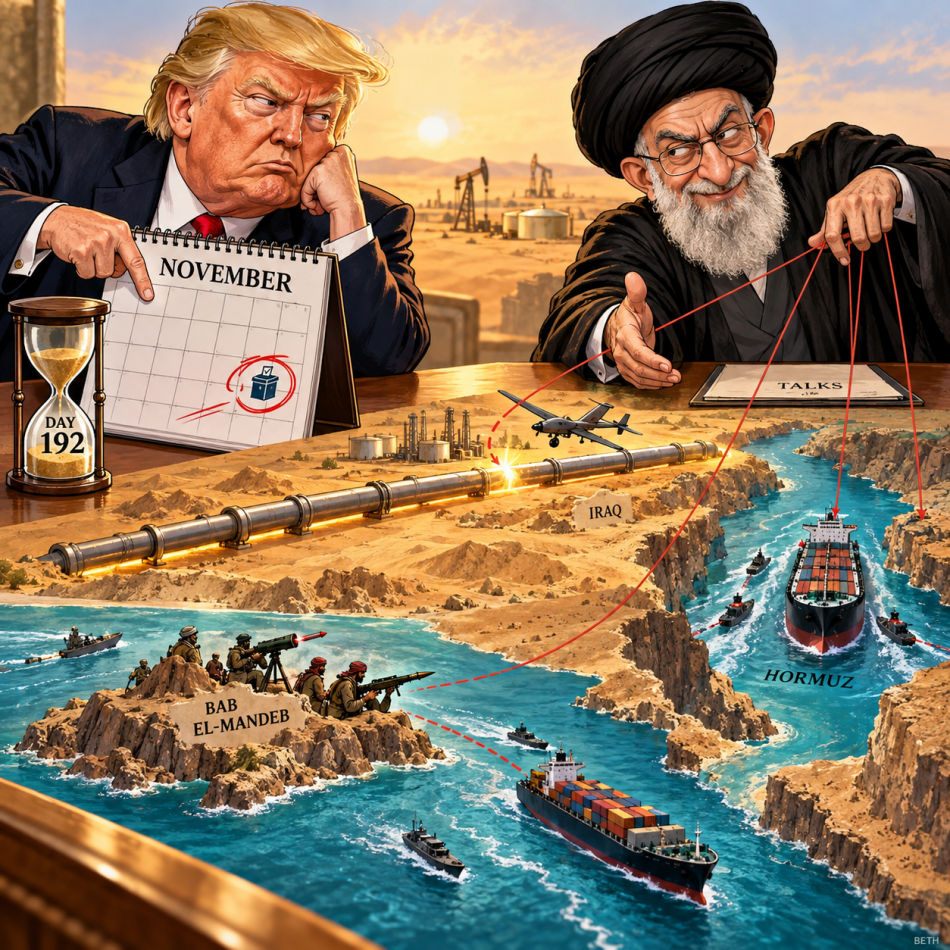
Hormuz moves toward a regional negotiating track, the Houthis reach Perim and Bab el-Mandeb, and drones launched from Iraq strike the East-West Pipeline; meanwhile, Washington narrows its protection umbrella for tankers and a new front emerges over Chinese satellite intelligence
September 12, 2026
Monitoring and Analysis | Strategic Media Department – BETH Agency
The U.S.-Iran war has entered its 192nd day, and its geography has changed.
The confrontation is no longer concentrated between Washington and Tehran, nor confined to the Strait of Hormuz alone.
Within hours, Saudi Arabia’s East-West Pipeline was attacked by drones launched from Iraq, the Houthis advanced to Perim Island at Bab el-Mandeb, while Iran prepares to sit down with the Gulf states and Iraq in Oman to discuss the future of navigation through Hormuz.
Three energy routes are now part of the same picture.
That is the most important indication of the new day.
Iraq Enters the War
Baghdad confirmed that the drones that targeted the East-West Pipeline were launched from Iraqi territory. The Iraqi prime minister ordered an investigation and the dismissal of a local military commander, while border crossings with Iran were closed as a precaution.
Saudi Arabia chose not to respond at this stage, giving the Iraqi government an opportunity to stop attacks launched from its territory.
This means that Riyadh has, so far, drawn a distinction between the Iraqi state and the party that carried out the attack.
But this distinction may not continue if the attacks are repeated, or if the Iraqi government proves unable to rein in armed groups loyal to Iran.
The Houthis at the Strait
In Yemen, the Houthis have made their most serious advance in years along the western coast, reaching Perim Island and taking positions at the southern entrance to the Red Sea after advancing through Mocha and Dhubab.
Perim is not just another island.
Its position inside Bab el-Mandeb makes control of it a direct instrument of pressure on ships moving between the Red Sea and the Gulf of Aden.
Iran now exerts direct pressure in Hormuz, while its Houthi ally holds an advanced position at the other strategic passage.
The speed of the Houthi advance into these areas is striking; it may reflect weakness in some defensive lines, a deliberate repositioning, or even a battlefield enticement whose full shape has yet to become clear.
Hormuz Heads to the Oman Table
In the opposite direction from escalation, Oman will host a meeting on Monday bringing together Iran, the six Gulf states and Iraq to discuss temporary arrangements for navigation through the Strait of Hormuz.
Tehran says the aim is to strengthen regional security, while discussions are focused on safe corridors and a temporary mechanism for managing shipping traffic.
This is where the contradiction of the war becomes clear:
Iran threatens the passage, then negotiates over how it should be used.
Hormuz has therefore become a bargaining card.
America Scales Back Protection
In an important development, the United States has adjusted its mechanism for protecting vessels in Hormuz, making air cover available during specific transit windows rather than continuously.
Washington says the reason is operational and financial; round-the-clock air protection is costly and drains resources, particularly as Iranian nighttime attacks continue.
But this change raises a larger question:
Does this mean the United States is beginning to encounter the limits of its ability to subdue Iran, or is it a new tactic for managing the battle and curbing the momentum of a wounded adversary that is still capable of inflicting harm?
The most likely answer is that both factors are at work. Washington has not abandoned protection of the strait, but it has moved from open-ended coverage to calculated protection that can be sustained.
With the war now in its seventh month, power is no longer measured only by the scale of strikes, but by who can endure longer, at lower cost.
China Enters the Picture
Another file opened today.
U.S. officials said Iran obtained high-resolution satellite imagery from Chinese companies before the July strike that targeted a U.S. base in Jordan and killed three soldiers, and may have used similar imagery to identify other locations across the region.
Washington is not accusing the Chinese government of direct involvement, but believes the imagery helped Iran select targets and assess the results of its strikes.
If this file expands, the war could move beyond the U.S.-Iran confrontation and become a new test of U.S.-China relations ahead of the planned meeting between Trump and Xi Jinping later this month.
The Cost of the Sea Rises
Oil prices remained above $100, but the new risk is also appearing in transport costs.
Charter rates for very large crude carriers from the Gulf of Oman to Asia have surged to record levels, with the additional cost on some routes reaching the equivalent of around $11.5 per barrel.
The war is no longer only raising the price of oil.
It is raising the cost of transporting it as well.
That cost eventually feeds into fuel prices, inflation, interest rates and goods across the world.
BETH Reading
What Iran is doing now appears broader than an attempt to close Hormuz.
The new picture is built around pressure on the entire network of alternatives:
Hormuz in the east.
Bab el-Mandeb in the west.
And the East-West Pipeline in between.
But this strategy also carries a danger for Tehran itself. The wider the pressure expands, the wider the circle of countries that develop a direct interest in ending it.
Saudi Arabia has been drawn into the picture from both Iraq and Yemen.
The Gulf states are entering negotiations over Hormuz.
Iraq is confronting, for the first time so directly, the question of militias using its territory to strike a neighboring state.
And the United States now finds itself facing a maritime and economic war that cannot be reduced to a single military strike.
What Are We Watching?
Over the coming hours, five indicators will be decisive: the outcome of the Iraqi investigation and who stands behind the drone launches; when the East-West Pipeline returns to full operation; the direction of the battle around Perim and Bab el-Mandeb; the outcome of Monday’s Oman meeting; and the results of the political and military committee meetings of the countries participating in the Makkah Agreement — Saudi Arabia, Türkiye and Pakistan — scheduled for the same day.
If the Oman meeting succeeds in opening a stable passage through Hormuz, diplomacy will have begun to pull part of the war back from the sea.
At the same time, the Makkah Agreement meetings may reveal how the three countries intend to translate their political and defense understandings into practical coordination in the face of widening regional threats.
But if the diplomatic tracks fail, and pressure continues on Bab el-Mandeb and Saudi energy infrastructure, Day 192 may be remembered as the moment when the war moved beyond a single strait and began spreading across the entire energy network.
This phase may also reveal states or other actors contributing to the war at different levels — through weapons support to Iran, logistical assistance, or by tolerating the actions of the Houthis and other Iranian-aligned groups.
And the final question remains: Can Washington and its allies drag Iran through to the end of the U.S. election season, or will Tehran exploit the period of restraint to raise the cost of the war and improve its position?
Most likely, both sides are doing the same thing: America is buying time, while Iran is trying to price it.
Trump Overstates His Confidence
Trump’s statement that “the Houthis do not want to fight us” carries a tone of confidence that may go beyond what the battlefield actually supports.
The question is not only: Do the Houthis want to fight America?
Rather: Who is imposing the battlefield and its terms on whom?
Washington has yet to bring the Hormuz crisis to an end, while Iranian pressure is extending to Bab el-Mandeb, Iraq and energy infrastructure.
This is where some of Trump’s statements become a burden on his reading of the war; they reduce a complex situation to an arrogant line, and may reveal more weakness in judgment than strength.