


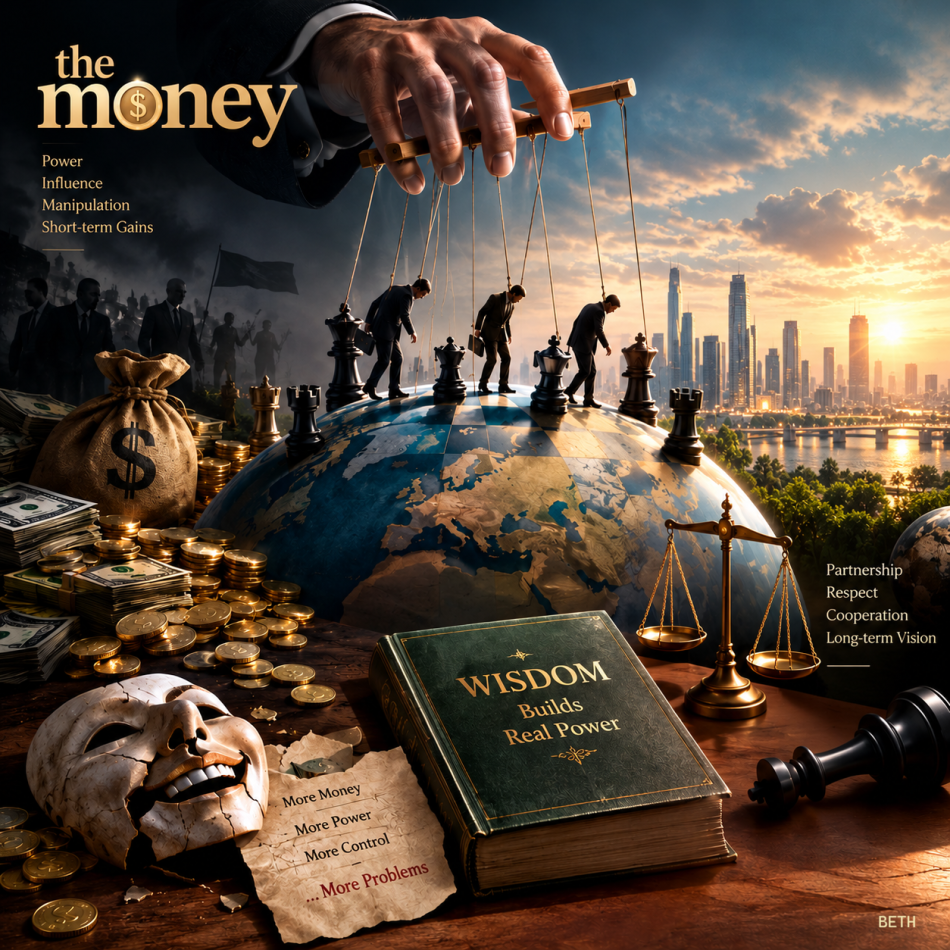
The World Is Not Burning Everywhere
From a drug that may help protect memory, to a treatment strategy opening a new path against prostate cancer, satellites learning to navigate without GPS, a historic decline in Amazon deforestation, solar power saving Europe billions in gas imports, and a technology boom driving China’s exports; behind the headlines of war, another world is quietly working to make life better
Special Report | BETH
It is easy these days to wake up convinced that the whole world is on fire.
War in the Middle East, disruption in maritime routes, missiles over cities, anxious markets, and international politics that often seems to know only confrontation.
But the picture is not complete.
Away from the noise of war rooms, a laboratory is studying how a familiar drug may help protect memory. Another team is searching for a weakness in a cancer that has learned to resist treatment. A satellite is learning to determine its own position without GPS. A vast forest is recording a historic decline in deforestation. Europe’s sunlight is cutting the cost of gas imports. And Asian factories are turning artificial intelligence from an idea into global trade.
These are not marginal stories.
In the long run, they may be the stories that change people’s lives more than many of today’s loudest headlines.
A Memory Less Vulnerable to Dementia
We begin with what touches people most directly.
A nationwide Danish study that followed 132,585 people diagnosed with type 2 diabetes found that starting statin therapy within the first year after diagnosis was associated with a 15% relative reduction in the risk of dementia over ten years compared with those who did not begin treatment within the first five years.
Starting treatment later was associated with a smaller reduction of around 10%.
The important detail is that this was an observational study. It shows a strong association but does not, by itself, prove that statins prevent dementia. Researchers therefore say clinical trials are still needed.
Even so, the signal is encouraging.
Medical progress does not always come from inventing an entirely new drug. Sometimes it comes from discovering a new value in a medicine we already know, and understanding when best to use it.
Cancer Changes Itself — Science Follows
At the University of Michigan, researchers are pursuing one of the more stubborn forms of prostate cancer.
Some advanced tumors can change their cellular identity in order to escape hormone therapy, making them harder to treat.
Researchers found that combining BET bromodomain inhibitors with DNMT inhibitors may slow the growth of these resistant tumors, with the combination performing better in preclinical experiments than either drug alone.
This is not yet a treatment ready for patients.
But the idea itself is compelling:
If cancer can change its identity to escape, science is beginning to learn how to target the process of change itself.
That is where the value of the research lies: moving from chasing the tumor to understanding the trick it uses to survive.
A Satellite That Knows Where It Is
Then we leave Earth for a moment.
In NASA’s Starling mission, an experimental system called FALCON successfully helped a satellite determine its location without relying on GPS.
How?
By using onboard cameras to identify known satellites and objects in orbit, then comparing what it sees with an internal catalog of space objects.
The idea sounds simple, but its significance is large, because GPS is not available with the same strength when spacecraft travel toward the Moon or deeper into space.
During the experiment, the system also helped improve orbital estimates for hundreds of space objects, opening the door to uses in collision avoidance and space traffic monitoring.
In simpler terms:
The spacecraft is beginning to look around and say to itself: I know where I am.
That is one of the foundations of a more autonomous future in space.
The Amazon Breathes Again
One of the most encouraging environmental signals comes from Brazil.
Data from the DETER monitoring system of Brazil’s National Institute for Space Research showed that deforestation alert areas in the Amazon fell 36% between August 2025 and July 2026, reaching about 2,874 square kilometers.
That was the lowest level since the current monitoring series began in 2016, and roughly 55.6% below the average of the previous ten years.
The number should still be read carefully. DETER alerts are not the final annual deforestation rate; they are a monitoring tool used to support enforcement and rapid response.
But the direction is hard to ignore.
When satellite monitoring, enforcement, and environmental policy work together, the curve of loss can bend downward.
The forest does not recover in a day, but it has begun losing fewer trees.
When Sunlight Becomes National Security
In Europe, the current energy crisis has revealed the value of investments made years before it began.
According to SolarPower Europe, solar energy saved the European Union more than €30 billion in gas imports used for electricity generation during the six months since the Middle East war began, while producing around 282 terawatt-hours of electricity.
In June, solar became the single largest source of electricity in the European Union, accounting for roughly 25% of generation that month.
The meaning goes beyond climate policy.
When pipelines and maritime chokepoints become vulnerable to war, every solar installation represents energy that does not need a tanker, a strait, or military protection in order to reach the consumer.
That is why renewable energy has moved from being only an environmental issue to becoming part of economic and strategic security.
The idea can be reduced to one line:
The more fragile the routes become, the more valuable the sun becomes.
China Turns AI Into Exports
We end with the economy, because China’s numbers show how artificial intelligence is moving from screens into factories and ports.
China’s exports rose 25% year-on-year in August to more than $400 billion, while the monthly trade surplus reached around $119 billion.
Global demand for technology products was one of the main drivers.
The value of integrated-circuit exports rose by around 130%, while exports of automatic data-processing equipment increased by more than 76%.
There is one important detail: part of the increase reflects higher prices for advanced technology components, not only greater shipment volumes, which also reveals the strength of demand and the tightness of AI-related supply chains.
Artificial intelligence is therefore no longer just software that answers questions.
It has become:
Chips, factories, batteries, ports, exports, jobs, and balances of power.
What Connects All of This?
At first glance, these stories seem unrelated.
Dementia.
Cancer.
Space.
Forests.
Sunlight.
Semiconductors.
But they share one thread:
Human beings are trying to reduce their own vulnerability.
Protect the brain from disease.
Find a way to contain cancer.
Give a spacecraft a way to navigate when the signal disappears.
Protect a forest before it vanishes.
Generate electricity that does not depend on a tanker passing through a strait.
Build technology that reduces dependence on others.
Perhaps that is why these stories are more connected than their headlines suggest.
Each one says, in its own way:
There is a problem, and someone is working on a solution.
BETH
The world is not perfectly well.
But neither is it the dark place that news screens sometimes create when they compress every war into a single hour.
At the same moment someone launches a missile, a doctor is trying to slow a disease.
At the moment someone closes a passage, an engineer is building another route for energy.
And while part of a forest burns, a satellite is watching thousands of kilometers in an effort to protect what remains.
This is not an attempt to beautify reality.
It is an attempt to see it whole.
Evil is loud, which is why we hear it quickly.
Progress, by contrast, often works quietly in a laboratory.
Perhaps that is why we sometimes need to go looking for it ourselves.
Life is not free of pain, but it still knows how to produce medicine, a tree, a beam of light, and a new idea.
And that, by itself, is reason enough to say:
Life is beautiful.