


A Call to Expel the Lovers of Blood
In this article, published by the Arab Thought Foundation, Lebanese writer and political analyst Nabih Al-Burji offers a sharp intellectual and political reading of the transformations taking place in Israel, the United States, and the Middle East. He links the rise of hardline religious discourse in Israel to shifts in American public opinion and to the declining ability of military power alone to manage the region. He also examines Saudi Arabia’s growing influence, the condition of establishing a Palestinian state, and the Makkah Defense Agreement as signs that the region is moving toward new equations that cannot be managed with the ideas and tools of the past.
Original article title as published by the source: A Call to Expel the Lovers of Blood from the Twenty-First Century
Even French Jewish philosopher Bernard-Henri Lévy has become so alarmed that he has warned of a “Kristallnacht in New York,” invoking what happened to Berlin’s Jews on the night of November 9–10, 1938.
A psychological and political earthquake is shaking the city that hosts the largest and most powerful Jewish community in the world. According to Lévy, younger generations have begun to find antisemitism more attractive than rock and roll.
He went even further, arguing that we are entering a dark era requiring general mobilization among Jews on both sides of the Atlantic so that another Holocaust does not take us by surprise at this existential crossroads.
We recall how President Donald Trump previously rallied New York Jews to confront Zohran Mamdani at the ballot box, arguing that his election as mayor represented a fatal moment for the city’s “identity.”
Now, commenting on the Democratic primaries in Michigan, Trump has gone so far as to describe the winner, Abdulrahman “Abdul” El-Sayed, an American of Egyptian origin who has expressed sympathy with the victims of Israel’s war in Gaza, as “a communist who hates Israel and the Jews,” in a return to McCarthyism under the pretext of combating that linguistic and historical invention called “antisemitism.”
J. D. Vance went even further, implicitly portraying Muslims as barbarians: “God forbid… Abdulrahman El-Sayed could become president in three years. We do not want him to undo all the wonderful work we have done.”
Is that simply because he is Muslim and “hates Israel”? A Muslim in Washington as president of the United States, and a Muslim in New York as mayor of the city. This is not merely an overturning of history, but an overturning of the globe itself—or of fate.
Jeremy Ben-Ami, president of the liberal Jewish organization J Street, which opposes the pro-Israel lobby AIPAC, believes that the Israeli leadership’s embrace of what he calls “strategic theology” is driving the Jewish state toward suicide amid the dramatic philosophical shifts of the century.
At the same time, he argues that the “ideological madness” in Iran contributed significantly to shifting power in Israel from one camp to another, leaving the policies of the current coalition resembling nothing so much as “a dance of ravens among graves.”
Wail, O Gates
Under the phrase “Wail, O gates… cry out, O city,” the Book of Isaiah says: “Damascus will cease to be a city and will become a heap of ruins.”
The Book of Ezekiel says: “The land of Egypt shall become a desolate wasteland.”
Psalm 29 says: “The voice of the Lord breaks the cedars… the Lord breaks the cedars of Lebanon.”
From within this graveyard, Benjamin Netanyahu raises the banner of “Greater Israel,” after saying in the wake of his invasion of Gaza that he would “change the Middle East,” always according to a biblical vision—as US Ambassador to Jerusalem Mike Huckabee has suggested.
But does not Hebrew mythology say that Yahweh hurled stones at passersby from his cave?
To this day, the “Lord of Hosts” continues to kill the gentiles with bombs, the stones of the modern age, whether for extermination or “to rebuild the Temple with their skulls.”
The third option is “praying at the feet of the rabbis,” as Ze’ev Jabotinsky once urged.
In the view of Shlomo Sand, author of The Invention of the Jewish People, “we may reach the moment when striking our heads against the Western Wall is no longer enough. But we should not be surprised if the stones of that wall begin falling on our own heads.”
American political scientist Norman Finkelstein has argued that “the time has come to expel the lovers of blood from that hall called the twenty-first century.”
He observed that recent wars have exposed the fragility of some leaders, each of whom still imagines himself to be “the charioteer of the ages.”
In reality, he says, such a leader is fit only to drive a hearse—“even hearses are driven by the dead.”
Those leaders have yet to understand that bones which no longer have a place in contemporary culture cannot simply be reconstructed, at a time when artificial intelligence can reassemble the human being itself.
No gods, no emperors—“we may even find history begging on the pavements of the world after dropping its staff by the roadside.”
Here he may converge with German scholar Angelika Neuwirth’s call to close the gates of fire in the Middle East, “so that the prophets may awaken again and push the emperors—whether they rest their heads against the technological wall or the ideological wall—to where that inferior kind of dead already lies.”
The Nihilistic Interpretation of the Torah
Can the United States adopt the “strategic theology” embraced by Israel?
Veteran diplomat Richard Haass provides the answer. He argues that the empire, even as Israel’s principal ally and the only true player in the arena—without ignoring the ghosts inhabiting the cracks in the walls—cannot, as an entity whose genius was forged through interaction among cultures, races, and religions, slide into the gravitational pull of the unseen.
Whenever that temptation emerges, it means skating either through mud or through fire.
Noam Chomsky has long spoken of the overlap between “cultivating the unseen and cultivating nothingness.”
American thinker David Wise has similarly warned US leaders against imitating Israeli leaders who embrace theological and nihilistic interpretations of the Torah, according to which resorting to nuclear buttons presents no problem because it would herald the appearance of the Messiah, who will rule the world for a thousand years.
He asks: what could happen if a man in the White House came to view the bomb as “a gift from God” for reshaping the world?
Reshaping this world—or reshaping the next?
That is the question posed by American cleric Dick Wells, who says: “One day we will all become Palestinians if we do not stop this Israeli octopus-like expansion, not only within the establishment, but also inside the religious institution.”
He described the late Senator Lindsey Graham as “the snake coiled around the Capitol dome,” while observing a geological transformation in the structure of America’s collective unconscious, which grew up under the influence of the English Puritans who migrated to the New World in the second half of the seventeenth century and saw themselves as reenacting the Exodus of the Children of Israel from Egypt.
Their slogan was the construction of an exemplary Christian society—a “City Upon the Hill.”
Wells asked: “How can they realize that slogan if they have replaced the cross with the Star of David?”
To the Jews of New York
Here we return to Bernard-Henri Lévy, who warns New York’s Jews against dissolving into the American whirlwind, whose movement appears to be driving the city toward a historic and ideological shift.
This was embodied in the election of Zohran Mamdani as mayor and in the Democratic Party primaries.
That comes after Democratic President Woodrow Wilson stood behind the Balfour Declaration, as Nahum Goldmann—one of the fathers of the state—explained in his papers, and after another Democratic president, Harry Truman, recognized Israel minutes after its declaration of independence.
Truman reportedly said: “Christ, when he was on earth, could not satisfy them. How can anyone expect me to have such a chance?”—as cited in John Judis’s book Genesis: Truman, American Jews, and the Origins of the Arab/Israeli Conflict.
Decades ago, Goldmann, former president of the Jewish Agency and one of the founders and presidents of the World Jewish Congress, warned them against “riding on the back of history, because that means riding on the back of the devil.”
Such, he argued, was the fatal mistake of the great empires whose sunsets we witnessed one after another, leaving us to hear laughter in the distance without knowing whether it was the laughter of history or the laughter of the devil.
The Descent into Meaninglessness
British writer Desmond Stewart once observed Israel’s “mechanical” recycling of metaphysical ideas and theories, “with many imagining that they live above the world—when in reality they live outside it.”
The result, he argued, is an ever deeper descent into meaninglessness.
Yet their survival in a region that Herodotus described as lying along an earthquake fault requires engagement with the dialectic of both time and place.
“These are societies that do not bury their dead,” he said. “Here, memory is a fire that never goes out.”
This recalls the words of an Israeli officer who lost his leg in Gaza: “We often felt as though the dead were emerging from their graves to fight us.”
In the aftermath of the June 1967 war, Stewart warned that Arab countries only recently emerging from centuries of colonialism could not remain permanently trapped in their present weakness.
Today, Israelis complain about Saudi pressure on President Donald Trump, which reportedly led him to retreat from a promise to recognize “Judea and Samaria” — the West Bank — as Israeli territory.
That prompted Itamar Ben-Gvir to launch a fierce attack on the US president, without considering the words of Gideon Levy in Haaretz: “Without daily American military supplies, we would have to fight the Palestinians with sticks and stones.”
Ben-Gvir, however, fears that the American move could be followed by others that “might threaten our existence.”
Benjamin Netanyahu, for his part, responded to the implicit warning from Vice President J. D. Vance that Washington could stop supplying Israel with weapons, after Israel had gone too far in what the article calls its Spartan policies, by saying: “We must now rely on our own capabilities to build our strength.”
Senator Bernie Sanders reportedly responded sarcastically: “Fine—import the aircraft from Mars.”
The Condition of a Palestinian State
Israeli anger erupted after Riyadh linked normalization to the establishment of a Palestinian state.
Channel 14 said: “The Saudis want to hang our bodies on the Western Wall,” even asking whether “the walls have begun collapsing around us.”
Yet Defense Minister Israel Katz, whose opponents describe his head as “a hole fit for breeding spiders,” still insists that the road to “Greater Israel” remains wide open.
On this basis, there would be “no withdrawal from the buffer zones in either Lebanon or Syria.”
The two countries, as gateways to realizing the myth, must remain perched on the mouth of the volcano.
Just as this pack of wolves slipped into power under cover of darkness, the article argues, it remains there under the slogan of Rabbi Meir Kahane: “Let all the candles in the Middle East go out.”
There are many questions in Israel over whether the right wing, which spent roughly a quarter century on the margins of power, is now heading toward retreat.
Opinion polls show General Gadi Eisenkot advancing. In the author’s view, however, his personality cannot be compared with that of Benjamin Netanyahu, with all its Shakespearean dimensions.
The picture remains unclear.
Eisenkot is the man who once described Lebanon as “the graveyard of Israeli prime ministers.” Naturally, he would not want a grave there himself.
But can he form a government amid that extraordinarily complex political mosaic?
“It is as though we are facing a political Guernica,” Maariv wrote, arguing that “forming a government requires a seasoned fox, not a rat digging randomly in the ground.”
The Likud leader does not want to end as his spiritual mentor Menachem Begin did, wrapped in a wool blanket, nor as his “legendary hero” Ariel Sharon did, in a coma.
Ehud Olmert, meanwhile, made his way steadily to prison, appearing in photographs like a skeleton that had just emerged from the grave to eat a bowl of soup before returning whence it came.
His wife Sara reportedly said: “We pack our bags and leave—let Israel burn,” after Amos Harel argued that Netanyahu seized the “Iranian moment” to wage a succession of wars.
According to the article, the Gaza war exposed the Israeli state before the world by foolishly shifting it from the role of victim—which once attracted enormous sympathy in the West—to that of executioner, who ought to be hanging from the gallows.
They Are Selling Their Souls to the Devil
In Israel, where the article describes a blind immersion in Torahic or Talmudic culture, politicians seem compelled to imitate the tragedy of Faust, by the great German writer Goethe: to sell their souls to the devil.
There is, the article argues, no awareness at all of the transformations taking place in American or global public opinion.
One need only follow what is being said and written.
At the Washington Institute for Near East Policy, the article claims there is shock within Israel’s “deep state,” to the point of saying: “It is as if Yahweh has abandoned us in this darkness.”
The signing of the Makkah Defense Agreement between Saudi Arabia, Türkiye, and Pakistan, it argues, is bound to produce a major shift in the strategic landscape of the Middle East.
The article presents it not as an externally inspired or programmed agreement designed for limited purposes, but as one arising from the shared interests of the three countries, with implications for other states long affected by ideological disorder in its geopolitical and geostrategic dimensions.
It also highlights Pakistan’s “nuclear shield,” which the author believes could push Israeli threats further away, particularly those centered on “expected, even inevitable, nuclear strikes.”
Naturally, the agreement, the article argues, should compel Tel Aviv—and perhaps others—to reconsider the rigid approach of “strategic theology,” now that it has become clear that some view reality only through a keyhole, keeping the region permanently on the edge of the abyss or the edge of extinction.
The question remains: what position will the great powers take toward this tripartite agreement?
And was French philosopher François Burgat right in calling for a reduced role for “thick fingers” attempting to manage generations, wealth, and even time itself in the Middle East?
Yet we now stand amid this apocalyptic chaos, in what the article calls “a waltz over corpses.”
Even former US General David Petraeus, who called for abandoning what he termed a “swamp strategy,” argues that the people of the Middle East must search for other roads and other doors through which to make a horizon, rather than remain forever hostage to trenches or graves.
Perhaps this is the end of closed minds and closed eras.
Centuries ago, Dutch Jewish philosopher Baruch Spinoza told Jews: “Throw this kind of rabbi off your shoulders as you throw off your worn coats, because they ride sacred texts just as they ride your souls.”
They chased him with knives from the Netherlands to the homeland of his ancestors in Portugal.
How many kinds of rabbis, from one end of the earth to the other, still chase us with knives—even in our own homes—so that we remain trapped in the cycle of existence or nonexistence?
BETH Commentary
The article is written from a distinctly intellectual perspective and employs dense literary, historical, and religious imagery. It should therefore not be read as a news report, but rather as the author’s analytical vision of the path Israel is taking and of the changing political environment around it.
From BETH’s perspective, the most important point is not the sharpness of the language, but the deeper idea behind it:
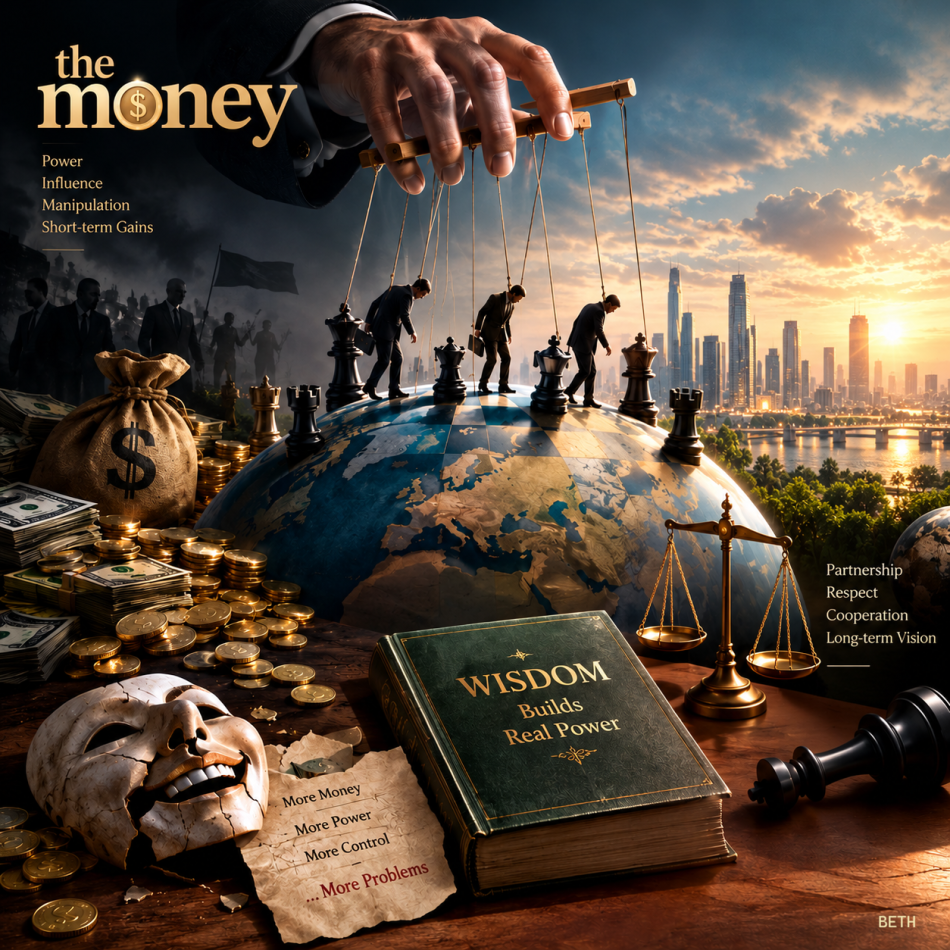
Power that fails to adapt to changes in international society, public opinion, and the balance of interests can, over time, turn from a source of protection into a burden on its owner.
The most significant development in the region today is that influential Arab states, led by Saudi Arabia, are no longer content merely to react. They are increasingly building political, economic, and defense instruments that give them greater room to shape regional balances.
The real question, therefore, is not how strong Israel is today, but how capable it is of reading the world that will take shape tomorrow.