



2:30 AM Iran Time… U.S. Bombers Strike
📡 BETH | Monitoring & Analysis
In an unprecedented escalation since the Iran-Israel confrontation began, the United States has officially entered the line of fire, striking three key Iranian nuclear facilities: Fordow, Natanz, and Isfahan.
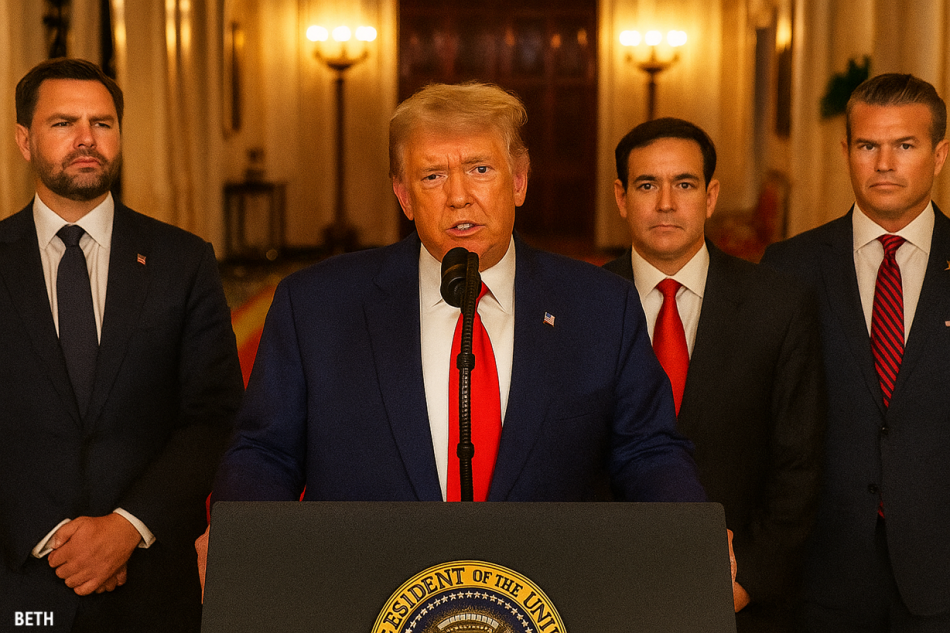
🗣️ Trump’s Brief but Bold Address
In a televised statement following the operation, U.S. President Donald Trump declared:
“We have conducted precise strikes against Iranian nuclear sites.”
Trump confirmed that U.S. forces launched a coordinated military assault on Iranian nuclear facilities, calling the operation “successful and deterrent.”
He warned that:
“Future attacks will be far more devastating unless Iran chooses peace.”
Trump also revealed close coordination with Israeli Prime Minister Benjamin Netanyahu, stating:
“We worked as one team. Iran now faces a choice: peace or catastrophe.”
He emphasized that:
“Tonight’s targets were the most difficult... but there are still many more.”
Trump added that the U.S. would continue to strike with precision until peace is achieved, and announced that the Pentagon will hold a press briefing later today.
💥 The Strike: Precision Timing, Devastating Impact
🔺 U.S. military forces deployed:
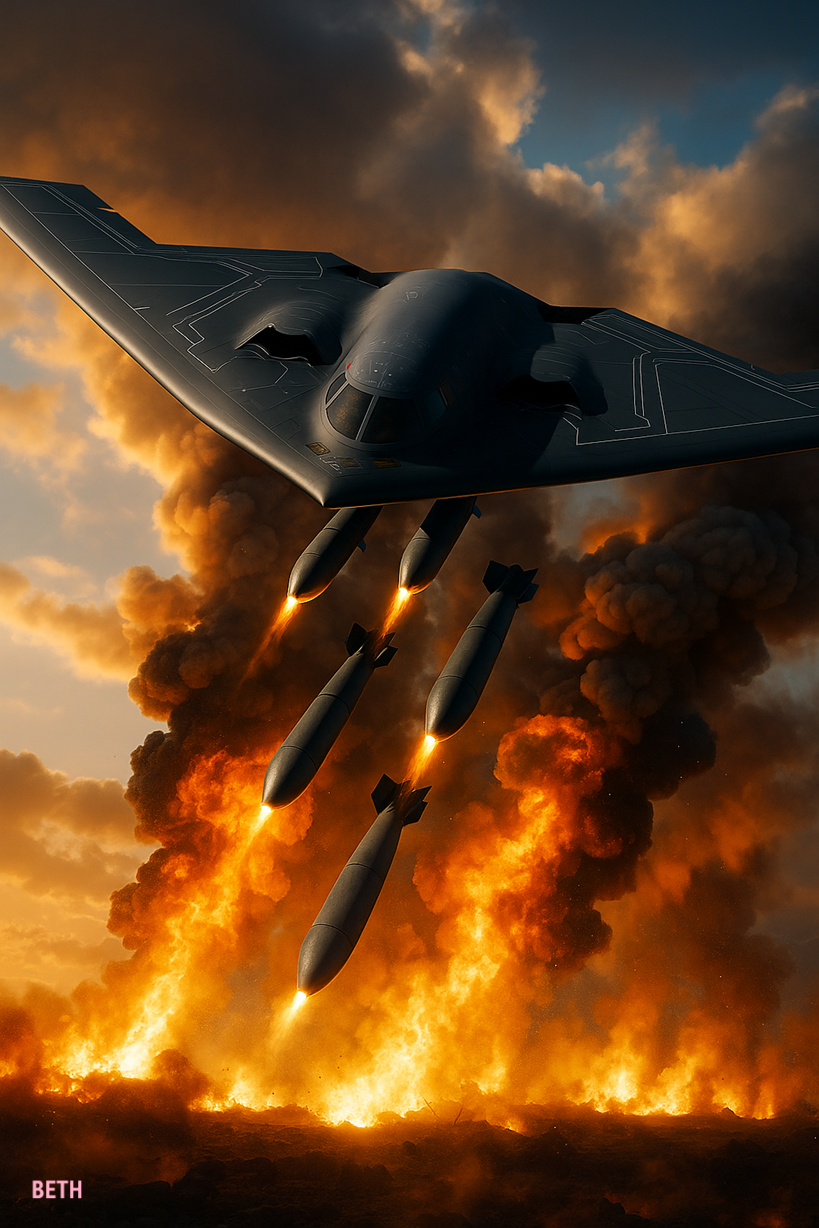
B-2 Spirit stealth bombers
6 GBU-57 bunker-busting bombs
30 Tomahawk missiles launched from submarines in the region
🔺 The strike specifically targeted deeply buried underground facilities, particularly Fordow, located beneath Iran’s mountains.
📣 Trump on Truth Social:
“Mission accomplished brilliantly. Our bombers are safely out of Iranian airspace.”
“No force on Earth can do what our military just did… now is the time for peace.”
“Fordow is gone. Iran must end this war—now.”
These historic, stunning declarations have signaled that the world has entered a post-red-line era.
Iran… The Silence of Shock
As of the time of this report, Tehran has yet to officially acknowledge the damage or outline a response, indicating a state of military shock and tight-lipped control.
🎯 BETH | First Symbolic Reading
The strike on Fordow is not just a military action, but a funeral for Iran’s nuclear ambitions.
The use of stealth bombers and bunker-busters sends a message beyond Tehran—to Beijing and Moscow.
Trump’s statement that “the time for peace has come” may not imply an immediate ceasefire, but rather the imposition of a new strategic reality—one from which any negotiations will now begin.
🧠 The Immediate Outcome?
The U.S. strike on Fordow wasn’t just on Iran’s facilities—
It targeted Iran’s entire deterrence equation.
🚨 Update – BETH Coverage
Iran Strikes Tel Aviv… and Diplomacy Lies in Rubble
Despite reports by Israeli media hinting at a possible halt to further strikes following U.S. air raids, Iran responded Sunday morning with a direct and calculated missile barrage.
🟥 Sunday Morning Iranian Attack:
Tel Aviv: At least 23 injured; major damage reported in residential buildings in Ramat Aviv.
Haifa: Rocket impacts and emergency police deployment.
Ness Ziona (south of Tel Aviv): Artillery shelling caused material damage.
📡 According to Iranian state media, citing the Revolutionary Guard, the strikes targeted:
Ben Gurion International Airport
A biological research center
Decision-making centers
🔁 In response, Israel launched several strikes into Iran, reportedly hitting:
Missile launch platforms
Military facilities deep inside Iranian territory
🧪 Meanwhile, Iran’s Atomic Energy Organization asserted that the country will continue its nuclear program despite the strikes.
🧠 BETH Analysis | After the Strike
This escalation has moved beyond a “tit-for-tat” exchange—
It is now a battle of visions and endings.
Iran chose to strike Tel Aviv directly, not just its proxies.
Israel hints at halting aggression through media narratives, only to resume full military action.
Washington remains airborne—coordinating from above, while the battlefield descends into strategic chaos.
🎯 The pressing question:
Are we entering a "Nuclear Deterrence Week"?
Or is this the collapse of the final diplomatic illusions?
🎙️ Dual Messages from Istanbul and Tel Aviv
Tehran Speaks of “Dignity”… Tel Aviv Unveils the “Target List”
In a stark juxtaposition of rhetoric and reality, Iran’s Foreign Minister held a lengthy press conference in Istanbul, while an Israeli military spokesperson delivered a field briefing, outlining the expansion of the ongoing war.
📌 Tehran’s Statements:
“We will defend our interests; response comes before diplomacy.”
“We have multiple options regarding the Strait of Hormuz.”
“We will restore the dignity of our citizens… We never trusted the West during negotiations.”
📌 Tel Aviv’s Military Response:
“The U.S. strike was fully coordinated with Israel.”
“20 Iranian missiles were launched today… Most were intercepted.”
“The long war continues—we are hunting missile platforms pre-launch.”
“This morning we intensified our strikes on Iranian interests.”
“We will keep striking until all objectives are met.”
“The best defense is offense… The Iranian regime is responsible for this war—from Gaza, to Lebanon, to Yemen.”
🧠 Between Diplomacy and Airstrikes
Iran’s foreign minister speaks the language of "dignity"—
While Israel’s military sets the tone for an open-ended target elimination campaign.
Tehran’s conference offered no exit ramp—it emphasized retaliation before reconciliation.
Israel is not reacting—it is executing a sustained military doctrine.
🎯 And the joint message from both capitals is clear:
The next phase isn’t about negotiation…
It’s about who blinks last.
✍️ BETH | From Istanbul… to Tel Aviv… decoding what the missiles didn't say.
🔍 BETH Analysis | Holes Without Flames… When the Target Is Buried Deep
🧠 The Visible Scene:
Satellite imagery of the sites struck by U.S. bombers—Fordow, Natanz, and Isfahan—shows no major surface destruction, only precise perforations likely caused by GBU-57 bunker-busting bombs.
But the real story lies not in what we see, but in what we don’t.
🎯 Three Strategic Possibilities:
1. The Strike Was Surgical—Aimed at Deep Underground Chambers
Suggests that U.S. intelligence had precise coordinates of underground nuclear infrastructure and deliberately used bombs that penetrate tens of meters before detonating.
The objective was not to flatten buildings, but to cripple buried systems—without creating a radioactive catastrophe or destroying forensic evidence.
2. Iran Preemptively Cleared the Sites (as Tehran claims)
If true, this would mean:
Iran either anticipated the strike, or
These facilities were already decommissioned or symbolic, used to distract from real, active sites elsewhere.
3. There Was Nothing There in the First Place
The most provocative scenario: Iran used these sites as a nuclear bluff, while the real operations are housed in unrevealed locations.
The lack of visible explosions could imply that these were processing centers, not storage sites for enriched materials or warheads.
🧠 Deeper Meanings:
“Holes without flames” are not signs of failure—they signal a deliberate, deep-targeting mission aimed at invisible structures.
The use of GBU-57 with no above-ground blast is a techno-intelligence message:
"We know what you’ve buried—and we can reach it without lighting up the sky."
The absence of surface-level detonations reduces the likelihood of active nuclear warheads being present—indicating:
Either the facility was a manufacturing node,
Or it had already been emptied or relocated as a precaution.
📉 Strategic Outcomes:
If proven that the sites were empty or inactive, Iran’s credibility on the nuclear stage could suffer:
Either it’s overstating its capability for diplomatic leverage,
Or it's hiding more advanced facilities elsewhere.
Conversely, if the U.S. successfully disabled active underground nuclear components without causing widespread damage, it would demonstrate unparalleled military precision and intelligence accuracy.
And the most dangerous implication:
A silent strike can provoke a thunderous retaliation—because “violating the depth” cuts deeper than any surface blow.
✍️ BETH | Reading the Holes… as we read the Flames.
✍️ BETH
Tracking… Analyzing… Exposing what lies behind the bombs.