



The Digital World Faces Widespread Disruptions: Has Technology Become a Threat to Itself?
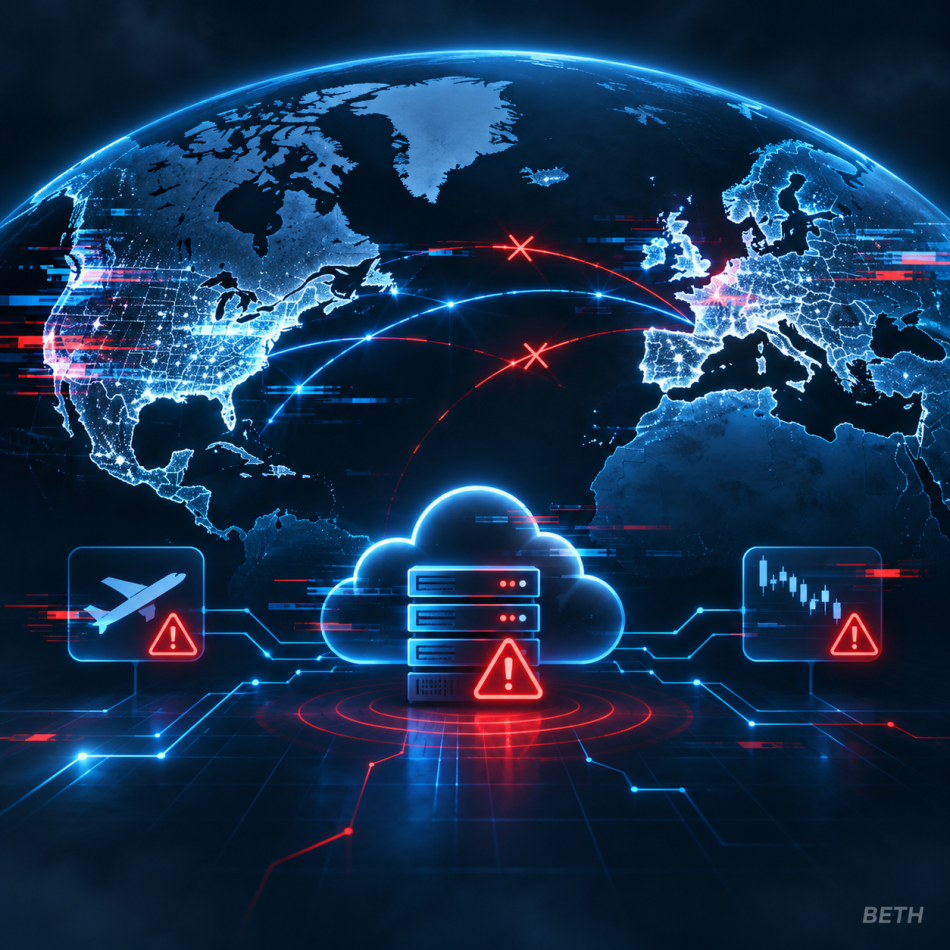
A wave of outages disrupts email, banking, aviation, and government services across the United States and Europe, exposing the vulnerabilities of a digital infrastructure on which global economies depend. Between software failures and cyberattacks, a strategic question emerges: Are these incidents interconnected, or has the world become increasingly vulnerable to cascading failures even without a single attacker?
Prepared and Analyzed by | Strategic Media Department – BETH News Agency
November 18, 2026
Technical outages are no longer simply problems that prevent users from accessing their email or opening an application on their phones. Recent developments have demonstrated that a failure within a single digital system can disrupt thousands of institutions, ground aircraft, obstruct banking transactions, and spread its effects across borders within minutes.
Between November 12 and 17, the United States and Europe experienced a series of disruptions affecting Microsoft and Apple services, American aviation systems, airlines, and banks. In Europe, cyberattacks targeting refrigeration systems in food retail stores were also reported.
However, the available evidence does not indicate that all these incidents were part of a single coordinated attack. Some resulted from software failures and internal updates, while others showed evidence of deliberate interference by malicious actors.
What Happened? Five Days That Exposed the Scale of Digital Dependence
November 12–13 | Microsoft and the Disruption of Global Services
Microsoft 365 services, including Outlook, Teams, and email platforms, experienced a widespread disruption lasting nearly a day, affecting businesses, government institutions, and users worldwide.
The company's preliminary technical report indicated that the incident resulted from three combined factors: a pre-existing software defect, a sudden increase in data traffic following the redistribution of workloads between systems, and insufficient server capacity.
This means the outage was not caused by a complete shutdown of equipment, but by an imbalance between software, data traffic, and operational capacity.
November 13 | US Air Traffic Grounded
The United States experienced a temporary nationwide halt to flight departures following a failure in the communications system used to manage air traffic.
The Federal Aviation Administration reported approximately 12,462 flight cancellations that day, in a disruption whose effects extended to passengers, airlines, and international travel.
Preliminary explanations pointed to problems involving communications equipment and aging systems, while the investigation into the root cause continued.
November 16 | Banks and Airlines
A technical failure at JPMorgan Chase disrupted some banking services, with effects reported by users of other financial services, including transfers through Zelle.
On the same day, a technical outage at United Airlines delayed departing flights. The airline did not state that the incident resulted from a cyberattack.
November 17 | Apple Joins the Series of Outages
Apple services, including the App Store, account services, and cloud-based platforms, experienced disruptions that prompted complaints from users in the United States and elsewhere.
Apple attributed the problem to an internal update and announced the restoration of several affected services.
Europe | Cyberattacks Move Beyond Screens to Food Infrastructure
Unlike the operational failures described above, refrigeration systems at European food retail stores were targeted by cyberattacks affecting equipment used to preserve products.
On November 9, France accused an entity linked to Iran's Islamic Revolutionary Guard Corps of carrying out attacks against refrigeration systems on French territory.
Similar incidents were reported in other European countries, although this does not establish that the same party was responsible for every attack.
Here, the nature of the threat changes. The problem is no longer merely the loss of an online service, but the potential for physical damage to facilities that depend on digital control systems.
Were These Coordinated Attacks?
This is the most sensitive question raised by the recent wave of outages.
The similarity in timing, the scale of the incidents, and their impact on aviation, banking, and government institutions justify investigating the possibility of coordination or hostile activity targeting Western digital infrastructure.
However, a professional investigation requires distinguishing between three categories of incidents:
Operational failures: Problems arising from software, updates, equipment weaknesses, or network malfunctions.
Cyberattacks: Deliberate interference intended to penetrate, disrupt, or sabotage systems.
Cascading failures: Disruptions originating with one service provider and subsequently affecting other institutions that depend on it.
According to the preliminary assessments and evidence made public by November 18, the major US incidents do not appear to be linked to a coordinated attack or a common hostile operation.
In Europe, however, the French accusation against Iran's Revolutionary Guard regarding attacks on refrigeration systems represents a different case, based on a security investigation into deliberate sabotage.
BETH Analysis: The occurrence of genuine cyberattacks alongside widespread technical outages does not prove that they were part of a single operation. Equally, the absence of publicly available evidence of coordination does not eliminate the need for further investigation and examination of other possibilities.
This distinction is fundamental because resolving a software failure is entirely different from confronting an organized cyber-sabotage campaign.
Digital Synchronization: A Shared Failure or Coordinated Interference?
The close timing of outages in the United States and Europe raises questions that extend beyond their immediate technical causes, particularly as the disruptions affected vital sectors, including aviation, banking, communications, and digital services.
Two main hypotheses emerge.
The first is that deep interconnections among global technological systems caused the effects of failures to spread between institutions and countries because of their dependence on shared cloud services, networks, and software.
The second involves the possibility that some systems were subjected to deliberate cyber interference, potentially interconnected or coordinated, with the aim of disrupting essential services and causing economic and security disturbances.
However, timing alone is insufficient to establish the existence of organized attacks. Likewise, multiple outages do not necessarily mean their causes were independent.
A failure within a single system can produce simultaneous disruptions across different institutions without all of them having been directly compromised.
BETH Analysis: Resolving these questions requires technical investigations into whether the affected systems share infrastructure or service providers, and whether any indicators connect the incidents to hostile cyber activity.
More seriously, the world could experience a widespread digital disruption without any external attack, simply because a shared component of its technological infrastructure fails. This represents a strategic vulnerability that could become a target for future cyberattacks.
Why Do Outages Keep Occurring in the Most Technologically Advanced Systems?
It may seem surprising that systems fail in countries hosting some of the world's largest technology companies, research institutions, and cybersecurity agencies.
Yet the problem does not necessarily lie in technological weakness, but in how modern technology systems have been designed and interconnected.
First | Global Dependence on a Limited Number of Companies
Government institutions, banks, hospitals, and airlines depend on cloud services and software supplied by a relatively small number of global companies.
When one of these providers experiences a major failure, thousands of customers may be affected even though their own equipment and local networks remain fully operational.
Second | The Complexity of Digital Systems
Digital services no longer depend on a single program. They operate through interconnected layers of servers, databases, identity management systems, security tools, routing mechanisms, and communications networks.
A minor failure in one layer can disrupt an entire service if isolation and protection mechanisms fail to contain the problem.
The recent Microsoft outage illustrates this vulnerability: multiple operational factors combined to create a global disruption despite the presence of backup systems.
Third | Updates That Can Become a Source of Risk
Modern systems require continuous updates to address vulnerabilities and improve performance.
However, any update introduced without sufficient testing can cause disruption rather than prevent it.
The paradox is that measures designed to strengthen protection can themselves produce outages when deployed too quickly or without adequate testing.
Fourth | Continued Dependence on Aging Infrastructure
Some modern institutions operate services through networks and equipment originally built many years ago, with newer technologies gradually added to existing infrastructure.
Problems may arise when these generations of technology are integrated, particularly in sectors that cannot tolerate interruptions, such as aviation, banking, and energy.
Europe: When a Technical Outage Becomes a Question of Sovereignty
The consequences of Microsoft's outage extended beyond interrupted services.
On November 16, the British House of Commons discussed the outage's impact, the extent to which public institutions depend on foreign technology companies, and the need to improve digital resilience and diversify suppliers.
This discussion reveals an important change in the understanding of national security.
Sovereignty is no longer associated solely with ownership of territory and physical infrastructure. It also includes the ability to keep government and economic services operating when systems located outside national borders fail.
BETH Analysis: Dependence on foreign technology is not inherently dangerous. However, relying on a single provider without an operational alternative can transform a commercial relationship into a source of strategic vulnerability.
This brings the issue of digital sovereignty to the forefront: the ability of a state to maintain control over its information and vital services and ensure their continuity during emergencies.
Can a Distant Country Disrupt Another Country's Economy?
The answer increasingly depends on the structure of digital infrastructure rather than geographical distance.
A country or institution that relies on foreign services for payments, communications, computing, and data management may be affected by a crisis occurring thousands of kilometers away.
This can happen even without a direct attack against it.
Such interdependence became evident when a power outage at a Google data center in Britain last October disrupted cloud services affecting financial institutions and dependent service providers.
More seriously, an institution may possess internal backup systems yet still be unable to operate if those systems depend on the same external provider.
The Consequences: From the Economy to National Security
The losses caused by digital outages cannot be measured solely by the number of hours services remain unavailable.
In aviation, suspended flights create knock-on effects at other airports, disrupt aircraft and crew schedules, and increase the cost of restoring operations.
The US aviation authorities reported approximately 12,462 flight cancellations on November 13, while clarifying that the nationwide ground stop was not the direct cause of every cancellation.
In banking, outages may prevent customers from accessing accounts or completing transactions, while also affecting interconnected financial services.
In hospitals and government institutions, system failures may obstruct access to records or the delivery of essential services, even when the physical facilities remain intact.
Beyond immediate financial losses, three longer-term consequences emerge: rising insurance and protection costs, increased spending on backup infrastructure, and declining confidence in the reliability of digital services.
No comprehensive, reliable financial estimate is yet available for the combined losses resulting from all the recent incidents.
What About Saudi Arabia, the Arabian Gulf States, and the Rest of the World?
Modern economies are connected through payment networks, communications systems, cloud services, and international suppliers.
This means that even countries with advanced technological infrastructure may be affected by disruptions originating beyond their borders.
The issue is particularly relevant to Saudi Arabia and the Arabian Gulf states as they expand digital government services, e-commerce, financial services, ports and logistics, data center investments, and artificial intelligence capabilities.
However, it would be inaccurate to assume that all these sectors experienced disruptions during the recent incidents without operational evidence confirming such effects.
BETH Analysis: The strategic opportunity lies in ensuring that the expansion of digital infrastructure strengthens national resilience during crises rather than increasing dependence on systems that may fail beyond national borders.
The true measure of digital infrastructure resilience is not merely its performance under normal conditions, but its ability to maintain essential services when one of its components fails.
The Solution: How Can a Technical Failure Be Prevented From Becoming a National Crisis?
No digital system can be guaranteed to operate without interruption under every circumstance.
However, the likelihood of failures can be reduced, and their consequences can be contained.
The solution begins with redesigning risk management at government and institutional levels.
1. Diversifying Service Providers: Avoid relying on a single company to operate all critical systems, while ensuring that alternatives are genuinely independent and operational.
2. Testing Business Continuity: Conduct regular simulations of cloud service, communications, and payment system outages, measuring the time required to restore essential operations.
3. Gradual Software Deployment: Test software and updates on a limited scale before full implementation, with the ability to revert quickly to earlier versions when problems emerge.
4. Separating Sensitive Systems: Isolate industrial control networks, aviation, energy, and water infrastructure from unnecessary systems to reduce the risk of failures or intrusions spreading.
5. Maintaining Alternative Operating Capabilities: Provide backup communications and operational procedures for sectors that cannot tolerate interruptions.
6. Strengthening Oversight and Accountability: Require critical service providers to report incidents, disclose technical investigation findings, and demonstrate their ability to prevent similar failures.
Most importantly, these measures must not remain merely regulatory documents. They must become regularly tested operational capabilities.
BETH Pulse | A More Connected World Is More Vulnerable to Disruption
The recent wave of outages reveals a paradox in digital transformation.
As institutions and countries become increasingly dependent on technology, services become faster and more efficient.
Yet they may also become more vulnerable to the spread of crises unless their systems are designed around operational independence and the availability of multiple alternatives.
Current evidence does not point to a single cyberwar campaign behind all the incidents.
Instead, it reveals two simultaneous problems: operational failures capable of spreading globally, and deliberate attacks capable of extending their effects from digital networks into physical infrastructure.
What Remains Unsaid?
The greatest danger may not lie in the ability of a hostile actor to penetrate systems, but in the possibility that a single technical failure could disrupt substantial parts of the economy and public services.
Technology has given countries unprecedented capabilities in communication, administration, and production.
At the same time, it has imposed a new responsibility: ensuring that these advantages do not become shared points of vulnerability.
Where Is This Leading?
These outages are likely to prompt governments and companies to reassess their dependence on digital service providers and increase investment in infrastructure security and business continuity.
The next measure of technological competitiveness may not simply be who possesses the fastest systems or the largest data centers, but who can keep their institutions operating when other services fail.
The strategic question left by this crisis is whether the world has genuinely built a robust digital infrastructure, or created a highly interconnected system in which a limited failure can disrupt vast parts of the global economy.